
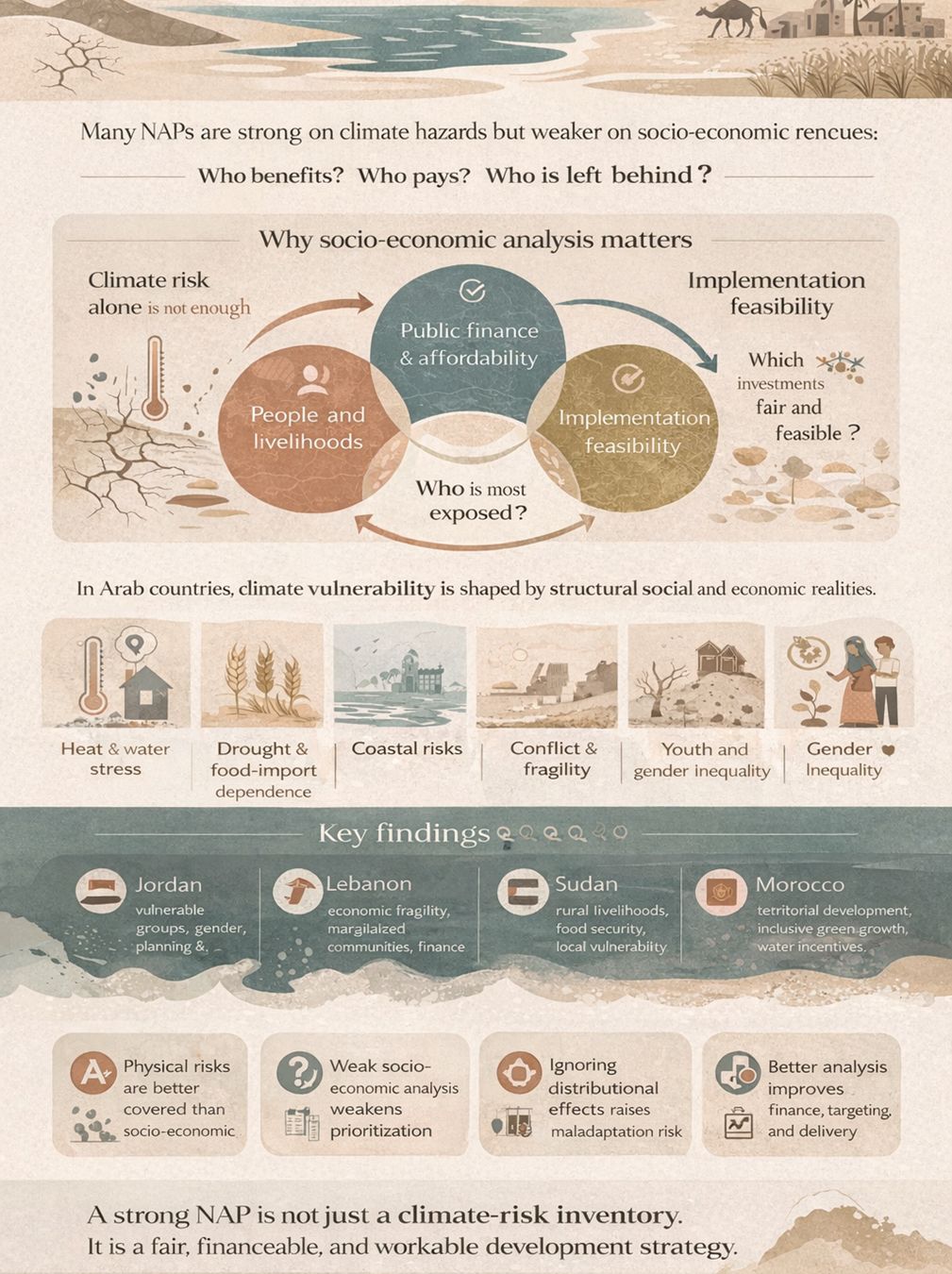
Core Thesis: National Adaptation Plans are most useful not when they only describe climate hazards, but when they show how adaptation choices affect people, livelihoods, inequality, fiscal space, and implementation feasibility. In Arab countries especially, socio-economic analysis is what turns adaptation from a risk inventory into a workable development strategy.
Executive Summary
National Adaptation Plans (NAPs) were created under the UNFCCC to reduce vulnerability and integrate adaptation into development planning. Yet the quality of adaptation planning depends not only on climate-risk analysis, but also on whether countries assess who is exposed, who can afford to adapt, who benefits from public investment, and who may be left behind. The central argument of this report is that socio-economic analysis is the missing link between adaptation ambition and adaptation delivery.
This issue is especially important in Arab countries. The region combines high exposure to heat, water stress, drought, coastal risks, food-import dependence, and conflict-related fragility with deep social and territorial inequalities. Adaptation choices therefore have distributional consequences: they affect farmers differently from urban consumers, informal workers differently from civil servants, poorer governorates differently from capital regions, and women and youth differently from groups with greater access to land, finance, and decision-making.
The review of Arab-country examples shows that NAPs are improving, but unevenly. Jordan’s 2025 NAP explicitly seeks to reduce vulnerability while considering gender and the needs of the most vulnerable groups and includes a socio-economic sector in its review. Lebanon’s 2025 NAP is explicit in linking climate risk to economic fragility, marginalized communities, and the need for financing tools. Sudan’s NAP treats climate change as a rural-development challenge and incorporates differences across income, gender, and age in vulnerability analysis. Morocco’s adaptation planning is closely tied to territorial development, biodiversity, green and inclusive growth, and water-saving incentives. Bahrain’s 2025 National Adaptation Investment Plan is notable for including situational, stakeholder, and economic and financial analyses. By contrast, Egypt has an advanced climate strategy, illustrating that many countries still frame adaptation through broader climate strategies rather than full NAP architecture.
This report advocates that socio-economic analysis improves implementation because it strengthens the case for budget allocation, concessional finance, local targeting, and cross-ministerial ownership. The practical implication is straightforward: NAPs should move beyond listing sectors and measures toward appraising livelihoods, employment, poverty, affordability, food and water prices, fiscal implications, social protection needs, and territorial disparities. In Arab countries, adaptation planning will be more credible and bankable when it shows not only where climate risk is rising, but also how adaptation can protect development gains and social stability under conditions of climate stress.
1. Why socio-economic analysis matters in NAPs
The NAP process was designed to do more than produce climate-risk diagnostics. Under the UNFCCC, its purpose is both to reduce vulnerability and to integrate adaptation into relevant policies, programmes, and development planning. That second objective is crucial. Once adaptation enters development planning, it becomes inseparable from public investment, social policy, local development, labor markets, and fiscal choices.
Climate-risk analysis typically identifies hazards, exposure, and sectoral sensitivity. It can show where temperatures are increasing, where rainfall is declining, where coastal flooding may intensify, or which ecosystems are under stress. But climate-risk analysis alone does not tell policymakers how those pressures translate into lower farm incomes, rising food prices, disrupted labor productivity, falling municipal revenues, higher household adaptation costs, or worsening territorial inequality.
Socio-economic analysis fills that gap. It asks who bears the costs of climate impacts; which households, firms, regions, and sectors face the highest adaptation burdens; whether adaptation measures are affordable; whether they create co-benefits for jobs and livelihoods; and whether they are politically and institutionally feasible. Without this layer of analysis, NAPs risk becoming technically competent but socially thin documents.
This matters particularly in the Arab region because vulnerability is mediated by structural factors: water scarcity, dependence on irrigated agriculture, urban informality, conflict and displacement, youth unemployment, and weak local service provision in many settings. A drought is never only a hydrological event. It also affects household income, debt, migration decisions, consumer prices, and social protection demand. The same logic applies to heat, flood, and coastal risk.
2. Main hypotheses for assessing NAP quality
A useful way to read NAPs is through a set of hypotheses about what socio-economic analysis changes.
- The first hypothesis is that many NAPs are stronger on physical climate risk than on socio-economic risk. This is visible when documents provide sectoral vulnerability narratives but do not rigorously assess income losses, employment effects, affordability constraints, or who among the population is most at risk.
- The second hypothesis is that weak socio-economic analysis weakens prioritization. When countries do not compare adaptation options in terms of distributional effects, avoided welfare losses, or fiscal feasibility, priority measures can end up reflecting sector visibility, international funding preferences, or institutional convenience more than real social value.
- The third hypothesis is that insufficient socio-economic analysis raises maladaptation risk. Adaptation can protect one group while shifting costs to another. Irrigation investments may favor larger producers over smallholders; urban flood protection may shield central districts while informal settlements remain exposed; water-pricing reforms may improve efficiency while undermining affordability unless accompanied by compensation or targeted support.
- The fourth hypothesis is that stronger socio-economic analysis improves implementation readiness. Ministries of finance, planning, agriculture, labor, and local government are more likely to support NAP implementation when adaptation priorities are linked to jobs, food security, avoided losses, household welfare, and investable pipelines rather than framed only as environmental measures.
3. What Arab-country examples reveal
Arab-country adaptation planning does not fit one pattern. Some countries now have formal NAPs on NAP Central, while others rely on climate strategies, sector plans, or investment frameworks. This uneven landscape is analytically useful because it highlights where socio-economic analysis is emerging and where it remains partial.
Jordan’s 2025 NAP is one of the clearest examples of an Arab NAP that explicitly links adaptation to vulnerable groups and planning systems. The document states that Jordan seeks to build adaptive capacity through comprehensive measures with consideration for gender aspects and the needs of the most vulnerable groups. It also reviews a distinct socio-economic sector and emphasizes mainstreaming adaptation into planning and budgeting. This is important because Jordan’s climate risks—especially drought, flooding, land degradation, and water stress—cannot be separated from fiscal constraints, social safety nets, and uneven territorial development.
Lebanon’s 2025 NAP is even more explicit in socio-economic language. It frames climate risk as interacting with economic fragility and post-conflict recovery, noting that these pressures undermine livelihoods, strain ecosystems, and deepen social and economic vulnerabilities. Its vulnerability analysis identifies marginalized communities and climate-sensitive sectors, and its agriculture chapter links adaptation to smallholder farmers, women, marginalized groups, and financing mechanisms. Lebanon therefore offers an example of a NAP that begins to connect climate risk with social targeting and implementation finance, although its own text also recognizes that weak institutional and financial support can block delivery on the ground.
Sudan’s NAP, although older, remains important because it treats climate change as a serious sustainable-development problem affecting rural communities in all 18 states. The plan links adaptation to agriculture and food security, public health, water resources, and support to rural communities. It also notes that vulnerability differs across population groups, including by income, gender, and age. Sudan thus shows that socio-economic analysis is not only about advanced macro-modelling; it can also emerge through grounded, bottom-up assessment of livelihoods, local vulnerability, and public investment needs.
Morocco’s adaptation planning is framed through territorial development, biodiversity, and green and inclusive growth. The national adaptation plan links adaptation to sustainable territorial development, participatory approaches, biodiversity, erosion control, and incentives for populations to conserve water. While the document is not organized primarily as a distributive analysis, it provides a strong example of integrating adaptation into wider development and territorial planning frameworks.
Bahrain’s National Adaptation Investment Plan, submitted in 2025, is especially notable because its stated objectives include situational analysis, stakeholder analysis, and economic and financial analysis. This signals a shift toward implementation-oriented adaptation planning in which finance, institutions, and actor incentives are treated as central rather than secondary.
Egypt is a revealing contrast case. Egypt’s National Climate Change Strategy 2050 clearly links climate action to quality of life, sustainable development, and economic growth, and identifies adaptation and resilience as a core goal.
This does not imply weak adaptation policy; rather, it shows that some Arab countries still address adaptation through broader strategic architecture rather than a formal NAP (Table 1). For this report’s purposes, Egypt illustrates why socio-economic analysis should be embedded whether the policy instrument is a NAP, a climate strategy, or an adaptation investment framework.
Table 1. Illustrative socio-economic signals from Arab-country adaptation planning
| Country | Instrument | Socio-economic signal | Main implication |
| Jordan | NAP 2025 | Considers gender and the most vulnerable groups; includes socio-economic sector review; mainstreaming into planning and budgeting. | Good basis for moving from sector lists to distributive prioritization. |
| Lebanon | NAP 2025 | Links climate risk with economic fragility, marginalized communities, smallholders, women, and financing mechanisms. | Strong language on social vulnerability, but delivery depends on finance and institutions. |
| Sudan | NAP | Bottom-up vulnerability assessment across states; attention to rural communities, food security, income, gender, and age. | Shows the value of livelihood-based analysis even in data-constrained settings. |
| Morocco | NAP 2025 | Connects adaptation with territorial development, biodiversity, inclusive green growth, and participatory approaches. | Useful model for embedding adaptation in broader development planning. |
| Bahrain | NAIP 2025 | Explicitly includes situational, stakeholder, and economic and financial analysis. | Signals a shift toward investment-ready adaptation planning. |
| Egypt | Climate strategy 2050 | Links adaptation to quality of life and economic growth, but NAP not submitted yet. | Illustrates that socio-economic logic is needed beyond formal NAP architecture. |
4. The main socio-economic gaps in many NAPs
- Weak distributional analysis: Many plans identify vulnerable sectors without identifying vulnerable people with equal precision. Yet adaptation choices affect smallholders differently from agribusiness, tenants differently from landowners, informal workers differently from formally employed households, and peripheral governorates differently from major cities. NAPs should therefore ask who benefits, who pays, and who remains exposed after adaptation investment is made.
- Limited analysis of livelihoods and labor markets: Climate impacts often enter the economy through lost working hours, crop failure, lower livestock productivity, reduced tourism days, health stress, and damage to local microenterprises. If NAPs do not examine these livelihood channels, they understate the development significance of climate risk and weaken the case for targeted adaptation support.
- Affordability: Some adaptation measures are technically sound but financially unrealistic for households, municipalities, or utilities. Heat adaptation may require cooling costs that poor households cannot bear. Water adaptation may imply tariffs, storage costs, or equipment costs that are affordable for some but not for others. Public budgets face similar trade-offs, especially where debt, subsidy reform, or post-conflict reconstruction compete for scarce resources.
- Implementation feasibility and political economy: Adaptation can fail because responsibilities are fragmented, because ministries lack incentives to coordinate, because local authorities have limited administrative capacity, or because politically influential groups resist reforms such as groundwater regulation or land-use restrictions. Socio-economic analysis should therefore include institutional and political feasibility, not only a list of sector measures.
- Inadequate treatment of the cost of inaction: Many plans estimate the cost of adaptation projects but do not sufficiently quantify the socio-economic cost of failing to adapt: lower growth, higher food import bills, rising social-protection needs, rural displacement, health burdens, and damage to public infrastructure. Without a cost-of-inaction lens, adaptation remains easier to postpone.
5. What stronger socio-economic analysis would change in practice
A more socio-economically robust NAP would improve prioritization by comparing options according to avoided losses, affordability, inclusion, and feasibility. Instead of simply listing measures by sector, it would show which interventions protect the largest number of vulnerable people, which reduce future fiscal burdens, and which are most likely to succeed institutionally.
It would also improve targeting. For example, drought adaptation in Arab countries should distinguish between rain-fed and irrigated systems, between large and small producers, and between areas where climate stress is mainly a production problem and areas where it is a market and food-access problem. Urban heat adaptation should distinguish among public buildings, outdoor workers, transport users, and low-income households facing cooling poverty. Coastal adaptation should separate the protection of strategic infrastructure from the protection of low-income settlements and livelihoods dependent on fisheries or tourism.
Stronger socio-economic analysis would reduce maladaptation risk. If irrigation subsidies encourage unsustainable groundwater extraction, or if flood defenses redirect risk to poorer neighborhoods, adaptation may look successful in engineering terms while worsening vulnerability in social terms. The goal is not to reject large investments, but to understand their distributional and institutional consequences before they are locked in.
Finally, socio-economic analysis makes adaptation more financeable. International funds and public treasuries are more likely to support adaptation when countries can show who benefits, what losses are avoided, how affordability constraints will be handled, and how projects support wider development objectives such as food security, jobs, resilience of public services, and territorial cohesion.
The key point is that socio-economic analysis should not be treated as an optional annex. It should shape the logic of the NAP itself: how priorities are ranked, how financing is justified, how vulnerable populations are targeted, and how adaptation is linked to national development goals.
6. Conclusion
The future quality of adaptation planning will depend less on whether countries can name climate hazards and more on whether they can govern climate risk as a socio-economic challenge. In the Arab region, this means acknowledging that adaptation is bound up with water scarcity, food systems, employment stress, territorial inequality, fiscal pressure, and in some cases conflict and displacement.
The most promising Arab examples already point in this direction. Jordan links adaptation to vulnerable groups and planning systems; Lebanon connects climate risk with economic fragility and marginalized communities; Sudan embeds adaptation in livelihoods and local vulnerability; Morocco ties adaptation to territorial and inclusive development; Bahrain signals the importance of stakeholder and financial analysis; and Egypt shows why socio-economic reasoning matters even outside a formal NAP structure.
A NAP that lacks socio-economic analysis may still be useful as a climate-risk inventory. But it will be less effective as a guide for fair prioritization, credible financing, and politically feasible implementation. The real test of adaptation planning is not whether a country can list measures by sector. It is whether the plan can answer three questions with clarity: who benefits, who pays, and who is left behind?
References
NAP Central. Submitted NAPs from developing country Parties, 23 February 2026.
UNFCCC. National Adaptation Plans 2026.
UNFCCC. National Adaptation Plans 2023: Progress in the formulation and implementation of NAPs.
Arab countries NAPs
Bahrain. UNFCCC 2026. National Adaptation Investment Plan (2025).
Egyptian Environmental Affairs Agency. Egypt National Climate Change Strategy 2050.
Jordan. UNFCCC 2026. The National Climate Change Adaptation Plan of Jordan (2025).
Lebanon. UNFCCC 2026. National Adaptation Plan (NAP) 2025: Strategy and Roadmap.
Morocco. UNFCCC 2026. Plan National d’Adaptation 2022–2030.
Sudan. UNFCCC 2026. National Adaptation Plan.