
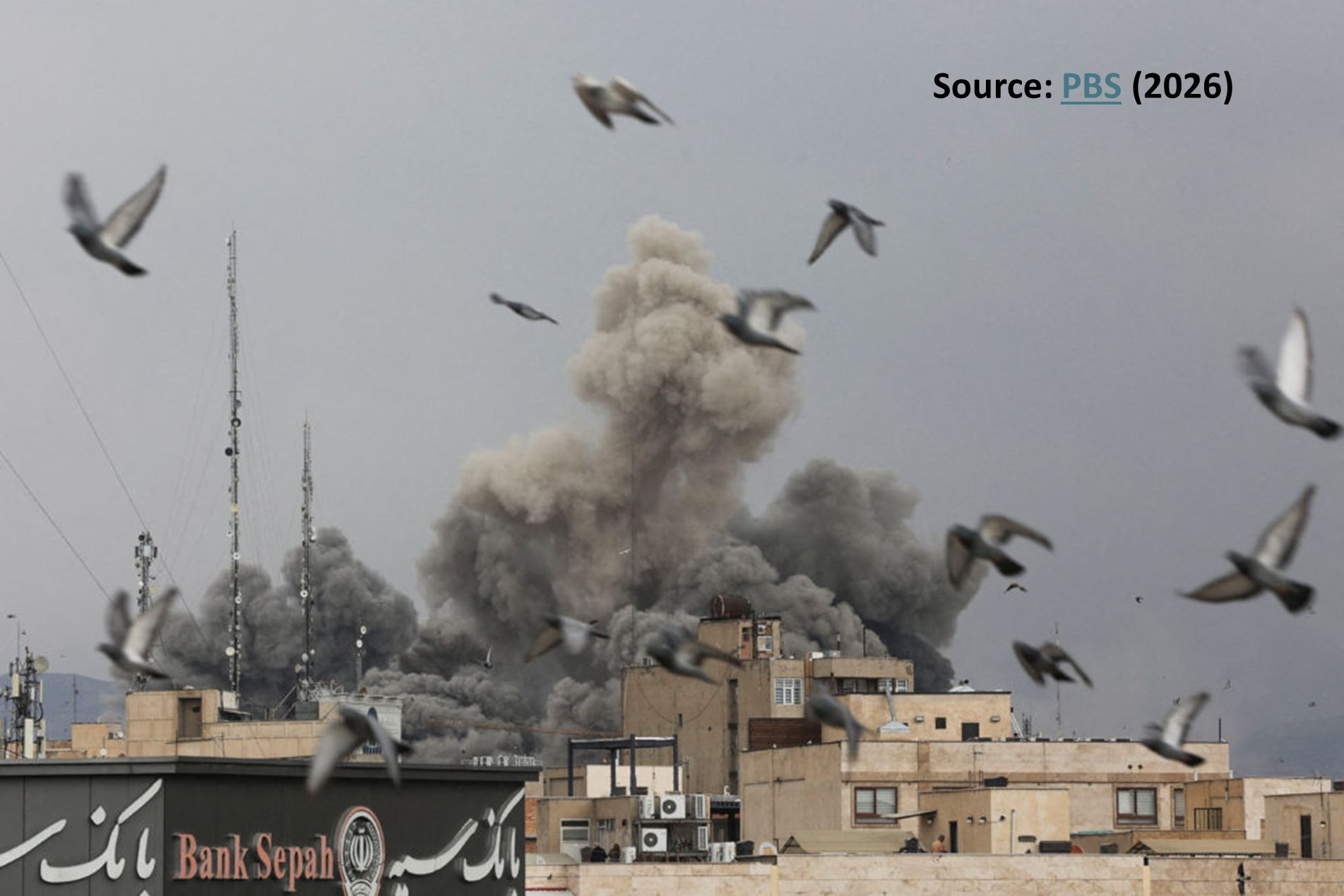
As geopolitical instability reaches its peak with the current Iran War, climate risks are increasingly treated as security risks, through food and water stress, disaster-response capacity, displacement, and state fragility. Without conflict-sensitive transition pathways, fragile and conflict-affected contexts risk being “left behind,” even as climate action is most essential for human security and peace (Germanwatch, 2026). This shift makes it necessary for climate policy to integrate peacebuilding, humanitarian planning, and foreign policy, with a sharper lens on who bears transition costs and who is excluded from finance, services, and protection in conflict-affected settings. This is evidenced by:
- The increasing human security framing of climate risks whereby climate policy must address and support conflict-sensitive adaptation, selective collectivism based on shared geopolitical and economic interests, and peacebuilding, rather than defaulting to militarized responses (Germanwatch, 2026). The broader fragmentation of multilateral climate leadership (including the U.S. retrenchment from key climate institutions) further elevates the need for selective collectivism resilience planning.
- The UN Security Council has explicitly highlighted rapidly growing links between climate pressures and conflict dynamics, calling for stronger international support and financing where climate shocks intensify instability (UN Press, 2025).
- War shock amplifies climate fragility and price volatility and complicates energy transition measures. The current US–Iran war is already driving sharp market reactions and heightened concern over chokepoints like the Strait of Hormuz, with oil prices rising materially on disruption fears (AP News, 2026). However, even if oil prices seemingly push for more renewables, the geopolitical shocks disrupt long-term transition policy planning.
Climate security is no longer a “future risk” discussion, it is becoming a present-day operating environment for climate policy. Arab governments should adopt conflict-sensitive transition planning as a core climate-security tool by embedding climate risk in national security strategies and NDC implementation; scaling anticipatory humanitarian action and early warning for drought/heat/floods; prioritizing water and food cooperation across borders; and conditioning climate and energy investments (renewables, grids, carbon projects) on do-no-harm safeguards, local benefit-sharing, and protections for displaced and conflict-affected communities, so the transition reduces fragility rather than exacerbating it.