
Executive overview
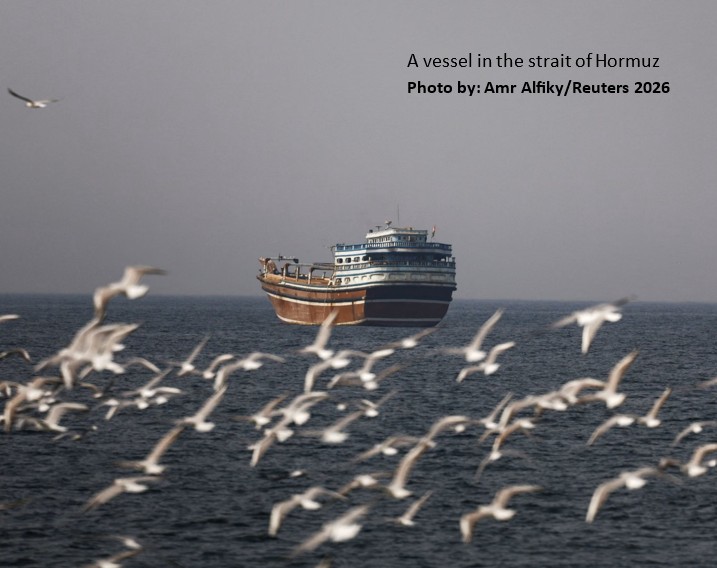
The current Iran war has triggered an acute energy-security shock centred on the Gulf and the Strait of Hormuz, one of the world’s most critical oil and Liquefied Natural Gas (LNG) chokepoints. Reporting notes heightened disruption risks and price spikes tied to threats to shipping and regional energy infrastructure (Time, 2026). In one view, this shock can push governments and firms to “double down” on net zero because renewables reduce exposure to geopolitically vulnerable fuel flows (The Telegraph, 2026). In another view, war and geopolitical fragmentation can hinder the transition by undermining investment confidence, constraining supply chains for critical minerals and components, raising financing costs, and distracting states toward short-term crisis management rather than long-term decarbonisation planning.
This report argues both propositions can be true simultaneously, the Iran war shock can both accelerate and hinder the energy transition at the same time. It can strengthen the case for net zero as a way to reduce exposure to volatile fossil fuel flows, but it can also undermine the stability, investment confidence, and supply-chain conditions that the transition requires. Whether the Iran war ultimately accelerates or slows net zero depends on (1) the duration and intensity of disruption, (2) how policy responds to price spikes (clean investment surge vs. fossil lock-in), and (3) whether governments proactively secure critical minerals and build circularity (recycling, reuse, urban mining) to reduce supply vulnerability.
For the Arab region, the war widens the divide between exporters and importers. Exporters may gain near-term revenues but face higher operational and logistics risk, while importers face balance-of-payments pressure, inflation, and subsidy stress. It also tests Gulf diversification, since investor confidence in tourism, logistics, and digital infrastructure depends on a stable “safe haven” image that insecurity can undermine. At the same time, the region’s transition could accelerate if governments convert the shock into structural change by scaling renewables, grids, storage, and efficiency, while anchoring critical-minerals and circularity strategies and protecting non-oil investment pipelines.
1) Context: Why the Iran war matters for energy transition pathways
1.1 The Strait of Hormuz as the “stress point”
The Strait of Hormuz is widely described as a key maritime chokepoint for global energy trade; disruption fears and actual reductions in shipping have been linked to oil and gas price surges and broader trade impacts (Time, 2026). Reports emphasize market volatility and real-economy spillovers (insurance costs, diversion routes, freight rates), which raise energy-import bills and intensify political pressure for “energy security” responses (The Guardian, 2026).
1.2 Energy Transition is not only about generation but also about critical materials, grids, and finance
Modern net-zero energy transition pathways are mineral and infrastructure-intensive. The International Energy Agency (IEA, 2024) notes that critical minerals are essential to clean energy technologies, and that supply chains face bottlenecks and geopolitical concerns. UNEP similarly highlights the centrality of minerals (copper, lithium, nickel, cobalt, etc.) for renewables and electrification, with demand potentially increasing dramatically in coming decades (UNEP, 2025). That means a geopolitical shocks such as the Iran war and its disruptions can push the energy transition through energy prices, but simultaneously constrain it through materials and supply chains.
2) The “accelerator” thesis: How war can push the energy transition and net zero
This section synthesizes and analyses the pro-transition logic reflected in the “net zero as the answer to the energy crisis” framing.
2.1 Price spikes and supply insecurity strengthen the case for domestic, price-stable power
When oil and gas prices rise due to geopolitical risk, the relative attractiveness of renewables and electrification increases, especially for countries exposed to imports. Recent coverage links the Iran conflict to surging energy prices and heightened disruption risk at Hormuz (The Telegraph, 2026). Unlike fossil fuels, wind and solar have no fuel price risk; their costs are largely upfront capital and operations. The “net zero answer” argument is that the way out of repeated energy crises is to reduce dependence on volatile fossil imports by scaling renewables, grids, efficiency, and electrification (Yahoo, 2026). In macro terms, geopolitical risk increases the “insurance value” of clean energy, i.e. energy systems with higher shares of domestic renewables and demand-side efficiency are less exposed to oil price shocks and maritime chokepoints.
2.2 Crisis politics can unlock energy transition policy momentum and capital reallocation
Energy crises often relax political constraints. They can justify faster permitting and grid investment, enable tougher efficiency standards, accelerate heat pumps and EV policies, and push firms to electrify processes to reduce exposure to volatile fuel inputs.
When energy security becomes urgent, reforms that were debated for years can suddenly be pushed through as “emergency measures.” Reports of senior policymakers – such as Peter Kyle, UK Business Secretary – calling to double down on net zero after the Iran war show how this crisis-to-action storyline can take hold (The Telegraph, 2026).
2.3 Strategic autonomy: war pushes for energy diversification away from chokepoints
The risk around Hormuz is not just an “oil story”, it is about geopolitics and economic strategy. When shipping routes feel unsafe, countries try to rely less on imported fuels by expanding domestic renewables, building cross-border power links, developing regional clean-energy trade (like green hydrogen and HVDC lines), and adding storage to cut dependence on gas.
Put more clearly: In a conflict era, energy transition can be reframed less as “climate altruism” and more as “strategic autonomy.”
2.4 War can raise the opportunity cost of fossil lock-in
Higher fossil price volatility increases the financial risk of building new long-lived fossil infrastructure. If investors expect persistent geopolitical shocks, they may demand higher risk premiums for fossil projects, shifting the balance toward clean infrastructure, particularly in power systems where renewables are already cost-competitive in many contexts.

3) The “anchor” thesis: How war can hinder the stability needed for transition
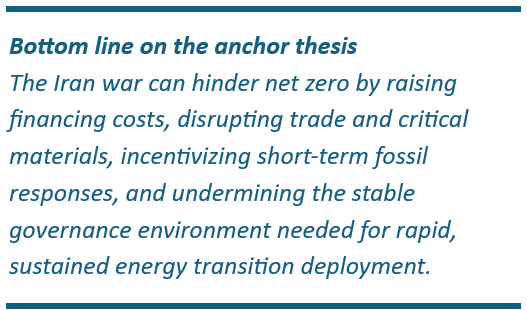
The counterview is that war undermines the very conditions required for sustained transition: stable investment climate, predictable policy, open trade, and secure mineral supply chains.
3.1 Policy myopia: crisis management crowds out long-term transition
War-driven energy price spikes trigger urgent political pressure to keep power running, limit the soaring costs of fossil fuels, and secure their supply. Governments may initially respond by securing sources for buying more fossil fuels in the short term (The Guardian, 2026), keeping old coal or gas plants running longer, pausing carbon pricing or cutting fuel taxes, and redirecting public funds away from clean-energy investment. Even if leaders still endorse net zero, prolonged instability often forces these near-term trade-offs, slowing the pace of renewable and transition projects.
3.2 Higher cost of capital and disrupted supply chains slow deployment
Clean energy projects need a lot of upfront investment. War raises risk and uncertainty, which increases financing costs, insurance premiums, shipping costs, and currency volatility, especially in emerging markets. Reports also point to disrupted shipping, higher war-risk insurance, and longer rerouted journeys, which push up overall logistics costs (The Guardian, 2026). These higher costs then flow into renewable supply chains such as those for turbines, inverters, transformers, and cables, making energy transition projects slower and more expensive.
3.3 Critical minerals: vulnerability rises under geopolitics and export controls
Even before this war, the IEA warned that supplies of critical minerals already face bottlenecks and geopolitical risks. It also highlighted that many minerals, especially at the processing and refining stage, are concentrated in a few countries, which makes the energy transition more vulnerable to trade disruptions and geopolitical restrictions (IEA, 2025).
The Iran war makes the critical minerals bottleneck worse by increasing transport costs as ships reroute or face higher security risks, which affects ores, concentrates, and refined materials. It can also trigger wider sanctions effects that complicate payments, financing, and insurance even for countries not directly involved. At the same time, governments may tighten or use export controls on strategic critical minerals, adding more uncertainty and price volatility to already fragile supply chains. This insecurity of minerals supply chains becomes a direct constraint on net zero timelines, particularly with deterred circularity.
3.4 Circularity is essential but hard to scale under instability
Circularity (recycling, reuse, and “urban mining”) is indispensable for minerals supply security and sustainability, and for building reserves to buffer against supply disruptions (IEA, 2026). However, it requires long-term policy stability, infrastructure investment, and predictable regulation. War can slow circularity by delaying investment in recycling plants and collection systems, disrupting trade in scrap and secondary materials, shifting public budgets toward defence and immediate subsidies. In short, war increases the need for circularity, but it also reduces the ability to develop and scale it.
4) Reconciling the two views: What determines the net effect?
The “accelerator vs anchor” outcome is not predetermined. Three variables largely decide which effect dominates: the duration and effect of disruption, policy pathways, and supply side strategy.
4.1 Duration and effect of disruption
- Short, sharp shock: can catalyse reforms and investment (accelerator).
- Prolonged conflict / recurring maritime insecurity: entrenches inflation, tightens finance, and disrupts supply chains (anchor).
4.2 Policy pathways: structural energy transition vs fossil buffering
After a major war-driven energy shock, governments typically move in one of two directions. One Pathway A is a structural clean-energy pivot, where leaders treat the crisis as a reason to speed up the transition, by fast-tracking permits for renewables, investing heavily in grid expansion, tightening efficiency requirements, accelerating heat pumps and EVs, and protecting vulnerable households through targeted support that does not weaken long-term incentives to shift away from fossil fuels.
The other Pathway B is fossil buffering, where governments focus on short-term price relief and supply security—through broad fuel subsidies, long-term LNG deals without a clear decarbonization plan, new fossil infrastructure that locks in emissions, and reduced priority for carbon markets and climate standards. The argument that “net zero is the answer” aligns most closely with the first Pathway A, because it frames clean energy as the durable solution to repeated energy crises.
| Path A: Structural clean pivot (accelerator) | Path B: Fossil stabilization (anchor) |
| fast-track renewables permitting major grid build-out efficiency mandates heat pump and EV acceleration targeted support for vulnerable nations and households without undermining price signals | generalized fuel subsidies long-term LNG contracting without decarbonisation plan new fossil infrastructure that locks emissions deprioritizing carbon markets and standards |
4.3 Supply-side strategy: minerals security + circularity
Because the IEA warns that critical mineral supplies are concentrated and vulnerable to disruption, a credible net-zero plan in a tense geopolitical environment needs to cover needs a “materials plan” (IEA, 2025). In practice, this means diversifying where minerals come from and where they are processed so supply is not dependent on a few chokepoints, creating strategic reserves for key minerals and components, and rapidly scaling recycling and circularity to generate a reliable secondary supply stream.
5) Policy implications: How to turn a war shock into a transition accelerator
5.1 Energy security packages
Energy security responses should prioritize clean solutions from the start, so crisis measures strengthen the transition instead of locking in more fossil dependence. In practice, this means:
- Protecting households through targeted relief for those most affected
- Keeping price signals as intact as possible to avoid encouraging higher fossil consumption
- Earmarking part of emergency public spending toward grid upgrades, storage, and efficiency improvements rather than new fossil infrastructure.
5.2 Accelerate grids and flexibility (the real bottleneck)
War-driven fuel shocks show that energy transition can only scale if power grids are strong and flexible. Governments should prioritize expanding transmission lines, building interconnections between regions and countries, scaling demand-response programs, and deploying more storage. Together, these steps reduce reliance on gas plants and help keep electricity prices more stable.
5.3 Build a critical minerals and circularity agenda
Use internationally tried and tested approaches to recycling and minerals security as a practical blueprint for strengthening clean-energy supply chains (IEA, 2026). This means investing in recycling infrastructure and “urban mining” to recover valuable materials from existing products, setting design-for-recycling rules so batteries and solar panels are easier to dismantle and reuse, creating regional hubs for battery and PV recycling to build local capacity, and applying strong sustainability safeguards to ensure these systems are safe, transparent, and environmentally responsible.
5.4 De-risk investment in emerging markets
War-related shocks often raise perceived risk in emerging markets, which makes clean-energy projects more expensive to finance. To reduce this risk and keep investment flowing, governments and development partners can scale up credit guarantees, use blended finance to crowd in private capital, expand political risk insurance, and provide currency-hedging facilities, especially for renewable and grid projects that depend on stable long-term financing.
5.5 Avoid militarized “energy security” that undermines transition
Physical protection for shipping routes and energy infrastructure may be needed, but relying mainly on military measures can reinforce long-term dependence on fossil fuels. The smarter goal is to reduce vulnerability in the first place by speeding up the rollout of clean energy, grids, and efficiency.
Implications for the Arab region
1) A sharper split between exporters and importers
- Oil exporters (e.g., GCC countries) may see short-term revenue from higher oil and gas prices, but that benefit is paired with higher operational and security risk to production, processing, and export logistics, especially if Hormuz disruption persists. The scale of disruption and shipping/insurance stress described around Hormuz signals real vulnerability for export-dependent fiscal models (The Guardian, 2026).
- Arab energy importers (e.g., Egypt, Jordan, Morocco, Tunisia, Lebanon) face immediate balance-of-payments pressure from higher fuel bills and freight surcharges, with inflation and subsidy burdens rising. War-driven supply chain disruption is not limited to oil but rather spills into fertilizers, plastics, and other inputs that affect food and industry (AP News, 2026).
2) GCC “post-oil diversification” plans face a confidence test
A core vulnerability is investment confidence, whereby diversification plans in tourism, logistics, and digital infrastructure rely on the region’s reputation as a stable business hub. Rising insecurity can undermine that “safe haven” image and disrupt ports, airports, and critical infrastructure, directly threatening diversification momentum (The Wall Street Journal, 2026). So, even if oil and gas revenues increase, the war can still undermine the non-oil investments Gulf states need to sustain diversification and support a long-term transition.
3) Energy transition could accelerate: only if!
The crisis strengthens the energy-security argument for:
- Scaling solar/wind where costs are already highly competitive in parts of MENA,
- Accelerating grid investment, storage, and efficiency to reduce exposure to imported fuels and chokepoints, according to MENA Energy Outlook (Dii, 2026). However, if the policy response becomes mainly “crisis buffering” (broad fuel subsidies, emergency fossil deals), it can delay structural transition.
4) Critical minerals and industrial supply chains become a new strategic battleground for Arab states
Several Arab countries are trying to build a role in critical minerals, processing, and battery/EV supply chains as part of economic diversification. The International Energy Agency (IEA, 2025) notes that Middle Eastern countries increasingly see critical minerals as a strategic priority and are investing across the value chain. However, war-related logistics disruptions, such as shipping delays, higher insurance costs, and rerouted trade routes, make it more expensive and uncertain to import the equipment and materials needed for renewables, grids, and storage (The Guardian, 2026).
5) Circularity becomes more valuable and harder
Recycling that strengthens supply security for critical minerals (IEA, 2025) will be much needed in the Arab countries but will also be most affected in and post conflict. Prolonged instability can deter investment, delay regulations, and disrupt cross-border flows of scrap and secondary materials, making circularity harder to expand in the Aran region just when it is most needed (AP News, 2026).
6) Regional cooperation becomes “security infrastructure”
With maritime and logistics routes stressed, Arab-region resilience will depend more on:
- cross-border power trade and interconnections,
- joint water–food security planning (e.g., fertilizer shipping disruptions), and
- coordinated early warning/contingency planning for energy and supply-chain shocks.
Practical takeaways for Arab policymakers and investors
- Make the transition an energy-security plan: speed up renewable deployment, grid upgrades, and energy-efficiency programs so economies are less exposed to chokepoints and fuel shocks (Dii, 2026).
- Secure materials through minerals and circularity: set clear recycling standards, build strong collection systems, and develop regional hubs for battery and solar (PV) recycling to cut reliance on imported raw materials (IEA, 2025).
- Keep clean energy projects investable during instability: expand guarantees, political-risk insurance, and foreign-exchange hedging tools to lower financing costs for renewables and grid projects, especially in importing Arab countries (The Guardian, 2026).
- Shield diversification from conflict risk: protect critical infrastructure (ports, airports, data centres, energy assets) and strengthen business-continuity planning so security shocks don’t derail non-oil investment and post-oil strategies (The Wall Street Journal).
- Protect economic diversification: Arab countries should better secure and strengthen key facilities like ports, airports, power plants, and data centres, and have backup plans to keep business running during crises. This helps prevent security shocks from scaring off investors and slowing down efforts to move the economy beyond oil (The Wall Street Journal, 2026).
Conclusion
The Iran war can plausibly accelerate net zero by making the energy-security case for renewables, efficiency, and electrification more compelling, an argument explicitly advanced in current commentary. However, the same conflict can also slow the transition by disrupting markets, increasing borrowing and financing costs, and most importantly, making it harder to secure the critical minerals and recycling systems that renewable technologies rely on.
The decisive factor is policy choice under stress. How governments respond under war pressure: if they use the shock to drive structural decarbonisation and strengthen the resilience of grids, minerals, circularity, and finance, the transition can accelerate, but if they fall back on broad fuel subsidies, long-term fossil contracts without a decarbonisation pathway, and delayed climate tools, the crisis will likely slow net zero by locking in short-term fixes and undermining investor confidence.
For the Arab region, this is not an abstract debate. It is a test of resilience and strategy. Exporters may gain near-term revenues but risk undermining the non-oil investment confidence needed for diversification, while importers face acute fiscal and inflation pressures that can crowd out clean investment. The practical priority is to convert insecurity into durability, strengthening grids and regional interconnections, anchoring critical minerals and circularity pathways, and de-risking finance, so the transition reduces vulnerability rather than amplifying it.