
Prepared by:
Prof. Khaled Fahmy
Dr. Mona Daoud
23 February 2026
The views expressed in this insight reflect those of the author(s) and do not necessarily represent the position of the Centre for Environment and Development for the Arab Region and Europe (CEDARE).
Executive Summary
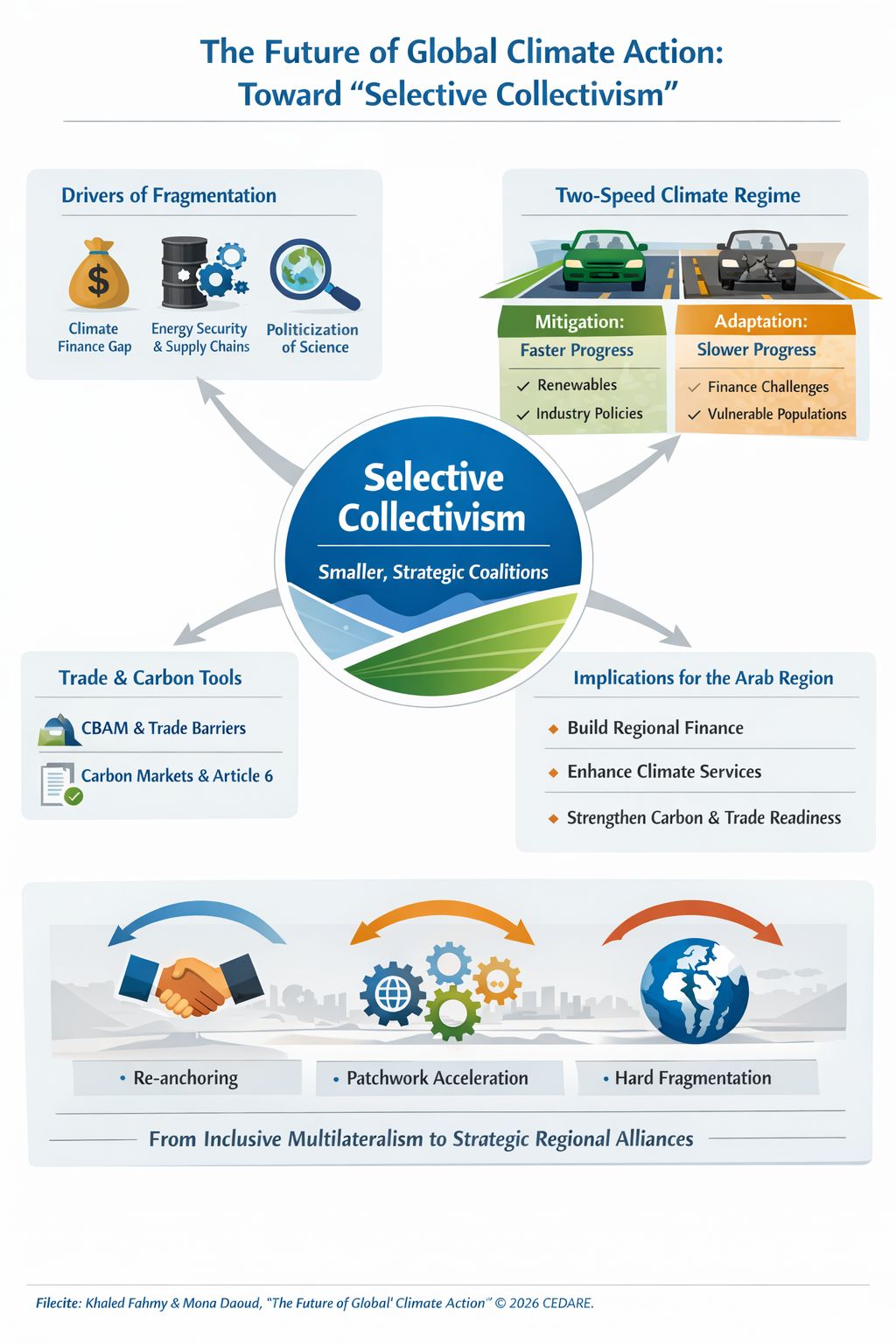
This insight examines the ongoing shift in global climate governance from the UN-centered model of “inclusive collectivism”, as assumed under UN multilateralism with the UNFCCC as the central track, toward a more realist pattern that can be described as “selective collectivism”: the formation of smaller, more functional coalitions built around converging interests (industrial competitiveness, energy security, supply chains, and domestically oriented policy constraints). This shift can enable faster progress on specific files, while deepening fragmentation in finance, standards, and narratives.
The analysis suggests the next phase is likely to produce a “two-speed climate regime”: a relatively faster lane for mitigation where economic incentives and industrial policy align with emissions reduction, versus a slower lane for adaptation and loss and damage, due to financing and governance bottlenecks and the absence of direct financial returns. This imbalance is not merely technical; it is a predictable outcome of political economy dynamics that allocate resources according to profitability and risk management.
For Arab countries, selective collectivism raises adaptation risks in a volatile international environment. At the same time, it opens a practical window to build regional finance and bankable resilience pathways, develop regional climate services (data/modeling/risk analytics), and strengthen carbon/trade readiness in response to tools such as the EU’s Carbon Border Adjustment Mechanism (CBAM), thus turning current exposure into an opportunity to modernize rules and capabilities and maximize developmental returns.
Introduction: Climate as a Global Issue in a Contested International System
Climate change is no longer treated as a separate “environmental” issue detached from economics and politics. It has become an intersection where national security, economic and industrial competitiveness, supply chains, and market stability converge. As climate risks intensify, reaching unified global formulas becomes harder, because every climate pathway has clear distributional effects: who bears the cost, who captures the gains, and who controls the technologies and standards that govern market access.
Global assessments show the window for meeting Paris Agreement goals is narrowing, and that every delay raises the cost of energy transition and the scale of adaptation required. However, growing climate risk does not automatically translate into stronger international cooperation. Governments still face domestic political constraints, energy security concerns and price volatility, and pressures to protect regulatory sovereignty and economic competitiveness. For that reason, the key question is not only whether cooperation is needed, but what kind of cooperation is feasible; how the system operates as risks intensify while the political space for broad, inclusive consensus narrows.
Analytical Framework: Defining and Explaining Selective Collectivism
Selective collectivism is understood as a mode of international cooperation that advances through smaller, more focused alliances of shared interests. These coalitions build operational rules around a specific issue, sector, or shared interest, and can move faster than traditional UN pathways when interests converge. They may be regional, sectoral (e.g., oil and its products), value-chain based (e.g., clean-tech manufacturing), or linked to market access through carbon and trade standards.
This framework of selective collectivism helps explain the rise of green industrial policies, the expanding role of supply chains and critical minerals, the growth of carbon-linked trade tools, and widening disparities between those who possess financing and technology capacity and those who do not. It is not the opposite of UN multilateralism so much as a redistribution of roles: the UN track remains the legitimacy anchor, while the “implementation engine” operates through multiple parallel coalitions.
Drivers of Fragmentation
1) Climate Finance: A Structural Gap and a Patchwork Logic
Climate transition and adaptation require massive investment, yet real flows remain uneven and skew toward sectors with clearer financial returns. As the gap between needs and flows widens, developing countries increasingly pursue pragmatic solutions: bilateral deals, debt swaps, regional funds, blended finance, and guarantees. These can deliver progress in some areas while deepening fragmentation, by shifting finance from a “global base” to interest-driven “patches.”
The problem is sharper for adaptation finance: it protects lives and socio-economic infrastructure but often lacks direct cashflows, reducing attractiveness for private capital without policy support (guarantees, insurance, interest subsidies, or public procurement). Thus, even when global climate finance rises, the adaptation gap can remain large, thus reinforcing the two-speed hypothesis.
International literature also indicates that closing the adaptation gap requires not only more money, but improved capacity to convert finance into executable bankable projects, reduce risk, and deploy innovative tools such as blended finance and debt-for-climate investment swaps.
2) Energy Security and Supply Chains: Transition as a Competitiveness Bet
Geopolitical shocks have reordered energy priorities around securing supply, managing prices, and ensuring system stability. As a result, the energy transition is no longer just about changing energy sources; it has become a strategic competition over supply chains, critical minerals, and key technologies. This dynamic is driving governments to adopt more protective industrial policies and expand domestic incentives, which can foster new, interest-driven alliances. At the same time, it heightens rivalry over technologies and standards, making fragmented and competing regulatory frameworks more likely.
In this context, some mitigation measures may advance quickly (especially those that boost competitiveness or cut import bills), while other actions slow where there is no immediate political or economic payoff. Climate policy becomes part of a geopolitical and economic strategic risk matrix, not a standalone environmental file.
3) Politicization of Science and Trust: Direct Impacts on Finance, Governance and Adaptation
Climate science provides the evidence base that gives climate planning its legitimacy. But when it becomes entangled in competing narratives or rivalry among major blocs, it can be politicized. Debate then moves away from the data itself and toward how it is interpreted and used in domestic politics. As trust erodes, financing becomes more expensive, MRV (measurement, reporting, and verification) gets harder to implement, decisions are delayed, and the level of confidence policymakers can rely on diminishes.
For adaptation, politicized science is especially damaging because adaptation depends on local data, precise modeling, and climate services capable of guiding investment toward the most effective options. Any decline in shared scientific baselines weakens decision quality and fundraising capacity, increasing vulnerability in high-risk regions.
A Two-Speed Climate Regime: The Imbalance Between Mitigation and Adaptation
Combining the finance gap, energy-security dynamics, trade tools, and politicized science yields a predictable imbalance between mitigation and adaptation. Mitigation moves faster because it can be more easily priced and structured as bankable investments (renewables, power grids, electrified transport, energy efficiency) that also fit neatly within industrial policy agendas. Adaptation, in contrast, is often delivered through public-benefit infrastructure and services (coastal protection, water management, early-warning systems, health) with mostly indirect financial returns, which makes it harder to attract funding, especially in countries facing higher sovereign risk. Thus because money, politics, and markets favor projects with clear returns, mitigation gets more momentum than adaptation, leading to an imbalance where vulnerability can keep rising even as emissions efforts speed up.
This does not mean the world “doesn’t care” about adaptation; it means current incentive structures favor what can be rapidly monetized and invested in. If this persists, risks will accumulate in more fragile states, generating cross-border effects (migration, supply-chain disruption, security tensions) and transforming adaptation from a development issue into an international stability issue.
Accordingly, strengthening adaptation finance becomes an institutional reform agenda: improving project readiness, developing guarantee instruments, expanding climate-risk insurance, and strengthening planning and data capabilities. Adaptation becomes more bankable when tied to infrastructure and services (resilient power grids, water systems, early warning) and when indirect economic benefits are better measured.
Climate as Trade, Economic, and Industrial Policy: CBAM as “Organized Fragmentation”
Measures like the EU’s CBAM show that trade is increasingly being used to drive climate action. On the positive side, these tools push companies and countries to measure, report, and reduce emissions across supply chains, and they create strong incentives to invest in efficiency and clean energy. At the same time, they can lead to fragmented and competing standards, because access to major markets may depend on rules set by specific blocs (e.g., the EU). In parts of the Global South, these measures are sometimes viewed as protectionist or as a way of shifting carbon costs onto exporting countries.
Overall, this represents a shift in climate policy: it is moving from voluntary pledges to market-access and competitiveness requirements. As a result, developing strong MRV systems, cutting methane, and improving energy efficiency become essential to staying competitive.
Carbon Markets and Article 6: Integrity Between Opportunity and Constraint
Carbon markets are presented as a tool to mobilize finance and connect emissions reductions to investment flows, but they face two core challenges: integrity (additionality, avoiding double counting, credit quality) and market structure (scale, transparency, registries, and demand stability). In a fragmented world, a realistic scenario is interconnected regional markets rather than one global market, provided integrity remains high enough to sustain trust and value.
Article 6 under the Paris Agreement matters because it offers an international framework, but slow resolution of methodologies and rules may, in practice, drive faster regional market development. The effective policy choice is therefore to invest in governance (registries, independent verification, transparency) to raise credit value and make regional markets, such as the competitive Arab markets, a credible financing channel.
As of early 2026, EU compliance carbon prices under the EU ETS remain far higher than those in Arab markets, reflecting the EU’s mature, tightly regulated system versus a MENA landscape that is still largely voluntary or at an early compliance stage. EU allowances have traded around ~€70/tCO₂e (Feb 2026) and are widely expected to rise over the medium term, while voluntary credits in the region are around $5–15+/tCO₂e, with premiums for high-integrity units. This price gap can work to the region’s advantage if used strategically. Arab countries can build a credible carbon market at lower near-term cost by strengthening MRV, expanding national verification capacity, and developing high-quality project pipelines (methane abatement, renewables, efficiency, and nature-based solutions where relevant). This requires clear rules on credit ownership, safeguards against double counting, and aligned disclosure standards, helping exporters remain competitive and manage trade-related carbon exposure (e.g., CBAM) as external requirements tighten.
Scenarios for the Global Climate Order: Re-anchoring, Patchwork Acceleration, or Hard Fragmentation
Three broad pathways can shape the coming years:
- Re-anchoring: improved credibility of climate finance, integrity solutions for Article 6, and “clubs” aligning with UN rules, containing fragmentation.
- Patchwork acceleration (most likely near term): fast sector deals, strong regional finance, uneven global coverage, and mitigation accelerates more than adaptation.
- Hard fragmentation: rival standards, trade conflict spillovers, finance turns transactional, which can lead to a trust collapse and an adaptation crisis.
These scenarios highlight that the system may deliver scattered successes without achieving equity or balance, and that risk management demands national and regional plans capable of operating under political and financing uncertainty. They also underscore the importance of building bridges between blocs of shared interests because without bridges, selective collectivism can lead to a lasting breakdown.
Implications for the Arab Region: From Managing Fragility to Building Regional Resilience Channels
The Arab region faces overlapping physical risks (extreme heat, drought, water stress, exposed coasts) and economic sensitivity linked to energy and global trade integration. Under selective collectivism, the risk grows that adaptation lags while carbon and trade standards move quickly, raising the cost of delay. Yet the same shift opens a practical pathway: build regional resilience finance through bankable adaptation project portfolios; use blended finance to de-risk and attract investment; develop regional climate services (data, modeling, risk platforms) to improve decision quality and bankability; and invest in MRV, methane reduction, and energy efficiency to protect competitiveness and translate obligations into market opportunities.
The decisive benchmark is moving from “scattered projects” to coherent pathways: a Water-Energy-Food-Ecosystem Nexus (WEFE Nexus) resilience pathway, a coasts-and-cities pathway, a grids-and-efficiency pathway, and a climate-services pathway. When governed regionally and financed through innovative tools and functional coalitions, these pathways can withstand geopolitical volatility and deliver tangible development outcomes.
Conclusion
This insight argues that the future of global climate action is heading toward a hybrid of cooperation and fragmentation: fast selective cooperation where interests align, alongside fragmentation in finance, standards, and narratives. The biggest risk is entrenching a two-speed climate regime, where mitigation advances selectively while adaptation structurally lags, intensifying vulnerability and risk especially in developing countries. The major opportunity is to use selective collectivism as an operational tool to deliver implementation and ensure its sustainability where possible, while building bridges that enable future re-convergence.
References
IPCC. (2023). AR6 Synthesis Report – Summary for Policymakers. https://www.ipcc.ch/report/ar6/syr/summary-for-policymakers/
UNEP. (2024). Emissions Gap Report 2024. https://www.unep.org/resources/emissions-gap-report-2024
UNEP. (2024). Adaptation Gap Report 2024. https://www.unep.org/resources/adaptation-gap-report-2024
OECD. (2024). Developed countries materially surpassed the USD 100 billion climate finance commitment in 2022. https://www.oecd.org/en/about/news/press-releases/2024/05/developed-countries-materially-surpassed-their-usd-100-billion-climate-finance-commitment-in-2022-oecd.html
IEA. (2024). World Energy Outlook 2024. https://www.iea.org/reports/world-energy-outlook-2024
European Union. (2023). Regulation (EU) 2023/956 (CBAM). https://eur-lex.europa.eu/eli/reg/2023/956/oj/eng
UNFCCC. (2024). Article 6.4 Supervisory Body. https://unfccc.int/process-and-meetings/bodies/constituted-bodies/article-64-supervisory-body
Climate Policy Initiative (CPI). (2024). Global Landscape of Climate Finance 2024. https://www.climatepolicyinitiative.org/publication/global-landscape-of-climate-finance-2024/