
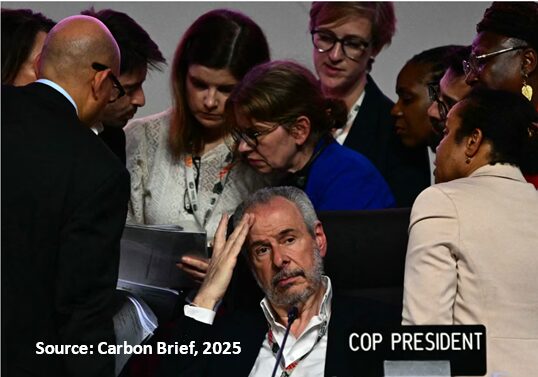
Speaking to Carbon Brief at COP30, Dr Osama Faqeeha, Saudi Arabia’s Deputy Environment Minister, said: “I think the issue is the emissions, it’s not the fuel. And our position is that we have to cut emissions regardless.” The climate debate’s new focus on restricting fossil fuel supply, rather than just reducing demand, threatens the economic sovereignty of producer states (mostly the Arab Group & LMDCs, Figure 1), creating a geopolitical dilemma of sovereignty vs. global common climate goal. This is supported by:
- There was nearly no prospect of consensus being reached on a fossil-fuel roadmap “80 for and 80 against” (Reccesary, 2025). However, the breakthrough came with the signing of Saudi Arabia at the last minutes of the COP30 on the non-binding phasing-down roadmap.
- Major fossil fuel producers and some developing states oppose the term “phase-out” in official climate plans, advocating instead for weaker language like “phase-down” (Carbon Brief, 2025). This debate is now central to climate diplomacy, driving the formation of new blocking coalitions.
- Producer states assert that managing their own fossil fuel resources is a sovereign right and crucial for funding their energy transitions, a stance that directly conflicts with the global “carbon budget” approach to supply restriction (Guardian, 2025). Furthermore, advocacy mainly by China and Russia at COP30 aimed to keep critical minerals, which are vital for renewable energy, off the formal negotiating agenda.
The fossil fuel controversy underscores that future climate governance will increasingly target supply chains. For the Arab region, a hub of fossil fuel production, strategic recalibration is essential. Arab states should proactively develop and articulate integrated national “phase-down” strategies that link managed production declines to economic diversification and renewable energy leadership, thereby shaping the narrative from within rather than being dictated to from outside.
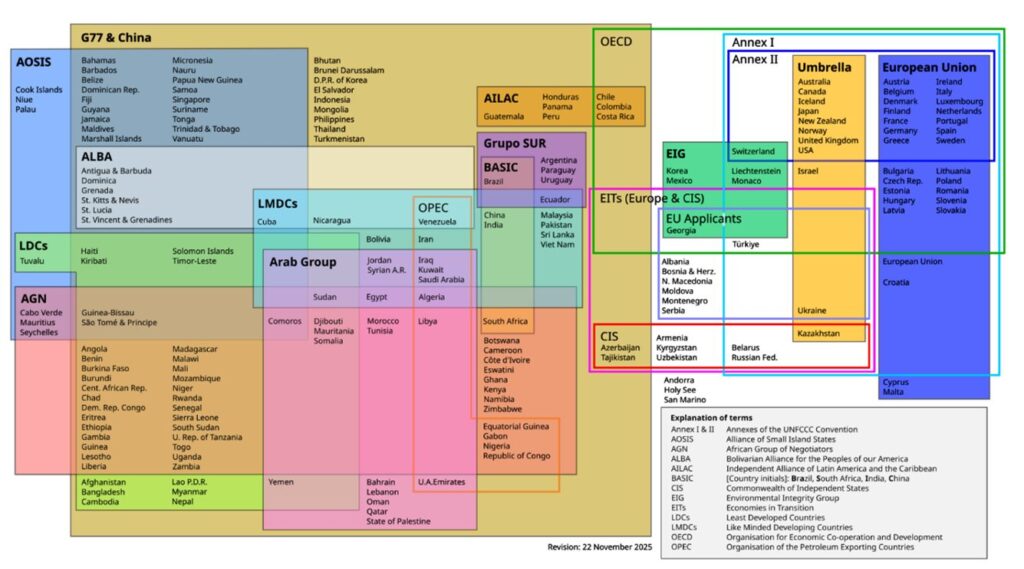
Figure1: UN’s climate negotiation blocs