
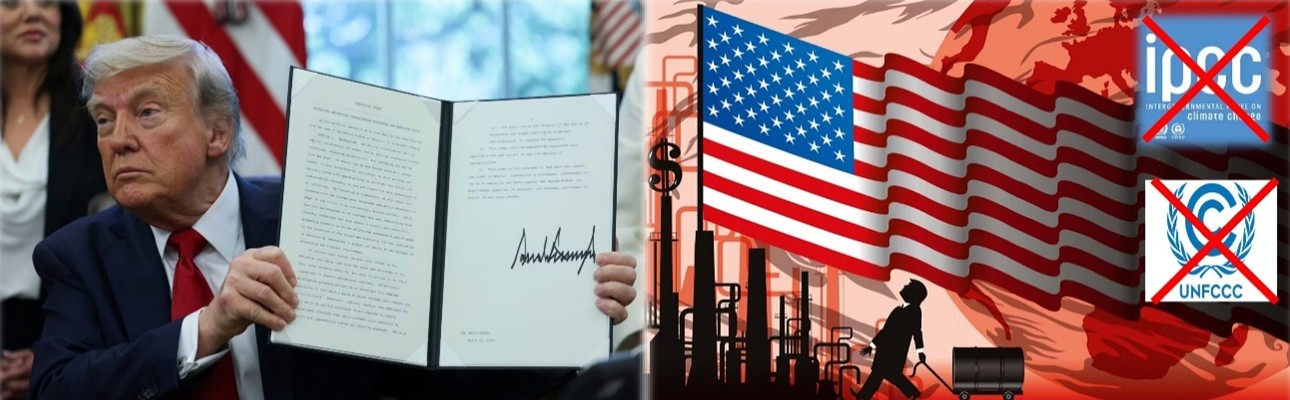
With regard to environmental and, more specifically, climate-related policies, and as has been customary for the White House under President Trump, the United States decided (January 2026) to move against the prevailing global trend and withdraw from the United Nations Framework Convention on Climate Change (UNFCCC) and the Intergovernmental Panel on Climate Change (IPCC). This decision represents a dangerous turning point for global climate action and for international climate discourse, particularly given that these two institutions are considered historical pillars of international cooperation on climate and climate science.
Despite the fluctuation of the U.S. political position on environmental and climate issues within formal negotiations, its informal presence has consistently added significant weight to the negotiation process. Consequently, the absence of the United States will undermine collective efforts to confront climate change at a moment that represents a critical juncture for global climate action. Supporting evidence for this assessment includes the following:
- The withdrawal of the United States from the United Nations Framework Convention on Climate Change, alongside 65 other international organizations it deemed to be “against its interests” (Carbon Brief, 2025). This marks the first time a country has sought to withdraw from the Convention, setting a precedent that may encourage other countries to follow suit, thereby weakening global cooperation on climate action.
- Withdrawing from the IPCC – the premier global authority on climate science – risks eroding scientific consensus and shared data that underpins policy and adaptation measures worldwide, weakening climate science leadership and evidence-based decision-making (UCS, 2025).
- Eroding US influence and cede leadership to other nations, which disrupts coordinated efforts on emissions reporting, funding, and mitigation strategies, at a time when global cooperation is critical to staying within safe warming limits (EDF, 2025).
Against the backdrop of the escalating climate crisis and the failure of COP30 to deliver the anticipated outcomes, the withdrawal of the United States from core climate institutions has come to confirm the onset of a phase of confusion, a slowdown in international cooperation, a weakening of the strength of global climate agreements, and a shift in the dynamics of international climate leadership.
At the Arab level, this development is likely to underscore the urgent need to strengthen regional cooperation, reinforce national climate governance, and engage proactively in alternative multilateral platforms in order to sustain momentum in adaptation and mitigation efforts. Investment in South–South partnerships and in building regional capacity in climate science will be critical to ensuring the continuity of climate action regardless of geopolitical shifts.