
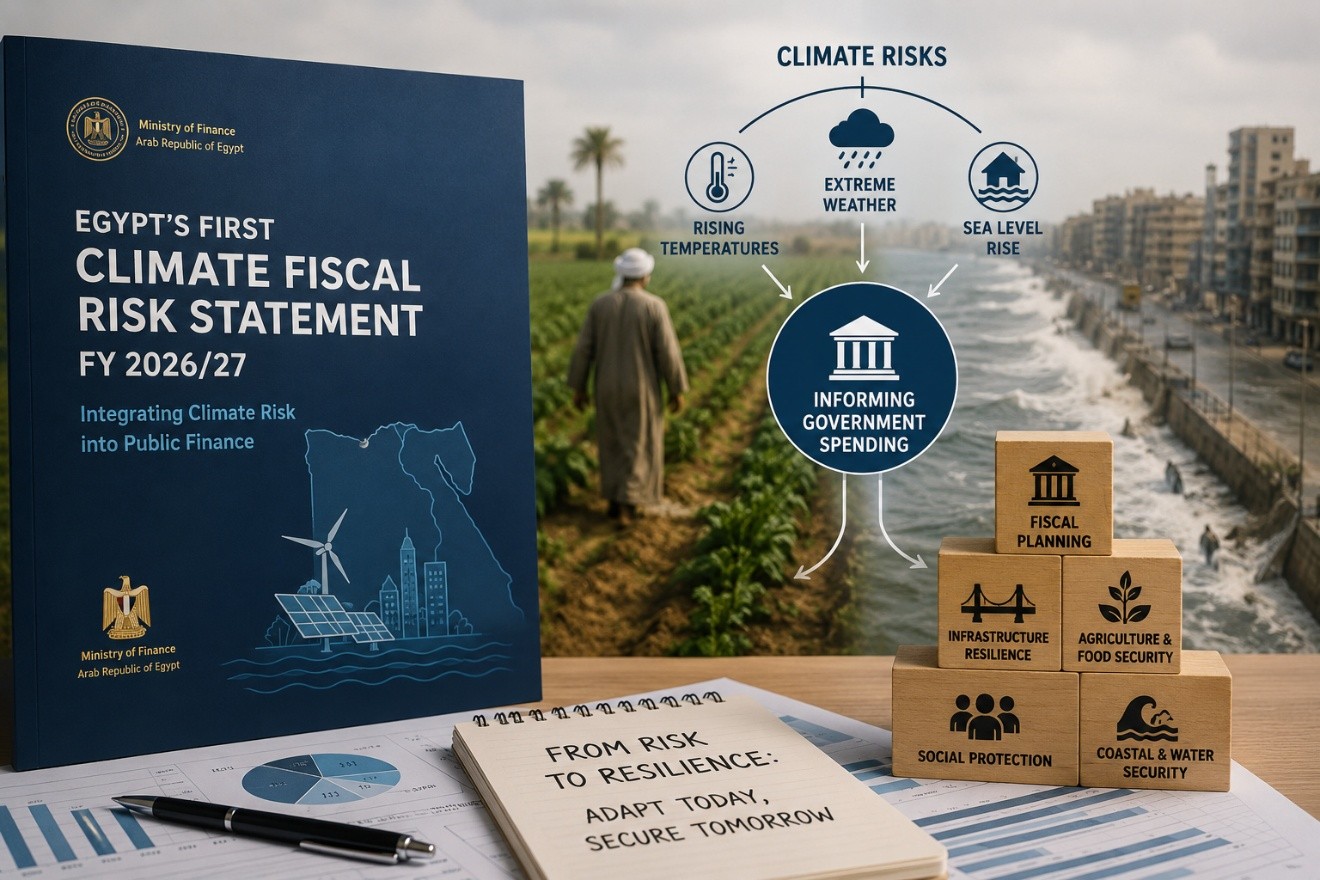
Egypt’s first Fiscal Risk Statement on Climate Change for FY 2026/27 represents an important shift in how climate change is understood within government (EnterpriseAM Egypt, July 2026). Rather than treating climate impacts primarily as an environmental concern, the statement begins to quantify them as risks to public assets, government guarantees, infrastructure projects, debt sustainability, and future public expenditure. This transforms climate action from a separate policy agenda into a central issue of fiscal management and economic planning in Egypt. This shift is evidenced by:
- Egypt is formally economically quantifying climate risk. The statement assesses how physical hazards, including extreme weather and sea-level rise, as well as the international transition away from fossil fuels, may affect government finances. It covers major infrastructure and public-private partnership projects in energy, transport, water, and coastal development (EnterpriseAM Egypt, July 2026).
- Climate risk is becoming a formal consideration in government budgeting. Egypt plans to integrate climate considerations into programme- and performance-based budgeting as part of its transition under the Unified Public Finance Law. This is a significant step towards moving from reactive spending after climate-related damage to anticipatory budgeting that identifies risks before projects and expenditure commitments are approved.
- The statement strengthens accountability for climate-related public investment. Assigning financial values and risk ratings to exposed assets can help ministries evaluate whether investments are resilient, whether government guarantees create hidden liabilities, and whether maintenance and adaptation costs are adequately reflected in medium- and long-term budgets. The development also responds to earlier recommendations by the IMF (2023), for Egypt to expand its fiscal risk reporting to include climate risks, create a register of vulnerable infrastructure assets, and integrate climate considerations more comprehensively into project appraisal, budgeting, and portfolio management.
However, the approach must expand beyond large infrastructure and transition risks.
The current assessment appears heavily focused on energy assets, public-private partnerships, and major infrastructure. While these are financially important, a comprehensive fiscal-risk framework must also capture vulnerable productive and social sectors, particularly agriculture, coastal communities, and tourism that are most vulnerable to climate impacts. Agriculture in particular should be a priority as it supports rural employment, food security, exports, and household livelihoods, but is highly exposed to rising temperatures, water scarcity, salinity, and changing crop productivity. Yields of maize, sugar crops, fruits, and vegetables in Egypt could decline by as much as 19% by 2050 under current practices (FAO, 2023).
Therefore, Egypt’s climate fiscal-risk statement should evolve into a whole-of-economy climate budgeting tool. Future editions should include sector-specific loss scenarios, in alignment with the Egypt NAP and NDC reports, governorate-level exposure, implications for food and water security, adaptation financing needs, and the distributional effects on smallholders and vulnerable communities. This would ensure that the new framework does not only protect major state assets, but also guides public expenditure towards protecting the sectors and citizens most vulnerable to climate change.