
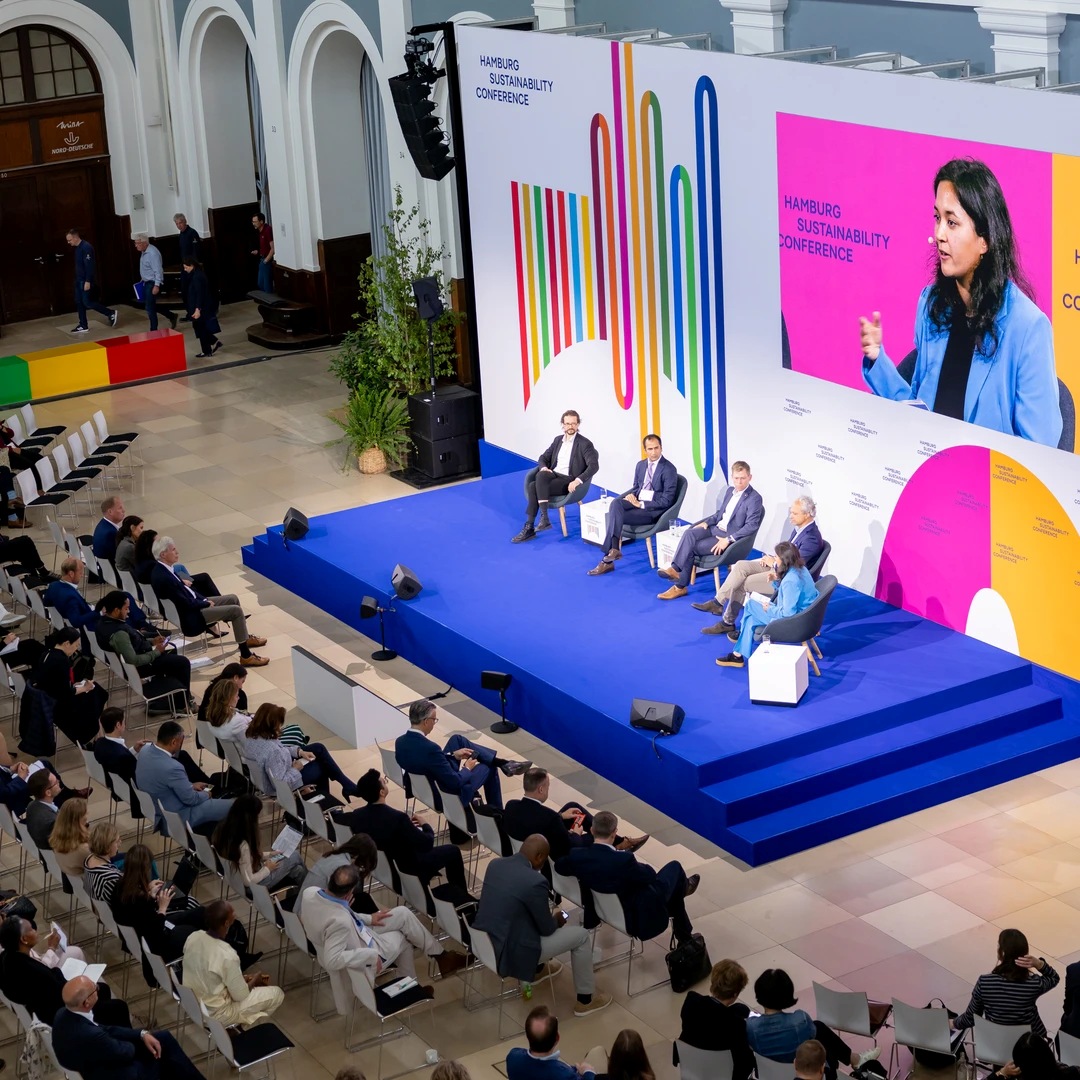
The third Hamburg Sustainability Conference (HSC 2026), held on 29-30 June 2026, brought together attendees from more than 110 countries to advance progress on the UN Sustainable Development Goals (SDGs) amid growing geopolitical tensions and economic uncertainty. The conference’s highlight was the launch of the South-North Commission on Development, a new independent initiative modelled after the 1977 Brandt Commission, aimed at rethinking international cooperation in an increasingly multipolar world. With themes spanning resilient economies, technology and risk, and multilateral governance, the conference also witnessed several other significant launches, including a ten-step UN80 reform proposal and a Call to Action on child nutrition. The overall message was clear: today’s challenges are not a reason to retreat from multilateralism but an impetus to reform it and transform ambition into action
For developing countries, the conference highlighted several persistent challenges alongside emerging opportunities. On the challenges front, high debt burdens have been preventing investments in the green transition while perceived risks, rather than economic fundamentals, continue to inflate borrowing costs across the continent, while fragmented creditor structures and complex borrowing arrangements complicate debt management and transparency. Water insecurity was identified as an increasingly critical constraint on industrial development, potentially acting as a growth barrier. However, significant opportunities also emerged. The South-North Commission, with majority representation from the Global South, offers developing countries a platform to shape the future of international cooperation beyond traditional donor-recipient relationships towards ‘partnerships among equals.’ The growing recognition of South-South trade’s potential, rapid expansion of digital services trade, and the HSC 2025 Hamburg AI Declaration’s emphasis on local ownership and capacity building all point to new pathways for inclusive development. Notably, the conference stressed that the Global South should be viewed not only as a region facing challenges but also as a source of opportunities, innovation and leadership.
For Arab countries, HSC 2026 offers several strategic insights relevant to their regional priorities and global positioning. First, the emphasis on water security presents an opportunity for water-scarce Arab nations to lead on water resilience and nature-based solutions, particularly given the conference’s focus on linking water security to economic and financial risk assessments. Second, the discussions on AI for sustainable development suggest that Arab countries can leverage their investments in digital infrastructure and technology to advance homegrown AI solutions aligned with local development priorities. Finally, the South-North Commission, co-chaired by former German Chancellor Olaf Scholz and former Costa Rican President Laura Chinchilla, represents an important forum for Arab countries to articulate their perspectives on reforming multilateral institutions, addressing debt sustainability, and advancing a more equitable international economic order that reflects contemporary geopolitical realities and the development aspirations of the Global South.