
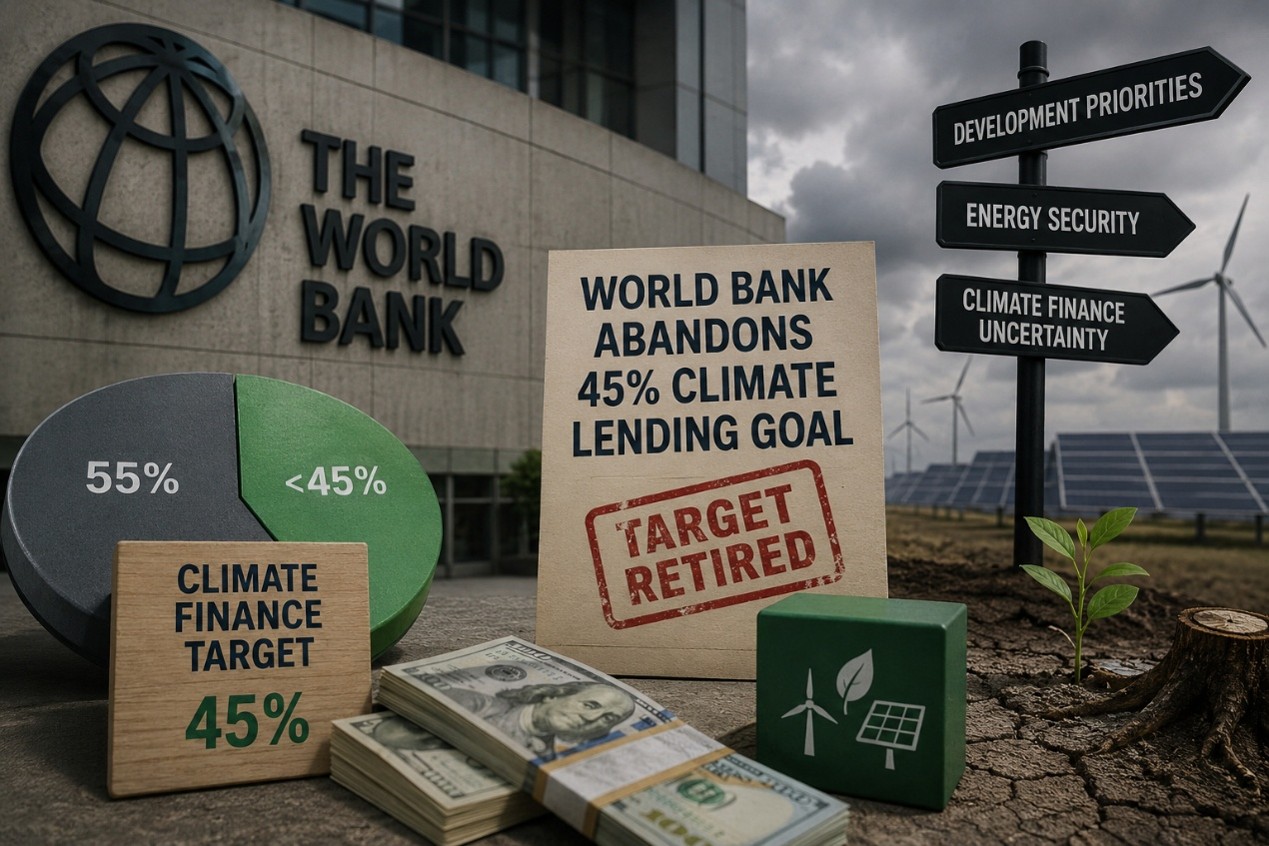
The World Bank’s decision on 29 June 2026 to retire its goal of devoting 45% of annual lending to climate-related projects marks more than a technical adjustment in institutional planning (Reuters, 2026). It reflects a broader shift in international climate funding, where climate finance is increasingly being reframed within “development-first” priorities rather than a dedicated global commitment. While the Bank maintains that climate action will remain client-driven and integrated into development lending, the removal of a quantified target weakens one of the clearest signals of multilateral prioritization at a time when developing countries need predictable, scaled-up, and concessional climate finance. This is evidenced by:
- A measurable climate finance benchmark is being replaced by a more flexible development narrative. At COP28, the World Bank committed to raise climate finance from 35% to 45% of total lending for 2025, equivalent to more than USD 40 billion in climate-related support (World Bank, 2024). The retirement of this target reduces institutional accountability and makes it harder to assess whether climate finance is being expanded, maintained, or diluted within broader development portfolios. The Bank’s new emphasis on “smart development” may preserve some climate co-benefits, but it also risks making climate prioritization less visible and less enforceable.
- The decision reflects growing geopolitical pressure on multilateral climate finance. The US, the World Bank’s largest shareholder, pressed the Bank to abandon the 45% climate lending target and refocus on core development lending, including broader energy financing (Reuters, 2026). European shareholders and developing countries sought to keep the target, revealing a growing disagreement over whether climate finance should remain a core development priority or be pushed aside by short-term political and energy-security concerns.
- The retreat comes as global climate finance needs are expanding.
Multilateral Development Banks (MDBs) climate finance is central to meeting international commitments, including the COP29 pledge for developed countries to mobilize at least USD 300 billion annually by 2035 and the broader push toward USD 1.3 trillion annually for developing countries. Removing a major MDB target risks weakening confidence in the global finance architecture and may push donors and recipient countries to seek alternative channels, including regional development banks, South–South finance, blended finance, and carbon market mechanisms (Financial Times, 2026).
Thus, in this fragmented climate finance landscape, countries that can present bankable, development-aligned, and climate-resilient projects will be better positioned to secure funding despite weakening global prioritization.
For Arab countries, this development reinforces the need to avoid overdependence on shifting multilateral climate finance signals. The Arab region should strengthen project pipelines, climate finance readiness, adaptation investment plans, and engagement with multiple financing channels.