
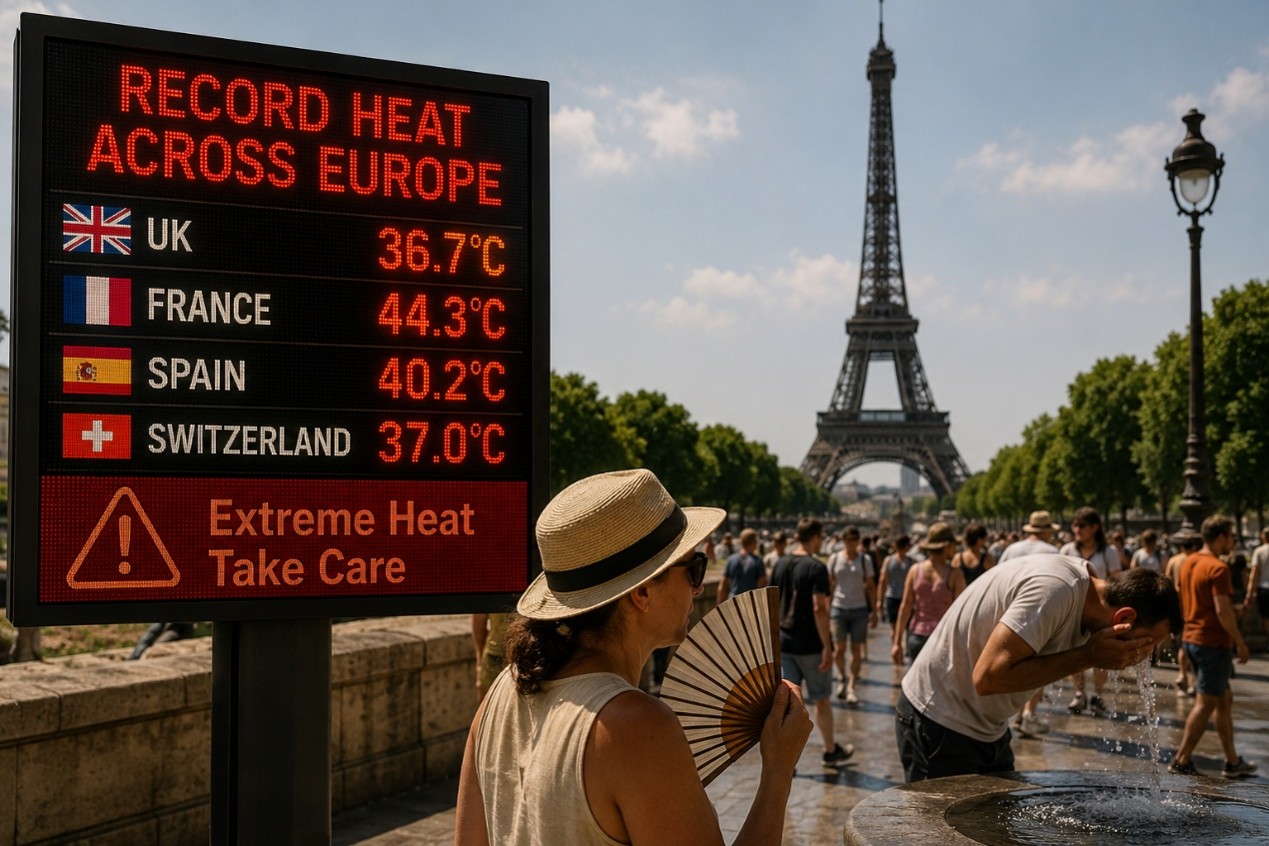
The record-breaking June 2026 heatwave across Europe is not an isolated weather anomaly; it is a clear signal of how climate change is reshaping risk even in regions with advanced infrastructure, health systems, and disaster-response capacities. The United Kingdom broke its June temperature record more than once, France recorded its hottest day ever on two consecutive days, Spain registered its highest daily average temperature for June, and Switzerland also reported its hottest June day (The Guardian, 2026). These events confirm that extreme heat is becoming a systemic climate, health, economic, and governance challenge, not merely a seasonal discomfort. This is evidenced by:
- Europe’s heat records show continent-wide heat stress, not isolated extremes. The UK recorded temperatures above 36°C, while France’s national heat index reached record levels and several French departments exceeded 40°C. Spain also recorded unprecedented June average temperatures, and Switzerland reached around 37°C in several locations (BBC, 2026).
- Extreme heat is exposing adaptation gaps even in high-income countries. The heatwave placed pressure on schools, hospitals, emergency services, transport systems, workplaces, and tourism sites. In the UK, the London Ambulance Service reportedly experienced exceptional pressure from life-threatening emergency calls, while in France and other countries, authorities activated red alerts, adjusted school schedules, restricted outdoor work, and introduced emergency public-health measures (CNN, 2026).
- Climate change is directly intensifying Europe’s heat extremes.
Rapid attribution analysis by World Weather Attribution, concluded that fossil-fuel-driven climate change made this heatwave far more severe and widespread, with such conditions described as virtually impossible in a pre-warming climate (CNN, 2026). Carbon Brief (2026) also highlighted that Europe is warming faster than the global average, increasing both the likelihood and intensity of dangerous heatwaves.
Europe’s heatwave should be read as a global adaptation warning. For Arab countries, particularly those already exposed to chronic high temperatures, water scarcity, urban heat islands, and vulnerable outdoor workforces, the lesson is urgent. Heat action plans, resilient health systems, climate-sensitive urban planning, early warning systems, occupational safety standards, and cooling strategies must become central components of national adaptation planning. Europe’s crisis shows that wealth alone does not guarantee resilience; preparedness, governance, and investment do.