
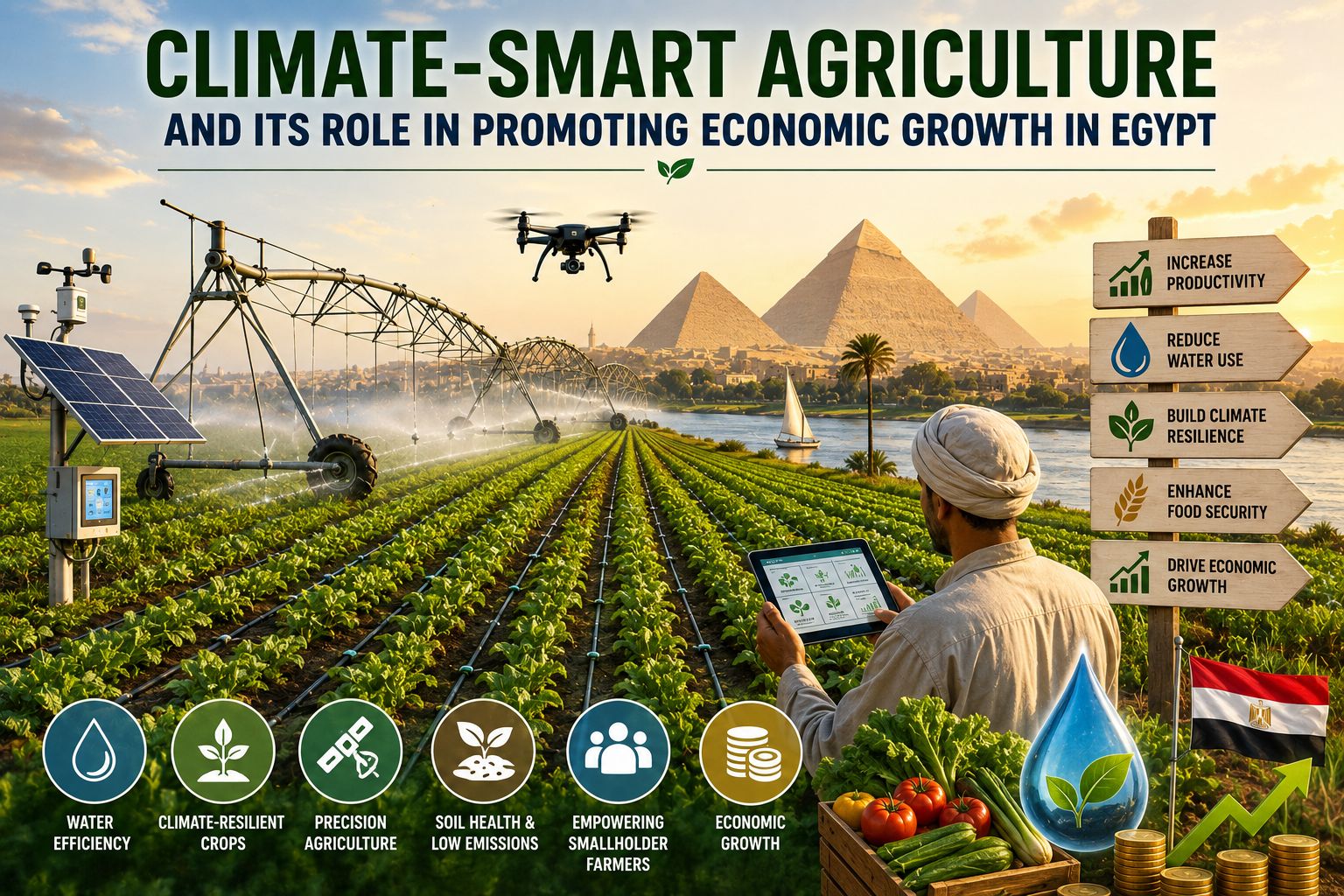
Agriculture in Egypt is considered one of the country’s most important economic and social sectors. It contributes approximately 13.3% of the Gross Domestic Product (GDP) and provides employment for about 20.5% of the labor force, according to the latest statistics issued by the Central Agency for Public Mobilization and Statistics (CAPMAS). At the same time, it accounts for approximately 85% of total freshwater consumption.
Egypt depends almost entirely on the Nile River, which provides more than 55.5 billion cubic meters of water, representing around 90% of the country’s renewable water resources. The total available water resources amount to approximately 59 billion cubic meters annually, while total demand exceeds approximately 110 billion cubic meters, reflecting a structural water gap that is managed through water reuse and food imports.
In this context, climate-smart agriculture becomes a strategic tool for achieving a balance between reducing water consumption per unit of production, enhancing domestic production and reducing dependence on imports, and improving the efficiency of agricultural value chains. In light of increasing climate pressures and water scarcity, there is an urgent need to adopt the Climate Smart Agriculture (CSA) model as one of the most important pathways for strengthening economic resilience and ensuring food security.
The role of climate-smart agriculture lies in utilizing modern technologies and data to improve agricultural production while protecting the environment. International and regional evidence indicates that implementing climate-smart agricultural practices can increase crop productivity by 15% to 25% in some farming systems, particularly through improved water and soil management and the use of heat- and salinity-tolerant crop varieties.
On the other hand, Egypt faces an investment gap in agricultural adaptation to climate change. World Bank estimates indicate that developing countries require hundreds of billions of dollars annually to finance climate adaptation, while agriculture currently receives less than 5% of global climate finance. In the Egyptian context, this gap is exacerbated by rising production input costs and the high cost of upgrading irrigation systems. A large proportion of agricultural land still relies on flood irrigation, which is significantly less efficient than modern irrigation systems that can reduce water consumption by up to 30–40%. Therefore, the primary challenge lies not only in the cost but also in the long-term economic returns generated by improving irrigation efficiency and reducing losses in water and production inputs.
Smallholder farmers (those owning less than five feddans) represent more than 85% of agricultural holdings in Egypt, making them both the most vulnerable group to climate change and the most important stakeholders in any agricultural transformation process. Nevertheless, the adoption of modern agricultural technologies remains limited due to: 1) Limited access to appropriate agricultural financing for small farmers. 2) Limited access to effective agricultural extension services. 3) The high cost of modern irrigation systems (sprinkler irrigation, drip irrigation, center pivot irrigation, and gated pipe irrigation). 4) The lack of continuous and accurate farm-level climate data based on geographic location.
It is worth noting that scalable technologies include high-efficiency drip and sprinkler irrigation systems, precision agriculture using remote sensing and artificial intelligence, drought-, salinity-, and disease-resistant crop varieties, and soil management practices aimed at reducing emissions and improving soil organic carbon.
Results indicate that projects implemented by the Egyptian Ministry of Agriculture in cooperation with international partners have demonstrated that the use of modern irrigation can increase the productivity of certain crops, such as wheat, by 15% to 25% while significantly reducing water consumption. This reflects the dual impact on productivity and sustainability, as well as its contribution to food security.
Improving water-use efficiency in agriculture can also free substantial quantities of water for reallocation to other sectors, such as drinking water and industry, or even for expanding cultivated agricultural land. This simultaneously enhances both water security and food security.
Despite these challenges, Egypt possesses significant opportunities to transition toward climate-smart agriculture, particularly through the expansion of national land reclamation projects, government initiatives to modernize irrigation systems, international partnerships in climate and agriculture, and the growing emphasis on climate finance and green agriculture. Initiatives such as the National Climate Change Strategy 2050 and water efficiency programs also provide a supportive institutional framework for this transformation.
The Centre for Environment and Development for the Arab Region and Europe (CEDARE) plays a leading role in introducing modern technologies and implementing good and climate-smart agricultural practices to address climate change, thereby protecting the environment and supporting the economy. Through its multidisciplinary team of specialized experts, CEDARE delivers programs and initiatives across the Arab, European, and African regions, focusing on digital transformation, climate adaptation, water and land management, the circular economy, green finance, and environmental governance.
Finally, climate-smart agriculture is no longer merely a technical option; it has become an economic and strategic necessity for Egypt in light of water scarcity, climate change, and food security pressures. Achieving a balance between increasing productivity, reducing resource consumption, and lowering adaptation costs lies at the heart of the required transformation. In this context, investing in agricultural technology, empowering smallholder farmers, and linking water and food policies constitute the most practical pathway toward enhancing Egypt’s economic growth and ensuring its long-term food security.