
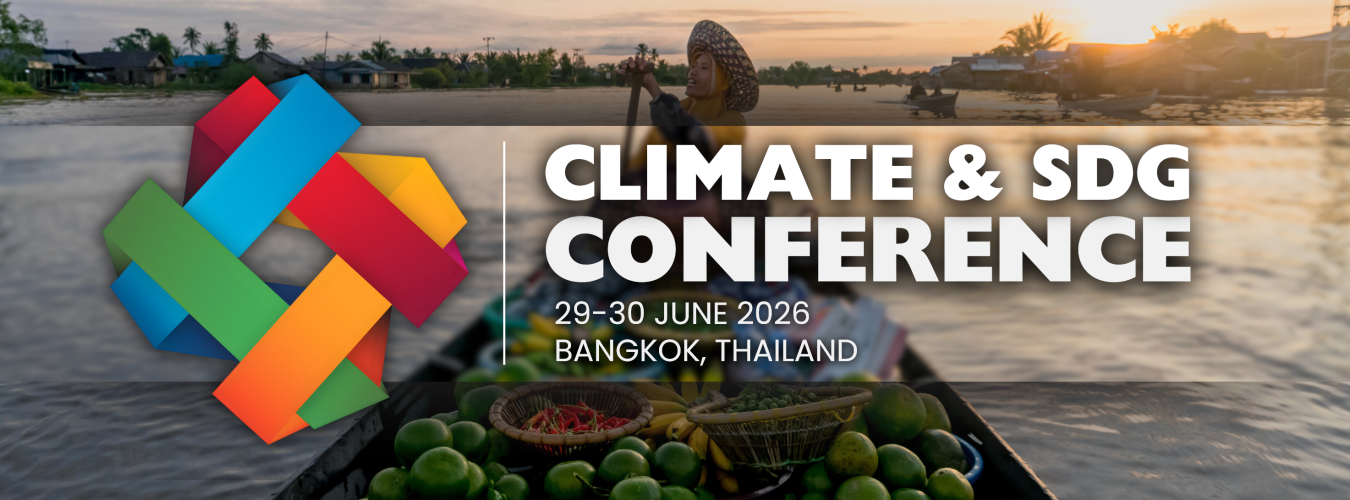
The Seventh Global Conference on Climate and SDG Synergies, Bangkok, Thailand, 29-30 June 2026, co-convened by the United Nations Department of Economic and Social Affairs (UN DESA) and the United Nations Framework Convention on Climate Change (UNFCCC) Secretariat, in collaboration with the United Nations Economic and Social Commission for Asia and the Pacific (UNESCAP), underscored a pivotal shift from aspirational commitment to practical delivery. With the 2030 deadline for the Sustainable Development Goals fast approaching and implementation of the latest Nationally Determined Contributions (NDCs) underway, the conference stressed that climate action and sustainable development are not parallel crises, but the same crisis, and one that requires integrated solutions. This recognition is driven by compelling evidence: when climate action and development plans unite, public expenditures can be up to 40 per cent more effective. However, persistent fragmentation in policy frameworks, institutions, and financing mechanisms continues to limit the potential of both agendas. The conference’s theme, “From Commitment to Delivery: Scaling Integrated Action in a Volatile World”, reflected the urgent reality that countries are essentially being asked ‘to do more with less’, making synergistic approaches not just beneficial, but essential for achieving greater impact than the sum of their parts.
For developing countries, the conference highlighted a dual-edged reality of significant challenges and emerging opportunities. On the challenge front, delegates stressed that climate change is actively eroding progress on poverty, food security, health, and ecosystems protection, while conflicts are reversing hard-won development gains. For Small Island Developing States (SIDS), speakers underscored that every fraction of a degree is a matter of survival, highlighting the existential threat of climate change. The financing gap remains a critical barrier, with speakers noting that the financial architecture is often designed with requirements that developing countries and women entrepreneurs structurally lack, making access to finance a persistent challenge.
However, the conference also identified clear opportunities. Speakers emphasized that well-designed climate action yields simultaneous progress on multiple SDGs—including health, food security, and economic development—generating co-benefits that can drive growth, innovation, and poverty reduction. The launch of the Asia-Pacific Synergies Report provides a practical tool for replicating and scaling best practices, with case studies demonstrating how health-centered climate action, nature-positive nexus approaches, and circular economy models can accelerate integrated development. Cities were identified as key “delivery platforms” for synergies, with integrated urban planning offering opportunities to close implementation gaps through multi-stakeholder partnerships and improved local governance. Moreover, the conference highlighted renewable energy as the cheapest and fastest way to meet growing demand for affordable and reliable energy, presenting an opportunity to simultaneously address energy access and climate mitigation.
For Arab countries, the conference offered several strategic insights relevant to the region’s unique development and climate challenges. First, the emphasis on diversifying energy supply chains and enhancing energy resilience is particularly pertinent given the region’s heavy dependence on fossil fuel revenues and vulnerability to global energy market shocks. The conference’s call to diversify away from fossil fuels and scale renewable energy aligns with the economic transformation agendas of many Arab states, presenting an opportunity to leverage abundant solar resources for energy security and green economic diversification. Second, the focus on water security and climate-health linkages is critical for water-scarce Arab countries. The conference stressed that glacier loss in the region, affecting millions across Central Asia, represents a development emergency, and called for integrated water governance that connects water management, disaster risk reduction, and climate change planning. Third, the recommendation to strengthen South-South and triangular cooperation resonates with Arab countries’ increasing role as development partners. Speakers called for co-created knowledge and technology transfer under frameworks like BRICS+, emphasizing that countries receiving support can simultaneously provide knowledge and capacity, and that finance must be understood not merely as a cost but as a development investment. Fourth, the conference’s call to break institutional silos and adopt whole-of-government approaches is a governance priority for many Arab states, requiring strengthening coordination across ministries, including ministries of finance, environment, planning, and education, to ensure climate and development plans are coherent and mutually reinforcing.
Finally, Arab countries can benefit from the conference’s emphasis on scaling up access to climate finance for adaptation, particularly as many Arab states are among the most climate-vulnerable countries globally. The call to operationalize the multidimensional vulnerability index to ensure climate-vulnerable developing countries are not excluded from concessional finance due to income status is directly relevant to oil-exporting Arab states that often fall into “middle-income” categories despite high climate vulnerability. By mainstreaming synergies into national development planning and Nationally Determine Contributions (NDCs), Arab countries can unlock up to 40 per cent more effective public spending while advancing climate justice, sustainable development, and regional stability.