
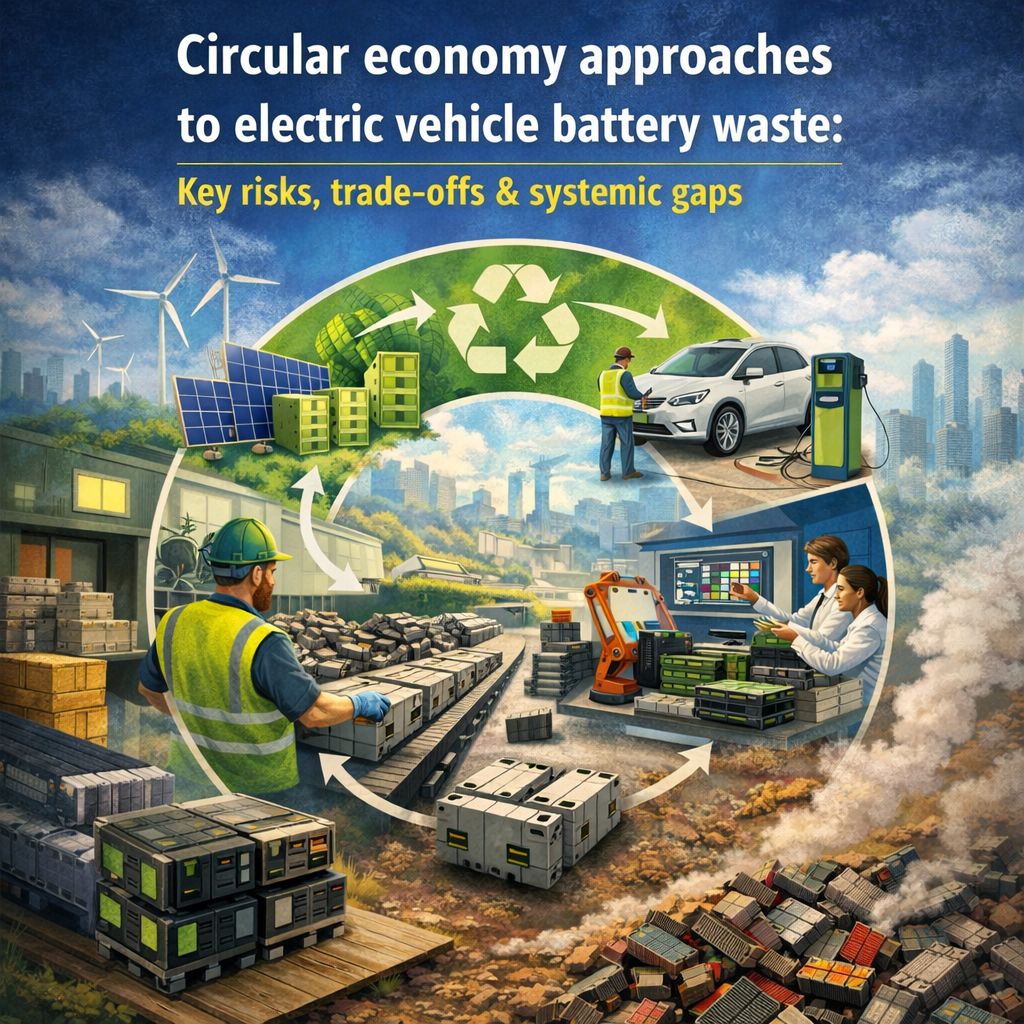
Introduction & Context
The rapid growth of electric vehicles (EVs) supports global decarbonization but creates a parallel challenge: managing end-of-life EV batteries. These batteries are material-intensive and contain valuable, often scarce, critical raw materials, making their disposal both an environmental and strategic resource issue. Without circular economy approaches, poor collection, storage, and disposal practices can lead to environmental damage, safety hazards, and the permanent loss of valuable materials.
While advanced economies are developing regulatory frameworks and recycling capacity, many Arab countries remain at an early stage of EV adoption and lack dedicated systems for battery collection, reuse, and recycling. As EV markets expand across parts of the Middle East and North Africa, the region faces a strategic choice: proactively embed circular economy principles into emerging EV policies or risk future regulatory gaps, informal practices, and dependence on external recycling systems.
The Arab region is not a major producer of EV batteries or critical battery materials, but it is increasingly integrated into global clean energy and vehicle supply chains. This position highlights the importance of early policy alignment to avoid future environmental risks and strengthen long-term resource resilience.
This report examines EV battery waste through a circular economy lens, with particular emphasis on critical raw materials, lifecycle-based management strategies, and governance approaches. It highlights key risks, trade-offs, and systemic gaps while identifying policy-relevant pathways to support sustainable and resilient EV battery value chains, taking into account priorities specific to the Arab region.
Overview of Electric Vehicle Battery Technologies
Electric vehicles primarily use lithium-ion batteries due to their high energy density and long service life. Compared to other battery applications, such as consumer electronics, EV batteries are larger and more material-intensive, increasing both their environmental footprint and their strategic importance from a critical raw materials perspective.
Battery performance depends on materials such as lithium, nickel, cobalt, manganese, and graphite. Differences in battery chemistry reflect trade-offs between performance, cost, safety, and supply risk. Efforts to reduce reliance on certain materials, particularly cobalt, illustrate how technology development is increasingly shaped by resource availability and sustainability concerns.
Designed for long operational lifetimes, EV batteries function not only as energy storage systems but also as concentrated stocks of critical raw materials. Their composition and design therefore directly influence future recovery potential, recycling efficiency, and broader resource security within a circular economy framework.
Critical Raw Materials in EV Batteries
EV batteries contain a range of critical raw materials that are essential to battery performance. These include lithium, cobalt, nickel, manganese, and graphite, which play key roles in energy storage capacity, stability, and longevity. Demand for these materials is rising rapidly, driven by the accelerated deployment of electric vehicles and the increasing use of electric technologies across transport and energy systems. As a result, concerns around supply security, affordability, and sustainability are becoming increasingly prominent.
The supply chains for many of these critical raw materials are highly concentrated geographically, amplifying economic and geopolitical risks. Lithium production is dominated by countries such as Australia, Chile, and Argentina; cobalt extraction is heavily concentrated in the Democratic Republic of the Congo; nickel production is led by Indonesia and a small number of other producers; and graphite supply is largely controlled by China. At the same time, EV battery manufacturing is concentrated primarily in East Asia—particularly China, South Korea, and Japan—while EV deployment and use are concentrated in China, the European Union, and the United States. This spatial separation between material extraction, battery production, vehicle use, and end-of-life management complicates circular economy implementation and increases reliance on cross-border material flows.
In an increasingly geopolitically polarized world, the extraction and processing of critical raw materials are associated with significant environmental and social impacts, including land degradation, water pollution, greenhouse gas emissions, and, in some contexts, labor and human rights concerns. These impacts underscore the importance of reducing dependence on primary extraction by keeping materials in productive use for as long as possible. When EV batteries reach the end of their service life, they can serve as an important source of recoverable materials that reduce supply risks and lower environmental impacts—but only if collected and processed properly.
When EV batteries reach the end of their useful life, critical raw materials can no longer be recovered for reuse or recycling if batteries are landfilled or incinerated, leading to permanent resource loss and additional environmental harm. While recycling technologies can recover certain materials — particularly cobalt, nickel, and lithium — recovery efficiency remains constrained by technical complexity, safety considerations, and financial feasibility for large-scale recycling. Ensuring proper collection, dismantling, and recycling is therefore essential to preserve critical raw materials, reduce waste, and support circular economy objectives.
Circular Economy Strategies Across the EV Battery Lifecycle: The trade-offs
Circular economy approaches to EV batteries require coordinated interventions across the full lifecycle, from design and production to use, reuse, and end-of-life management. Decisions made early in the lifecycle significantly shape the feasibility, cost, and environmental performance of downstream circular strategies.
At the design and production stage, circularity can be enabled through durability, modularity, and safe disassembly. For example, the European Union’s Battery Regulation (2023) sets eco-design requirements aimed at improving reparability and material recovery, and encourages design features that simplify dismantling and recycling. However, design trade-offs emerge: optimizing batteries for performance and energy density may increase material complexity, which can complicate recycling. Similarly, reducing cobalt content to address supply concentration and geopolitical risks may increase reliance on other materials such as nickel or lithium, illustrating a trade-off between different sustainability and resource security objectives.
During the use phase, lifetime extension strategies — including predictive diagnostics and controlled operating conditions — can delay waste generation. Japanese and South Korean OEMs, such as Nissan and Hyundai, are deploying advanced battery management systems that enable real-time health monitoring to extend battery life. Yet extending battery life may postpone the recovery of critical materials needed to meet growing demand, creating a temporal trade-off between immediate resource recovery and maximizing product utility.
Second-life applications, such as repurposing EV batteries for stationary energy storage, further extend functional life and reduce short-term demand for new materials. In Germany and the Netherlands, utilities and storage companies are integrating used EV batteries into grid storage pilot projects, where retired batteries support renewable integration and peak-load management.
However, second-life deployment can introduce logistical, safety, and standardization challenges — including inconsistent performance and unclear warranties — and may reduce the economic viability of recycling if material recovery is significantly delayed.
As batteries ultimately reach end-of-life, effective collection systems and reverse logistics are critical to prevent environmental harm and material loss. China’s provincial recycling networks and mandated take-back schemes exemplify how structured collection pathways can feed authorized recycling facilities. Recycling represents the final stage of the circular loop, where critical raw materials can be recovered and reintroduced into supply chains. Yet here too, trade-offs exist: achieving high recovery rates often requires energy- and capital-intensive processes, raising questions about environmental impacts and the financial feasibility of large-scale recycling, as seen in pilot commercial facilities in the United States where cost remains a barrier to full material recovery.
Across all stages, circular outcomes depend on alignment between manufacturers, recyclers, and policymakers. For instance, France has implemented producer responsibility schemes with financial incentives tied to recycling performance, but coordination challenges remain in linking design incentives with downstream recovery outcomes. Clear standards, economic measures, and regulatory frameworks are essential to balance environmental performance, material security, and economic viability.
Policy, Regulatory, and Governance Framework
Policy and regulatory frameworks are central to enabling circular management of EV battery waste. For example, the European Union’s 2023 Battery Regulation requires mandatory collection targets, minimum recycled content (e.g., lithium, cobalt, nickel), and digital battery passports to ensure traceability. Similarly, China obliges EV manufacturers to take back and recycle used batteries under Extended Producer Responsibility (EPR) rules, supported by a national traceability platform.
At the international level, the Basel Convention regulates the transboundary movement of hazardous waste, including spent lithium-ion batteries, to prevent unsafe exports to countries lacking recycling capacity.
Despite these measures, governance gaps remain. For instance, many developing countries, as is the case in the Arab countries, lack clear EV battery–specific regulations or enforcement capacity, leading to informal dismantling or unsafe storage.
Greater policy alignment, clearer technical standards, and stronger enforcement are therefore essential to ensure safe and circular EV battery value chains.
Key Challenges, Systemic Gaps, and SWOT Snapshot
Circular management of EV battery waste is constrained by limited collection and recycling infrastructure, uneven regulatory enforcement, data gaps on battery flows, and safety risks in handling and processing. These challenges are most acute in regions with weaker institutional capacity. For example, in parts of Nigeria and India, end-of-life lithium-ion batteries are often dismantled informally without proper safety standards, while countries such as Kenya, Ghana, and Tanzania still lack EV battery–specific regulations, increasing risks of unsafe storage and disposal.
Strategically, high material value (e.g., lithium, cobalt, nickel) and growing policy attention are key strengths, while technological complexity and high capital costs for recycling plants remain weaknesses. Opportunities include improved chemical recycling technologies, second-life applications for grid storage, and cross-border cooperation. Threats include supply chain concentration in countries such as China, illegal waste shipments, and delays in enforcing emerging battery regulations.
In the Arab region, EV battery circularity is constrained by structural scale and market limitations. Because electric vehicles are still limited and unevenly adopted across many countries, few batteries are currently reaching end-of-life. This makes it difficult to justify investing in large-scale recycling facilities, as there is not yet sufficient battery waste to make such operations economically viable. In addition, limited technical capacity and the absence of specialized infrastructure for lithium-ion battery collection and processing further slow the development of organized end-of-life systems. Combined with near-total dependence on imported batteries and critical raw materials, these factors increase exposure to external supply chain risks and may delay the development of resilient, regionally anchored circular value chains.
Conclusion and Future Outlook
Conclusion and Future Outlook
The rapid growth of electric vehicles will lead to a substantial increase in end-of-life EV batteries, making circular economy approaches increasingly central to sustainable mobility. Effective lifecycle management can reduce environmental and health risks, retain critical raw materials, and strengthen the resilience of battery supply chains.
In the Arab region, this transition presents both emerging risks and strategic opportunities. Countries such as the United Arab Emirates and Saudi Arabia are investing in EV adoption and clean energy strategies, yet dedicated EV battery recycling infrastructure and regulations remain limited across much of the region, including Egypt and Jordan. In the absence of timely and proactive planning, the region may face growing volumes of unmanaged battery waste.
Looking ahead, mainstreaming circular economy principles within national transport and waste management strategies, developing regional recycling hubs, and aligning policies with international frameworks will be essential. Greater institutional strengthening, private-sector investment, and Arab regional cooperation will be critical to ensuring that EV battery circularity keeps pace with market growth and delivers lasting environmental and resource benefits.