
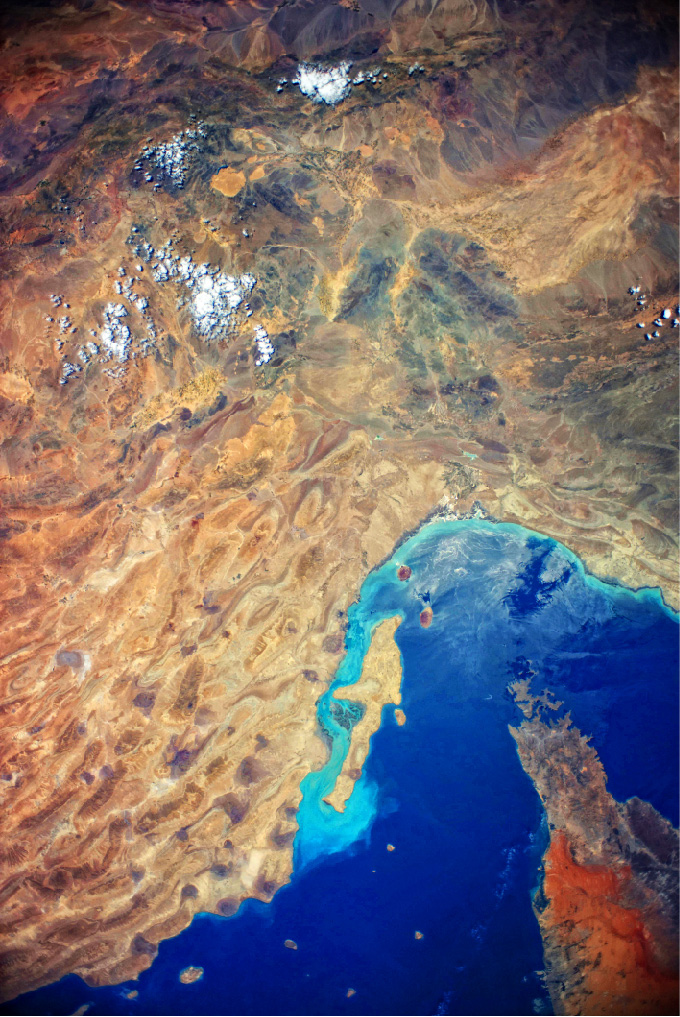
There is a familiar way to read regional escalation: watch oil prices, track shipping lanes, and estimate the hit to growth. But that lens is now too narrow. What the latest UNDP report shows is more unsettling: in the Arab region, a military shock no longer stays inside the energy sector. It spills into water systems, food affordability, environmental health, and the daily reliability of essential services. That is what makes the current crisis so consequential. It is not one disruption. It is four, arriving at once (UNDP 2026).
What is most striking in the underlying materials is not only the scale of the risk, but its logic. The biggest danger is not simply that the region exports energy. It is that energy now underpins everything else: desalination, irrigation, fertilizer production, refrigeration, shipping, humanitarian delivery, and ultimately the cost of basic survival. That systems effect is the real story.
Environment: the damage travels farther than the front line
One of the most underappreciated findings in the UNDP assessment is that environmental damage is not a secondary consequence of conflict. It is part of the primary shock. The report notes that attacks on critical infrastructure and fires in Lebanon and the Gulf are already degrading air quality and creating risks from fine particulate matter, hydrocarbons, dioxins, and other toxic by-products. It also warns that pollution from burning petroleum infrastructure can travel hundreds of kilometres in a single day. In other words, the environmental footprint is regional even when the strikes are geographically concentrated.
Recent UNEP reporting reinforces that point. UNEP warns that strikes on oil facilities can contaminate soil, groundwater, crops and marine areas, while damage to desalination and other water infrastructure can set back both water and climate resilience. That is a powerful reminder that environmental recovery will last much longer than any ceasefire. The surprising part is how quickly conflict converts into a multi-year ecological burden: toxic smoke today becomes public-health stress, contaminated land, and food-safety risk tomorrow (UNEP 2026).
This matters for policy because environmental damage is often treated as something to assess later. It should not be. In this crisis, environmental monitoring is part of early response, not post-conflict clean-up. The longer sampling, remediation and surveillance are delayed, the more likely it becomes that hidden contamination will migrate into water, crops, fisheries and human health systems.
Energy: the real shock is not just price, but interrupted flow
The most visible impact is in energy, but even here the most important takeaway is slightly counter-intuitive. The core issue is not merely that oil and gas prices rise. It is that physical disruption to the Strait of Hormuz changes the reliability of movement itself. UNDP identifies Hormuz as the central transmission channel, and the IEA’s April 2026 market reporting describes the resulting oil shock as the largest supply disruption in the history of the oil market (IEA 2026).
The scale is hard to ignore. The Strait carried roughly one-fifth of global petroleum liquids and about one-fifth of global LNG trade before the disruption, while Qatar and the UAE remain especially dependent on it for gas exports. Alternative routes cannot absorb those volumes quickly. That is why the market reaction has been so sharp: when the route itself becomes uncertain, every linked system reprices at once, from shipping and insurance to aviation fuel and electricity generation (IEA 2026).
There is also a deeper regional paradox. Some hydrocarbon exporters may record temporary fiscal gains from higher prices, and UNDP notes this especially for parts of North Africa. But those gains do not amount to resilience. They mask a broader deterioration in trade, investment, inflation and service continuity. In effect, the region can look stronger on paper at the same time that it becomes more fragile in practice. That is one of the most important, and most easily misunderstood, lessons in the current moment.
Food security: the first bottleneck may be fertilizer, not grain
Food security is often discussed as a grain story. The more revealing insight from the latest evidence is that it may first be a fertilizer story. UNDP highlights the Gulf’s role in fertilizer and agricultural input flows, and recent external assessments make that risk even clearer: a large share of globally traded fertilizer moves through Hormuz, while higher energy costs push up the cost of production, transport, irrigation, storage and refrigeration at the same time (UNCTAD 2026).
This is why the food signal is so serious even before a visible grain shortage appears. FAO has warned that a prolonged Hormuz crisis could trigger an agrifood catastrophe, while WFP estimates that, if the conflict continues and oil remains elevated, almost 45 million more people globally could fall into acute food insecurity. FAO’s March 2026 Food Price Index rose to 128.5, up 2.4 percent month on month, and international wheat prices rose 4.3 percent. Those are not abstract global statistics. In Arab economies where food can account for 30 to 50 percent of household spending, such increases move quickly into household distress (WFP 2026).
The most important implication is that food insecurity in this crisis is being built upstream. It begins with fertilizer terminals, shipping insurance, bunker fuel, and freight costs long before it shows up in food prices. That makes it harder to detect politically, because by the time food inflation becomes visible to consumers, the underlying disruption has already been underway for weeks.
Water security: in the Gulf, water security is energy security
If there is one section of the UNDP report that deserves much more attention, it is water. The report notes that GCC countries operate roughly 400 desalination plants, produce around 40 percent of global desalinated water, and supply most drinking water in several Gulf states. It also estimates that nearly 100 million people depend on these systems. This is the most important infrastructure fact in the entire crisis. It means that a strike on energy or coastal infrastructure is no longer only an energy event. It can become a municipal water emergency.
That exposure is layered on top of an already severe baseline. The World Bank describes MENA as the most water-scarce region in the world, with average water availability of about 480 cubic metres per person, far below the global average and below the threshold of absolute scarcity. In that setting, desalination is not a supplement. It is a lifeline. That is why UNEP’s warning about strikes on desalination plants carrying “catastrophic consequences” is so important. It is not rhetorical. It is operational (World Bank 2026).
The counter-intuitive takeaway is that water vulnerability in the Gulf is highly modern, not traditional. This is not only a story of drought or low rainfall. It is a story of technologically advanced societies whose water security depends on uninterrupted energy, chemicals, maintenance, digital controls, and safe maritime access. In a conflict setting, that sophistication is both a strength and a point of fragility (UNEP 2026).
Strategic objectives and priority actions
The strategic objective now should be clear: reduce the chance that a military shock becomes a prolonged systems failure. That requires acting across infrastructure, logistics, social protection and regional coordination at the same time.
1. Protect critical water-energy nodes as one integrated system
Desalination plants, wastewater facilities, power generation, fuel storage, ports and digital control networks should be treated as a single resilience portfolio. Separate sector planning is no longer sufficient when the failure of one node can trigger breakdowns across several others.
2. Build a regional fertilizer, grain and humanitarian logistics buffer.
The priority is not only more imports. It is smarter continuity planning: pooled procurement, emergency warehousing, green-lane shipping arrangements, and rapid financing for fertilizer and staple foods. The region needs buffers for the inputs that determine tomorrow’s food prices, not just today’s inventories (WFP 2026).
3. Treat environmental monitoring as an emergency function.
Air, water, soil and coastal surveillance should begin early, alongside debris and hazardous-waste management. In this crisis, environmental intelligence is part of humanitarian protection and public-health defence.
4. Cushion households through targeted support, not broad distortionary subsidies.
The poorest households will feel the crisis through food, fuel and transport costs first. The most effective response is well-targeted cash, food and livelihood support, especially in import-dependent and fragile settings where inflation passes quickly into poverty (IMF 2026).
5. Use the crisis to accelerate structural resilience.
The long-term lesson is not simply to diversify away from oil. It is to diversify supply chains, water systems, logistics routes and productive capacity. Energy transition, water reuse, decentralized backup power, and regional coordination are no longer side agendas. They are central pillars of economic security (World Bank 2026).
A final thought
The most important insight from this crisis may be the simplest one: the Arab region’s core vulnerabilities are now deeply connected. Energy can no longer be analysed without water. Food cannot be analysed without fertilizer and freight. Environmental damage cannot be separated from public health or recovery costs. Once those linkages are visible, the policy challenge changes as well. The question is no longer whether the region can absorb the next shock. It is whether it can redesign resilience before the next shock arrives.