
Executive Summary
Electronic waste (e-waste) is one of the fastest-growing waste streams globally, driven by rapid technological change, rising consumption of electronic devices, and increasingly short product lifecycles. Countries in the Arab region, including Egypt, the United Arab Emirates, Saudi Arabia, and Morocco, are experiencing a steady increase in electronic consumption, particularly smartphones, computers, and household appliances. However, the development of formal collection and recycling systems has not kept pace with this growth, resulting in environmental risks as well as missed economic opportunities.
At the same time, e-waste represents an important source of valuable secondary raw materials. Devices such as mobile phones and laptops contain copper, aluminum, gold, and other materials that can be recovered through modern recycling systems. Countries with advanced recovery infrastructure, such as Germany, Japan, and South Korea, have demonstrated that e-waste can be treated not only as a waste management challenge but also as a strategic resource stream. In contrast, in countries such as Egypt and Jordan, a large share of e-waste is still handled through informal collection channels, where recovery is often inefficient and associated with environmental risks.
This report examines the role of e-waste within the circular economy, focusing on the resource recovery potential of e-waste, the systemic challenges that limit circularity, and the policy pathways that can improve material recovery systems. Drawing on examples from the Arab region and international experience, the report argues that e-waste should be viewed not only as an environmental challenge but also as a strategic economic opportunity. Strengthening regulatory frameworks, improving collection systems, and investing in recycling infrastructure will be essential to unlock this potential.
1. Introduction & Context
Over the past two decades, the rapid expansion of digital technologies has fundamentally changed patterns of production, consumption, and communication. Smartphones, laptops, televisions, and a wide range of household appliances are now central to economic activity and daily life in both developed and developing economies. As a result, the volume of discarded electronic products has increased significantly, making e-waste one of the fastest-growing waste streams worldwide. Short product lifecycles, frequent technological upgrades, and strong consumer demand continue to accelerate the rate at which electronic devices are replaced.
This trend is becoming increasingly visible across the Arab region. Countries such as Egypt, the United Arab Emirates, Saudi Arabia, and Morocco have experienced steady growth in the use of electronic devices, particularly smartphones, personal computers, and small household electronics. Expanding digital infrastructure, the growth of online services, and rising demand for consumer electronics have all contributed to higher levels of electronic consumption. However, systems for managing discarded electronic products remain limited in many cases. In Egypt and Jordan, a large share of e-waste is still collected through informal channels, while in several other countries in the region formal recycling capacity is still at an early stage of development.
Electronic waste is no longer viewed only as an environmental issue. Discarded devices contain valuable materials such as copper, aluminum, gold, and other strategic raw materials that are increasingly important for modern industries. Countries with advanced recycling systems, including Germany, Japan, and South Korea, have demonstrated that e-waste can be treated as a source of secondary raw materials rather than simply as a disposal problem. Material recovery from discarded electronics can reduce environmental pressures, improve resource efficiency, and contribute to more sustainable production systems.
These developments have increased the relevance of circular economy approaches to e-waste. Instead of relying on a linear model based on production, consumption, and disposal, circular economy strategies aim to extend product lifecycles, improve repair and reuse systems, and recover valuable materials at the end of a product’s life. This shift is particularly important in the case of electronic products because of the growing demand for critical raw materials and the environmental impacts associated with primary resource extraction.
Despite growing awareness of the importance of circular economy approaches, significant structural challenges continue to limit effective e-waste management.
Weak collection systems, limited recycling infrastructure, fragmented regulatory frameworks, and product design challenges all contribute to low material recovery rates in many countries. These issues are especially relevant in the Arab region, where the rapid increase in electronic consumption has not yet been matched by equally strong institutional and policy responses.
This report examines the role of e-waste within the circular economy, focusing on the resource recovery potential of e-waste, the systemic challenges that limit circularity, and the policy pathways that can support more effective material recovery systems. By drawing on examples from the Arab region as well as international experience, the report aims to provide a clearer understanding of how e-waste can be transformed from a growing environmental challenge into a strategic resource opportunity.
2. Understanding Electronic Waste in the Circular Economy
E-waste refers to discarded electrical and electronic equipment that has reached the end of its useful life or is no longer wanted by users. This includes a wide range of products such as smartphones, laptops, televisions, refrigerators, washing machines, printers, and small household electronics. In countries such as Egypt, Saudi Arabia, and the United Arab Emirates, the fastest growth in recent years has been observed in small electronic devices, particularly mobile phones, personal computers, and consumer electronics. The rapid replacement of these products has significantly increased the volume of discarded electronic equipment, even in countries where overall industrial activity remains relatively moderate (ITU & UNITAR, Global E‑waste Monitor, 2024).
The growing importance of e-waste within the circular economy is largely linked to the materials contained in electronic products. Modern devices are highly material-intensive and often contain copper, aluminum, gold, silver, and a range of other valuable metals. In addition, certain electronic products contain strategic raw materials such as cobalt and lithium, that are increasingly important for advanced technologies. When these products are discarded without proper recovery systems, these materials are not just effectively lost, but rather turn into hazardous waste to the people and environment. In contrast, countries that have invested in formal recycling systems, such as Germany, Japan, and South Korea, have demonstrated that e-waste can serve as an important source of secondary raw materials.
The shift from a traditional waste management perspective to a circular economy approach has therefore become particularly relevant in the case of e-waste. In a linear system, electronic products are manufactured, used for a relatively short period, and then discarded. Circular economy approaches aim to extend product lifecycles through repair and reuse, improve collection systems, and recover valuable materials once products reach the end of their useful life (European Parliament, 2023). This transition is especially important because the demand for electronic products continues to grow in both developed and developing economies, including many countries in the Arab region.
Another factor that makes e-waste particularly important in the circular economy is the speed at which technology evolves. Smartphones and computers are often replaced after only a few years, even when they remain technically functional. In countries such as the United Arab Emirates and Qatar, rapid technological adoption has contributed to shorter product lifecycles, while in countries such as Egypt and Jordan large volumes of older devices continue to circulate through second-hand markets before eventually being discarded. These patterns highlight the complexity of e-waste systems and the need for policies that address not only recycling but also product lifespan, reuse, and material recovery.
Understanding e-waste within the circular economy therefore requires a broader perspective than traditional waste management approaches. It involves recognising e-waste as both an environmental challenge and a resource opportunity, as well as addressing the entire product lifecycle from design and consumption to reuse and material recovery. This broader perspective is essential for developing effective policies that can improve resource efficiency while reducing the environmental impacts associated with growing volumes of discarded electronic products.
3. Resource Recovery Potential of Electronic Waste
Electronic waste represents a significant source of valuable materials, making it an important component of circular economy strategies.
3.1 Valuable Materials in E-Waste
The composition of electronic products varies, but several key materials are particularly important, as shown in the following table.
| Material | Use | Recovery |
| Copper | Used extensively in wiring, printed circuit boards, and connectors. | High recovery potential exists in both small electronics and larger household appliances. |
| Aluminum | Commonly found in casings and electronic components. | It is widely recyclable and requires significantly less energy when recycled than when produced from raw materials. |
| Precious metals (Gold, Silver, Palladium) | Found in circuit boards and connectors. | Even small volumes are economically valuable due to their high market price: A single ton of discarded smartphones can contain up to 300 grams of gold and 1.5 kilograms of silver, highlighting the potential economic value that can be unlocked through proper recovery systems. |
| Critical raw materials (Cobalt, Lithium, Rare Earth Elements) | Found in batteries, magnets, and certain electronic components. | These materials are strategically important, with limited global supply, making recovery from e-waste increasingly relevant. |
3.2 International Examples of Recovery
Several countries, global leaders in e-waste recycling, have established advanced recycling systems that demonstrate the potential of e-waste as a secondary raw material source.
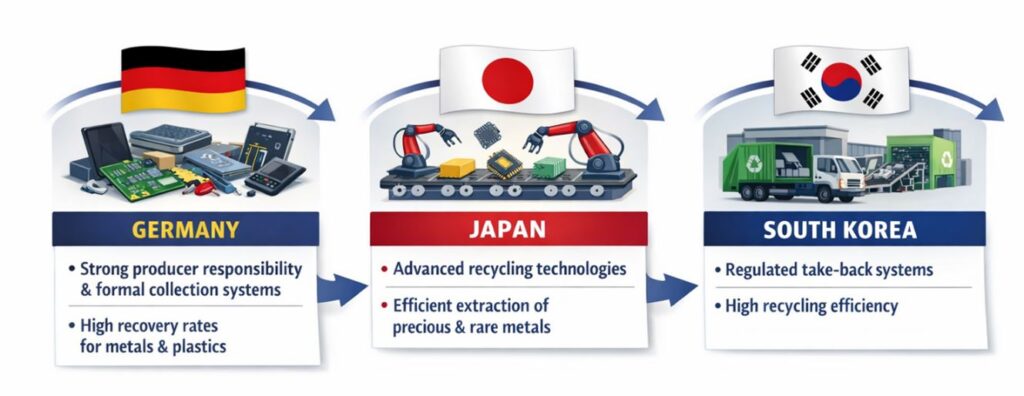
These examples show that e-waste can be a strategic resource, not just a disposal problem.
3.3 Opportunities in the Arab Region
In the Arab region, formal e-waste recycling infrastructure remains limited, but the potential for resource recovery is significant, as shown in the following figure.
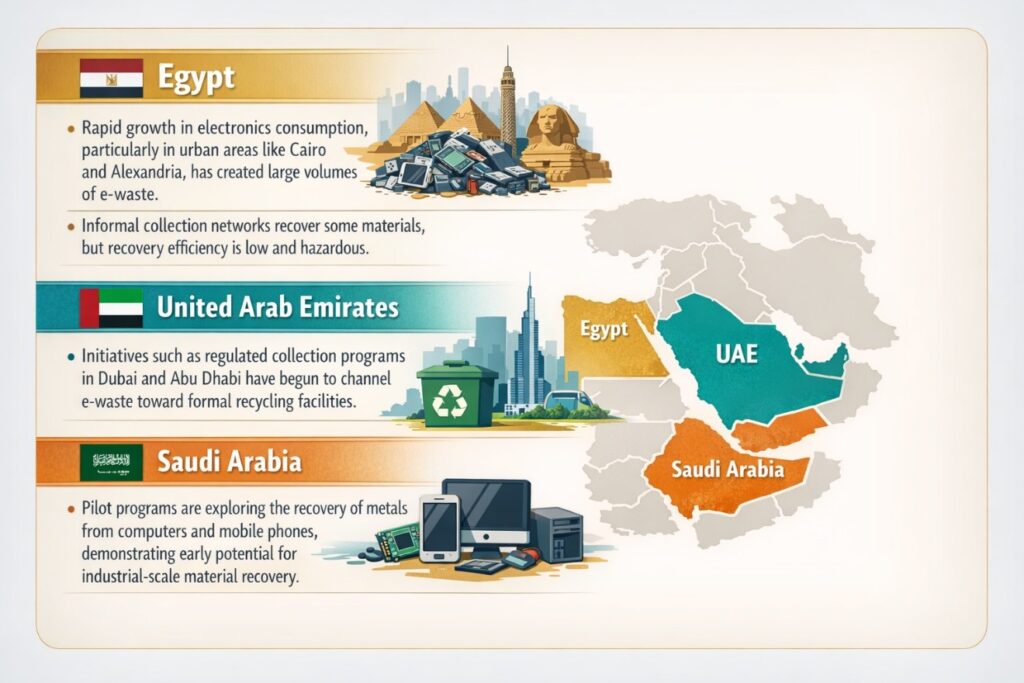
If properly implemented, formal recovery systems in these countries could recover significant quantities of metals and critical raw materials, supporting both economic and environmental objectives. For instance, capturing metals like copper, aluminum, and gold from the growing stock of discarded electronics in Egypt alone could offset a portion of the country’s reliance on imported raw materials. For example, Egypt generated an estimated 690 000 tonnes of electronic waste in 2022, but formal collection and recycling in the Arab region — including Egypt — remains below 1%, indicating that the vast majority of valuable metals are currently unrecovered (ITU & UNITAR, Global E‑waste Monitor, 2024).
3.4 Strategic Implications
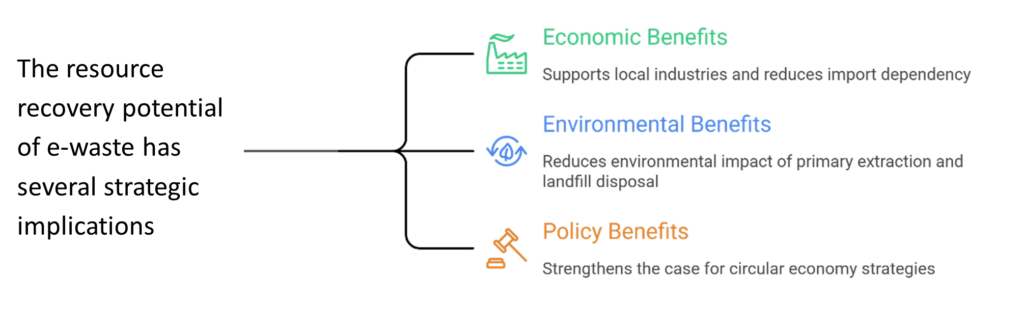
Overall, the resource embedded in e-waste presents both an opportunity and a challenge. The opportunity lies in converting discarded products into a reliable supply of secondary raw materials, while the challenge lies in building the infrastructure, governance, and incentives necessary to unlock this potential.
4. Systemic Challenges Limiting Circularity
While e-waste offers significant potential for resource recovery, multiple systemic challenges limit the effectiveness of circular economy approaches. These challenges span infrastructure, governance, collection systems, product design, and the informal recycling sector, and they often interact to reduce overall recovery rates.
4.1 Weak Collection Systems
One of the primary barriers to effective e-waste management is insufficient collection infrastructure. In countries such as Egypt and Jordan, a large proportion of discarded electronics never enter formal recycling channels. Instead, e-waste is often collected informally through street collectors or sold directly to small workshops. This results in low material recovery efficiency, while hazardous components such as batteries and circuit boards may be improperly disposed of, causing environmental contamination.
Informal or unsound e‑waste collection and recycling often release hazardous substances like lead, heavy metals, and toxic organic chemicals into the air, soil, dust, and water, causing environmental contamination and posing risks to ecosystems and human health (World Health Organization, 2024).
In contrast, countries with structured collection networks, such as Germany and South Korea, demonstrate how formalized take-back systems can ensure high recovery rates and proper handling of hazardous components.
4.2 Informal Recycling and Unsafe Practices
Informal recycling is widespread in many Arab countries, where small workshops manually dismantle electronics to extract metals. While these operations recover some valuable materials, the processes are often unsafe, inefficient, and environmentally harmful. For instance, in Egypt, informal e-waste workshops frequently use open-air burning to extract copper from cables or circuit boards, releasing toxic fumes. Similarly, in parts of Morocco, informal dismantling of electronics exposes workers to heavy metals such as lead and cadmium. Such practices highlight the trade-off between the economic livelihoods for informal workers and the need for safe, efficient material recovery systems.
4.3 Limited Recycling Infrastructure
Even where collection exists, formal recycling infrastructure is often insufficient to process the volume of e-waste generated. In Saudi Arabia and the United Arab Emirates, pilot recycling facilities have been established, but large-scale operations remain limited. Without modern facilities equipped to separate and process metals, plastics, and critical materials, much of the resource potential embedded in e-waste remains untapped, as there is substantial unrealized potential for material recovery and only a fraction of e-waste is properly recycled (International Energy Agency (IEA), 2024). In contrast, countries such as Japan employ advanced mechanical and chemical separation technologies to recover high-purity metals from discarded devices, demonstrating the efficiency gains possible with proper infrastructure.
4.4 Product Design Challenges
Many electronic devices are not designed with repairability, reuse, or recycling in mind. Smartphones, laptops, and household appliances often use tightly integrated components, adhesives, or mixed materials, which make disassembly difficult. Short product lifespans and planned obsolescence exacerbate the problem. In the Arab region, where second-hand electronics markets are significant, limited product modularity often reduces the potential for reuse and refurbishment, further decreasing the circularity of e-waste streams.
4.5 Governance and Policy Gaps
Regulatory frameworks for e-waste are fragmented or still emerging in much of the Arab region. While countries such as the United Arab Emirates and Saudi Arabia have introduced laws and take-back programs, enforcement is often inconsistent, and responsibilities for e-waste management may be divided across multiple ministries or authorities. In Egypt, for example, policies related to waste management, environmental protection, and industrial regulation often overlap without clear coordination, resulting in gaps in implementation. This contrasts with Germany’s Extended Producer Responsibility (EPR) system, where clear legislation assigns responsibility to manufacturers for collection and recycling, creating strong incentives for effective circularity.
Overall, these systemic challenges—weak collection networks, informal recycling practices, limited infrastructure, product design barriers, and governance gaps—interact to limit the recovery of materials from e-waste. Addressing these issues is critical for enabling effective circular economy strategies and unlocking the economic and environmental potential of e-waste in the Arab region and beyond.
5. Circular Economy Pathways for Electronic Waste
Moving e-waste toward a circular economy requires shifting from a disposal-focused system to one that prioritizes value retention, resource efficiency, and product longevity. Unlike traditional waste management approaches, circular strategies aim to keep electronic products, components, and materials in use for as long as possible while minimizing environmental and economic losses.
5.1 Design for durability, repair, and modularity
One of the most important circular pathways begins at the product design stage. Many electronic devices are currently designed with limited repairability, short lifespans, and tightly integrated components, which makes reuse or refurbishment difficult. Adopting design approaches that emphasize durability, standardized components, and modular structures can significantly extend product lifetimes and reduce waste generation. For example, devices designed with easily replaceable batteries, screens, or memory components can remain in use much longer and retain higher economic value over time.
5.2 Strengthening repair, refurbishment, and reuse markets
Repair and refurbishment represent some of the most effective circular economy strategies for e-waste because they preserve the highest level of product value. In many developing countries, including those in the Arab region, informal repair markets already play a major role in extending the life of electronic products. However, these markets often lack access to spare parts, technical documentation, and formal support systems. Strengthening repair ecosystems through right-to-repair policies, training programs, and better access to components could significantly reduce the volume of e-waste while creating local employment opportunities.
5.3 Improving collection and reverse logistics systems
A major barrier to circular e-waste management is the low rate of formal collection. Many discarded electronic products remain stored in households, are sold informally, or end up in mixed waste streams. Establishing efficient collection systems—through take-back programs, collection centers, and incentives for consumers—can help channel e-waste into formal recycling and reuse pathways. Well-designed reverse logistics systems are particularly important for recovering high-value materials such as copper, rare earth elements, and precious metals.
5.4 Expanding safe and efficient recycling capacity
While reuse and refurbishment should be prioritized, recycling remains essential for recovering valuable materials from devices that have reached the end of their usable life. However, in many regions, recycling activities are either limited or carried out using unsafe and environmentally harmful methods. Investing in modern recycling infrastructure and strengthening environmental regulations can improve material recovery rates while reducing health and environmental risks. Meanwhile, integrating informal sector actors into safer, formalized systems can help preserve livelihoods while improving overall efficiency.
5.5 Policy and institutional frameworks for circularity
Effective circular economy pathways for e-waste depend on clear and well-coordinated policies. Extended Producer Responsibility (EPR) systems, for example, can shift responsibility for collection and recycling to manufacturers, creating strong incentives to design more durable and recyclable products. In addition, clearer coordination between waste management authorities, environmental agencies, and industrial regulators can help close existing policy gaps and improve implementation.
6. Policy Pathways & Recommendations
Strengthening circular economy approaches to e-waste requires targeted policy interventions that address design, collection, and recycling simultaneously. Rather than relying only on end-of-life waste management, policies should focus on extending product lifetimes, improving material recovery, and creating clear institutional responsibility:
- Governments should establish clear Extended Producer Responsibility (EPR) frameworks for electronic products. Assigning responsibility for collection and recycling to manufacturers can create strong incentives to design more durable, repairable, and recyclable devices while improving formal collection rates.
- Policies should support repair and refurbishment ecosystems. This can include improving access to spare parts, encouraging right-to-repair measures, and supporting small repair businesses through training and certification programs. Such measures are particularly important in countries where informal repair markets already play a significant role in extending product lifetimes.
- Strengthening formal collection and recycling systems should be a priority. Governments can support this through take-back schemes, consumer awareness programs, and investment in safe recycling infrastructure. In parallel, better coordination between environmental authorities, waste management agencies, and industrial regulators is necessary to reduce policy fragmentation and improve implementation.
- Integrating circular economy objectives into broader industrial and environmental strategies can help ensure long-term progress. Linking e-waste policies to resource efficiency, local manufacturing, and green job creation can strengthen both environmental outcomes and economic benefits.
Conclusion & Key Takeaways
The growth of electronic waste presents both environmental risks and opportunities for resource efficiency. Extending the lifecycle of electronic products through durability, modular design, repair, and refurbishment is essential to minimize waste generation and preserve valuable materials. Informal repair and reuse markets already play a significant role in many regions, but formal support systems are needed to maximize their impact safely and efficiently.
Efficient collection and reverse logistics systems are critical to channel end-of-life electronics into reuse or recycling pathways. Take-back schemes, standardized collection points, and public awareness campaigns can help increase formal recovery rates and prevent harmful disposal. Recycling infrastructure must be improved to safely recover critical materials while integrating informal sector actors where feasible.
Policy frameworks, particularly Extended Producer Responsibility (EPR) systems, are key to aligning incentives for manufacturers to design repairable and recyclable products. Coordinated governance across environmental, industrial, and waste management authorities is necessary to close regulatory gaps and strengthen implementation.
Ultimately, a circular approach to electronic waste not only reduces environmental impact but also creates economic opportunities through material recovery, job creation, and local repair industries. Prioritizing policy actions that support durability, reuse, safe recycling, and clear accountability will be essential for building a sustainable and resilient e-waste management system.