
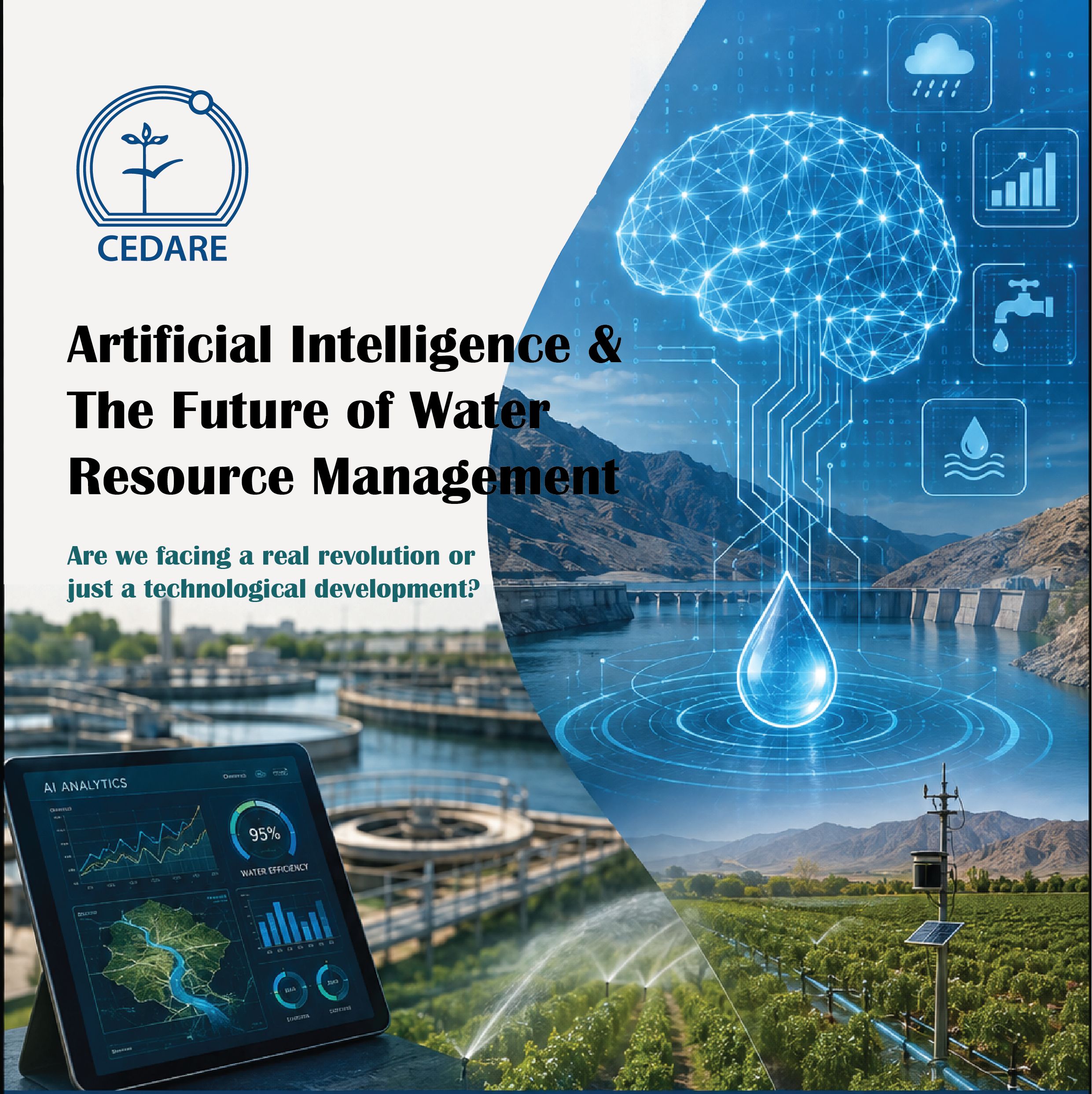
From Data to Decision: Are We Witnessing a Real Transformation in Water Management?
The water sector is undergoing a rapid digital transformation driven by advances in Artificial Intelligence (AI), Big Data, the Internet of Things (IoT), remote sensing, and early-warning systems. AI is no longer simply an emerging technology; it has become a powerful tool for supporting more efficient, resilient, and sustainable water resources management in the face of climate change, population growth, urbanization, and increasing water demand (UNESCO & Deltares, 2025; IWA, 2025).
Why Is AI an Opportunity for the Water Sector?
The fundamental value of AI lies in its ability to transform vast amounts of data into actionable information. By integrating data from satellites, monitoring stations, meteorological systems, smart meters, sensors, and historical records, AI can support faster and more accurate decision-making in areas such as flood and drought forecasting, reservoir management, water allocation, and water-quality monitoring (UNESCO & Deltares, 2025; OECD, 2024).
Key Applications Include:
- Flood and drought forecasting and strengthening early-warning systems (UNESCO & Deltares, 2025; WMO, 2023).
- Early detection of water leaks and reduction of water losses (IWA, 2025; World Bank).
- Optimizing dam and reservoir operations and water resources management (UNESCO & Deltares, 2025).
- Improving irrigation efficiency and optimizing crop water requirements (FAO, 2024).
- Enhancing the efficiency of water treatment and desalination plants while reducing energy consumption (UNESCO, 2024).
- Monitoring water quality and predicting contamination risks (UNESCO & Deltares, 2025).
- Predictive maintenance and extending the operational lifespan of water infrastructure (IWA, 2025).
What Does This Mean for the Arab Region?
The Arab region is one of the world’s most water-scarce regions, while pressures from population growth, rising temperatures, recurrent droughts, and increasingly extreme climate events continue to intensify (FAO, 2024; UNESCO, 2024). AI can therefore provide significant opportunities, particularly for improving agricultural water-use efficiency, managing groundwater resources, optimizing desalination operations, and strengthening early-warning systems (UNESCO & Deltares, 2025; WMO, 2023).
However, realizing these opportunities faces several key challenges, including limited data availability and quality, inadequate digital infrastructure, shortages of specialized skills, data-governance issues, and the costs associated with digital transformation. International evidence also confirms that successful AI applications depend on high-quality data, effective integration between hydrological expertise and data science, and clear frameworks for governance, transparency, and model explainability (UNESCO & Deltares, 2025; OECD, 2024).
Conclusion
AI is not a magic solution to the water crisis, and its success should not be measured by the number of algorithms or applications deployed, but by its ability to improve decision-making, enhance resource-use efficiency, and strengthen institutional capacity to address climate-related risks.
Digital transformation in the water sector should therefore be built on three fundamental pillars:
Reliable Data → Responsible Technology → Capable Institutions
Moreover, the future of AI in water resources management depends on appropriate technology that is affordable, locally manageable, and sustainable in terms of operation and maintenance.
References
- FAO. (2024). AQUASTAT Database.
- IWA. (2025). GenAI and Agentic AI for Water Utilities.
- OECD. (2024). Digital Water: Digital Transformation to Improve Water Services.
- UNESCO. (2024). United Nations World Water Development Report 2024: Water for Prosperity and Peace.
- UNESCO & Deltares. (2025). Applications of Artificial Intelligence for Water Management.
- WMO. (2023). State of Climate Services 2023: Water