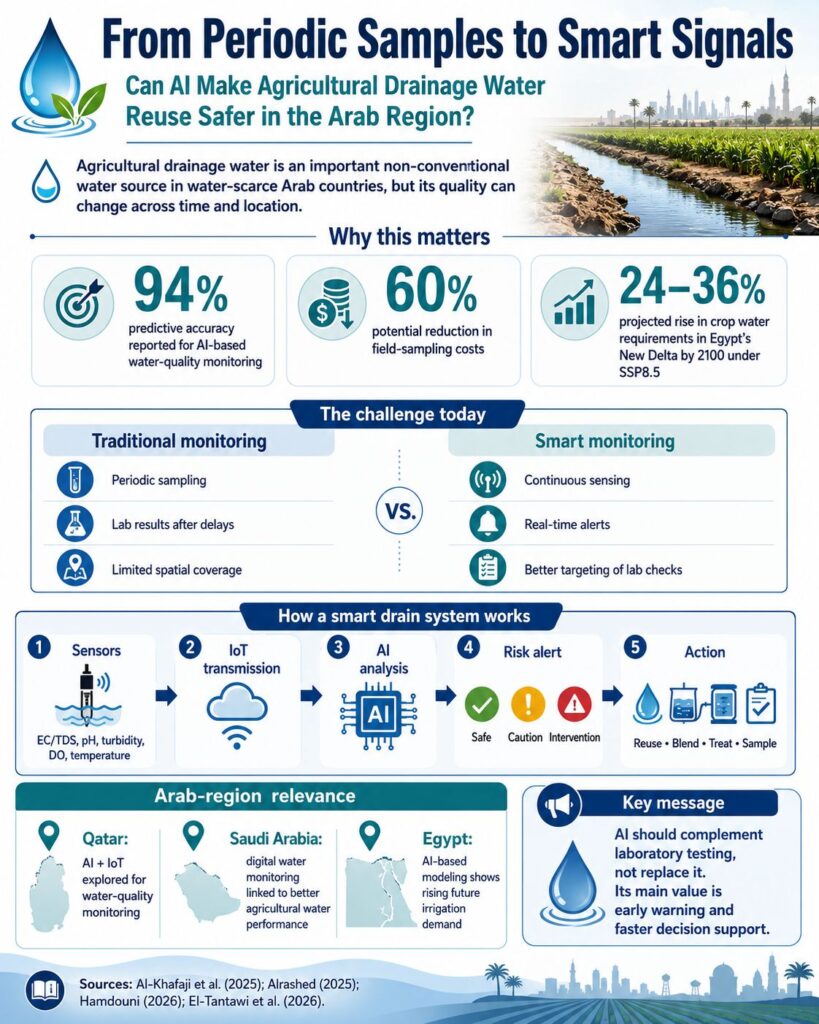
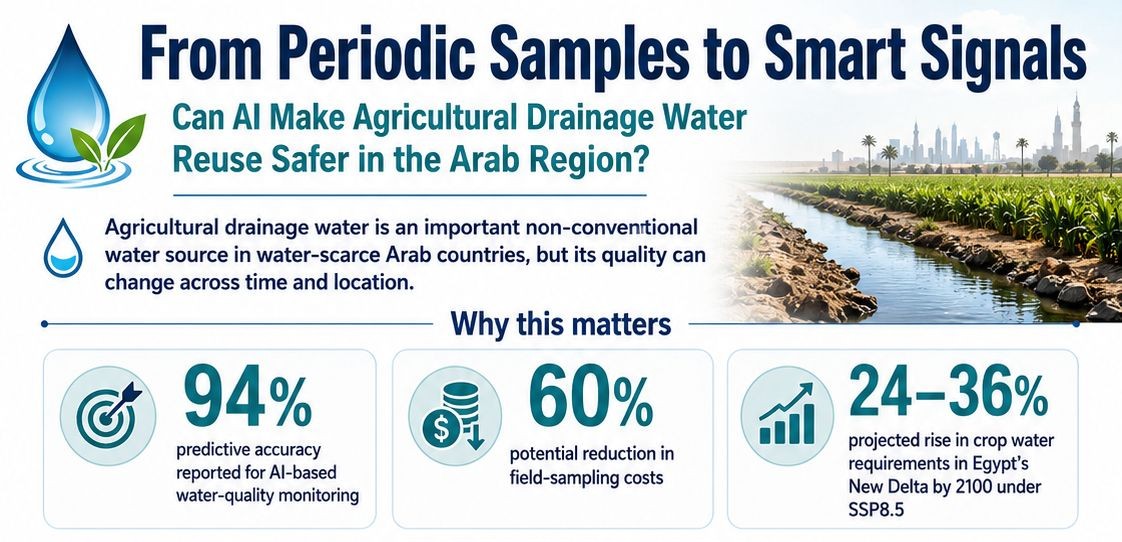
For water-scarce Arab countries, agricultural drainage water is increasingly more than a waste stream—it is a potential resource. Yet reuse depends on one critical question: is the water safe and suitable at the time it is needed? Conventional monitoring based on periodic sampling and laboratory analysis can leave significant gaps between measurements, while drainage-water quality may change spatially and over time.
Artificial intelligence, Internet of Things (IoT) sensors and remote sensing could help close this information gap. Sensors installed at strategic drainage points can continuously measure parameters such as electrical conductivity/TDS, pH, turbidity, dissolved oxygen and temperature, while AI models analyse incoming data, identify abnormal patterns and provide early warnings. A 2025 systematic review covering 1,032 studies reported that AI-based water-quality monitoring approaches achieved around 94% predictive accuracy and could reduce field-sampling costs by approximately 60%, demonstrating the potential for a shift from periodic assessment toward continuous intelligence (Al-Khafaji et al., 2025).
This transition is particularly relevant to the Arab region. In Saudi Arabia, a 2026 study covering 13 administrative regions and six major crops found digital water monitoring to be positively associated with water-use efficiency and agricultural productivity, reinforcing the role of monitoring as an enabling component of AI-supported water management (Hamdouni, 2026). In Egypt’s New Delta, AI-based modelling achieved R² values approaching 0.98, while projected crop-water requirements could rise by 24–36% under SSP8.5, further increasing the importance of safely managing alternative and reused water resources (El-Tantawi et al., 2026).
The opportunity is therefore not to replace laboratories, but to create a smart early-warning layer:
Sensors → Real-time Data → AI Analysis → Water-Quality Alert → Reuse, Blend, Treat or Sample
For Arab countries, the next frontier could be “smart drains” that continuously report their condition, enabling safer reuse and faster, evidence-based water-management decisions.
References
Al-Khafaji, M.S., Abdulameer, L., Al-Shammari, M.M.A., Al Maimuri, N.M.L., Dulaimi, A. and Al-Jumeily, D. (2025) ‘Revolutionizing Water Quality Monitoring with Artificial Intelligence: A Systematic Review’, Journal of Studies in Science and Engineering, 5(1), pp. 358–385. DOI: 10.53898/josse2025528. Article (EngiScience)
Hamdouni, A. (2026) ‘Artificial Intelligence-Driven Integrated Water Management and Agricultural Sustainability: Evidence from Saudi Arabia’, Resources, 15(3), 38. DOI: 10.3390/resources15030038. Article (MDPI)
El-Tantawi, A.M., Moursy, F.I., Almetwaly, W.M. and El-Mahdy, M.E. (2026) ‘AI-based assessment of climate change impacts on water requirements in Egypt’s New Delta’, Scientific African, 31, e03182. Article (ScienceDirect)