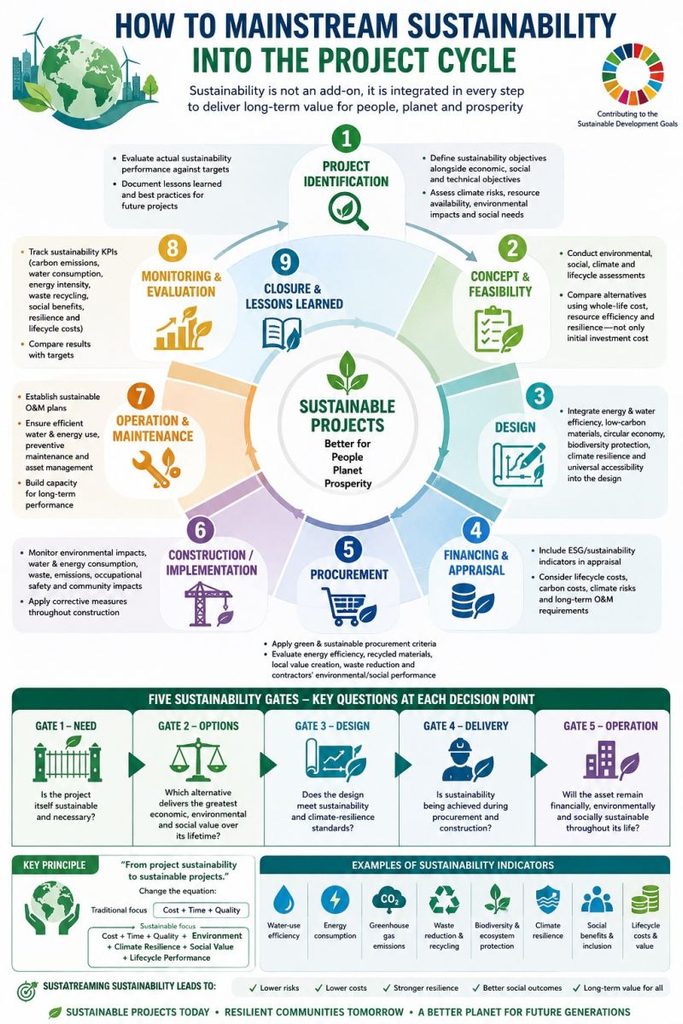
Sustainability should be embedded in every stage of the project cycle, from identification through operation and evaluation.
Mainstreaming sustainability throughout the project cycle
Project stage How to mainstream sustainability
- Project Identification Define sustainability objectives alongside economic, social and technical objectives. Assess climate risks, resource availability, environmental impacts and social needs.
2. Concept & Feasibility Conduct environmental, social, climate and lifecycle assessments. - Compare alternatives using whole-life cost, resource efficiency and resilience—not only initial investment cost.
- Design Integrate energy and water efficiency, low-carbon materials, circular economy principles, biodiversity protection, climate resilience and universal accessibility into the design criteria. Space optimization, luxury offices and redundant meeting rooms … etc. have impact on energy consumption and sustainability.
- Financing & Appraisal Include sustainability indicators in investment appraisal. Consider lifecycle costs, carbon costs, climate risks and long-term operation and maintenance requirements.
- Procurement Introduce green and sustainable procurement criteria, including energy efficiency, recycled materials, local value creation, waste reduction and contractors’ environmental/social performance.
- Construction / Implementation Monitor environmental impacts, water and energy consumption, waste, emissions, occupational safety and community impacts. Apply corrective measures throughout construction.
- Operation & Maintenance Establish sustainable O&M plans, including efficient water and energy use, preventive maintenance, asset management, monitoring and climate adaptation.
- Monitoring & Evaluation Track sustainability KPIs such as carbon emissions, water consumption, energy intensity, waste recycling, social benefits, resilience and lifecycle costs.
- Closure & Lessons Learned Evaluate actual sustainability performance against targets and document lessons for future projects.
A practical approach
I would recommend establishing five sustainability gates in the project cycle:
Gate 1 – Need: Is the project itself sustainable and necessary?
↓
Gate 2 – Options: Which alternative delivers the greatest economic, environmental and social value over its lifetime?
↓
Gate 3 – Design: Does the design meet sustainability and climate-resilience standards?
↓
Gate 4 – Delivery: Is sustainability being achieved during procurement and construction?
↓
Gate 5 – Operation: Will the asset remain financially, environmentally and socially sustainable throughout its life?
Key principle
“From project sustainability to sustainable projects.”
This means changing the project decision-making equation from:
Cost + Time + Quality
to: Cost + Time + Quality + Environment + Climate Resilience + Social Value + Lifecycle