
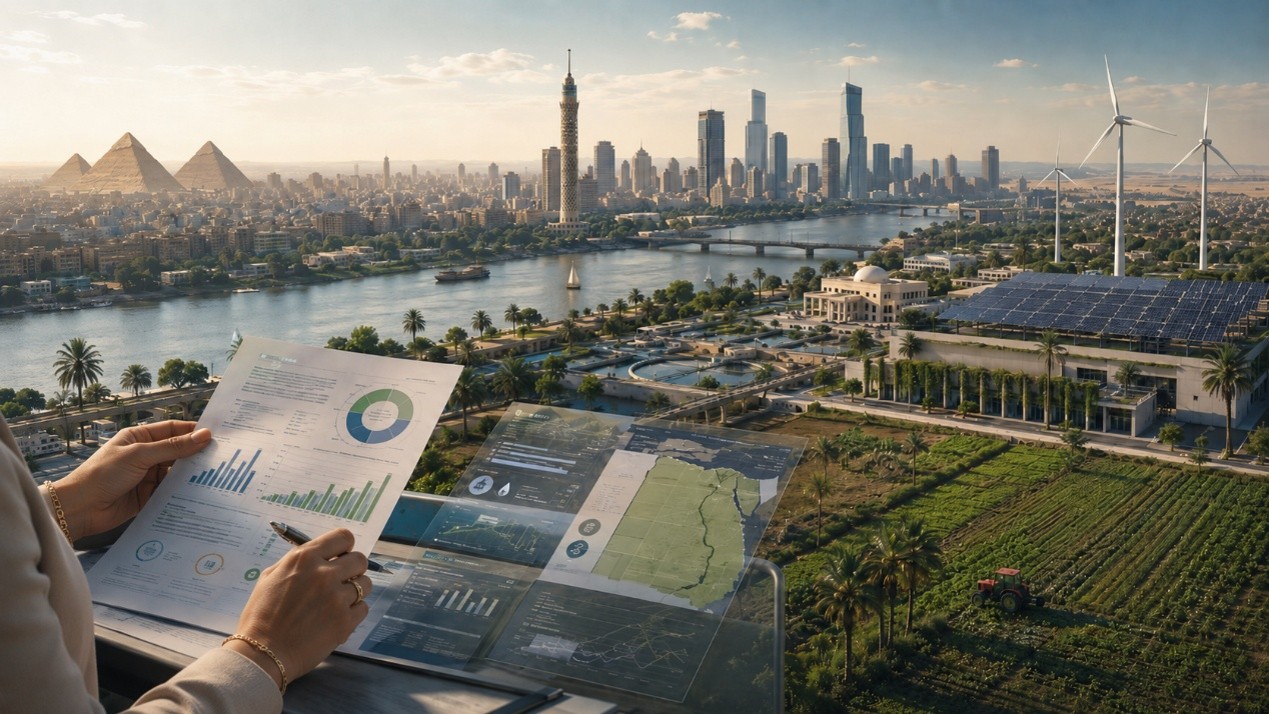
Egypt’s official completion of its Fourth National Communication on 8 June 2026, alongside preparations for its third Nationally Determined Contributions (NDC3), is not merely a technical climate-reporting exercise. It signals a broader shift in which climate commitments are increasingly becoming tools for sustainable development planning, investment attraction, economic resilience, institutional reform, green growth, sectoral transformation, and the advancement of Egypt Vision 2030 and long-term development priorities (Daily News Egypt, 2026). This is evidenced by:
- Climate reporting is becoming a governance tool, not just an international obligation. Egypt’s Fourth National Communication (June 2026) and first Biennial Transparency Report (September 2025) provide greenhouse gas inventories, mitigation opportunities, adaptation measures, technology-transfer priorities, and capacity-building needs (UNFCCC, 2026). This makes reporting a foundation for evidence-based decision-making across sectors, helping government institutions move from fragmented climate actions toward more integrated national planning.
- NDC3 links climate action with sustainable development.
According to the Ministry of Local Development and Environment, Egypt’s upcoming NDC3 will present updated targets and policies for emissions reduction, adaptation, and sustainable development (Daily News Egypt, 2026, UNDP, 2026). This reflects the reality that climate commitments are becoming national development instruments, not merely climate pledges. - Climate transparency can support green investment and resilience.
By strengthening climate data, reporting systems, and sectoral assessments, Egypt can improve investor confidence and better identify bankable green projects (UNFCCC2, 2026). This is especially important as developing countries face rising climate impacts while international finance remains uncertain.
Egypt’s Fourth National Communication therefore represents an opportunity to reposition climate policy as part of a wider development agenda. or Egypt and other Arab countries, climate reporting is increasingly becoming a strategic tool for planning, financing, and delivering sustainable development, rather than merely a reporting requirement for the UNFCCC. For Egypt’s climate commitments to become a bridge between international climate obligations and domestic economic transformation, Egypt’s NDC3 must be clearly linked to national budgets, sectoral investment pipelines, local adaptation priorities, private-sector engagement, and measurable development outcomes.