
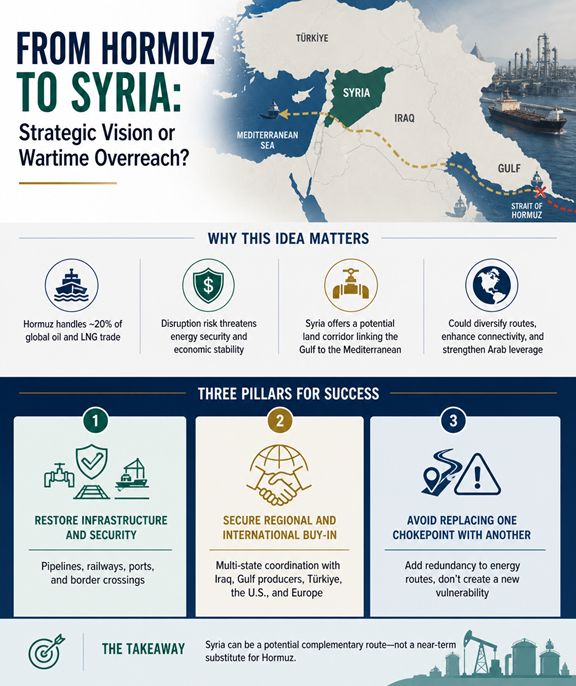
As the Middle East confronts the economic and geopolitical fallout of the Iran war and the closure of the Strait of Hormuz, Syria is seeking to rebrand itself as an alternative energy corridor to Hormuz for regional energy and trade flows (BBC, 2026). The Syrian interim president, Ahmad al-Sharaa, has promoted this vision through the “Four Seas” project and the “4+1” plan, presenting Syria as a potential land bridge linking the Gulf, Iraq, Türkiye, and the Mediterranean. Despite the strategic appeal of this vision, Syria’s transformation into a credible alternative to Hormuz remains highly uncertain. The proposed corridor depends not only on geography, but also on security stabilization, infrastructure rehabilitation, regional political coordination, and major external financing (AlMajalla, 2026). The success of Syria’s energy-corridor ambition is therefore contingent on three main pillars:
- Restoring infrastructure and security along proposed transit routes, including pipelines, railways, ports, and border crossings (BBC, 2026). Without reliable protection of infrastructure and predictable governance, Syria cannot become a trusted corridor for strategic energy flows.
- Securing regional and international buy-in, especially from Iraq, Gulf producers, Türkiye, the United States, and European energy buyers. The Four Seas concept depends on multi-state coordination, and Washington’s focus on turning Syria into an oil transit hub after the Hormuz disruption (Enab, 2026).
- Avoiding turning diversification of the corridor into a new vulnerability, as a Syria-based corridor would still pass through a politically fragile landscape. Therefore, its main value is not replacing Hormuz, but adding a backup route that reduces exposure to maritime disruption (IEA, 2026).
Syria’s corridor proposal highlights the need to rethink energy security beyond traditional maritime chokepoints. If implemented gradually, it could support regional connectivity, diversify export routes, and strengthen Arab leverage in global energy markets. However, if pursued prematurely, it risks becoming an overstated geopolitical project that exceeds Syria’s current institutional, financial, and security capacities. The practical priority for Arab states should therefore be to treat Syria as a potential complementary route, not a near-term substitute for Hormuz.