
The planet is currently running a thermal deficit it cannot afford to ignore. Think of the Earth not merely as a spinning globe, but as a complex thermal engine. For decades, anthropogenic greenhouse gas emissions have functioned as a form of planetary insulation, thickening the atmosphere and preventing heat from escaping back into space. The “State of the Global Climate 2025” report by the World Meteorological Organization (WMO) serves as a definitive audit of this crisis, revealing that the “energy bill” for our fossil-fuel reliance is no longer a future concern—unfortunately, it is an active, compounding debt.
While 2024 was defined by the scorched records of a strong El Niño, 2025 was expected to offer a reprieve as the system transitioned into a cooling La Niña phase. Yet, that fever did not break. This year’s data shows that the underlying warming trend is now powerful enough to overwhelm the Earth’s natural cooling cycles. From atmospheric carbon concentrations reaching 423.9 ± 0.2 ppm—a staggering 152% of pre-industrial levels—to a doubling of sea-level rise, the report highlights five realities that suggest we have moved past a period of “extremes” into a permanent state of climatic disruption.
The “Energy Imbalance”
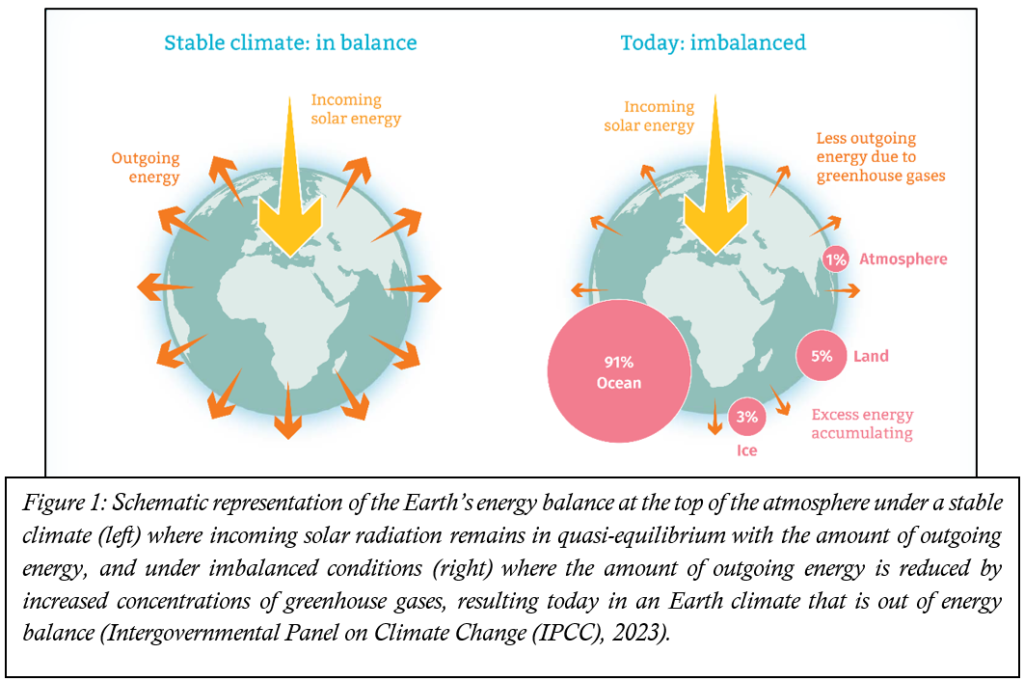
For the first time, the WMO has prioritized a critical new indicator: the Earth’s Energy Imbalance (EEI). This is the fundamental physics of the crisis—the difference between the solar energy the Earth receives and the amount it radiates back into space. Because we have effectively operated at a 52% carbon “overdraft” compared to the year 1750, our planet is gaining energy at an accelerating rate.
The data reveals a startling distribution of this “excess” energy. While the warming we feel in the atmosphere is what dominates headlines, it stands for only 1% of the trapped heat. The true “engine room” of global warming is the deep ocean, which has absorbed 91% of the surplus. Most concerning is the speed of this accumulation; the rate of the Earth’s energy imbalance surged to 0.30 ± 0.1 Watts per square metre per decade during the 2001–2025 period. Focusing solely on surface temperatures is like watching the steam rising from a pot while ignoring the boiling water inside; the real danger lies in the heat inventory building up beneath the waves, fuelling every other indicator in this report.
The 1.43°C Milestone: The Warmest “Cool” Year on Record
There is a dangerous paradox in the 2025 data. Statistically, the year was “cooler” than 2024 (which saw an anomaly of 1.55 °C ± 0.13 °C), yet it is still one of the most alarming years in meteorological history. The global mean near-surface temperature for 2025 was 1.43 °C ± 0.13 °C above the 1850–1900 average.
The significance of this figure lies in its context: 2025 is officially the warmest year on record without the heating boost of El Niño. We have reached a point where even our “cool” years—those influenced by the transition to La Niña conditions—are hotter than the record-breaking warm years of earlier decades. With the past eleven years (2015–2025) now ranking as the eleven warmest on record, we are witnessing an overwhelming of natural cycles. This is not just a streak of bad luck; it is a fundamental shift in the baseline of life on Earth.
The Surging Sea Levels and a Doubling of Pace
The ocean is not just getting hotter; it is physically expanding and rising at a pace that has nearly doubled in a single generation. Since January 1993, the global mean sea level has risen by a total of 11 cm. While that may sound gradual, the rate of change tells a more urgent story.
Between 1993 and 2011, the sea level rose at an average rate of 2.65 ± 0.3 mm/year. Between 2012 and 2025, that rate jumped to 4.75 ± 0.3 mm/year. This acceleration creates compounding risks for coastal society that extend far beyond simple flooding. The rising tides are driving groundwater salinization and threatening the integrity of critical infrastructure that was never designed for such a swift, relentless ascent.
The Expanding Map of Disease and Heat Stress
The 2025 report makes it clear: climate change is no longer just an “environmental issue”; it is a global public health emergency that is actively rewriting the geography of risk.
The Suitability for Disease Higher temperatures are expanding the “map of suitability” for infectious diseases. Warmer conditions accelerate mosquito development, making new regions vulnerable to viruses like Dengue. The WHO now estimates between one hundred million and four hundred million Dengue infections annually as transmission seasons lengthen in endemic areas.
Occupational Heat Stress Simultaneously, extreme heat is transforming the nature of labour. Roughly 1.2 billion workers—one-third of the global workforce—are now exposed to workplace heat stress, particularly in the construction and agriculture sectors. As the IPCC AR6 notes: “Vulnerable communities who have historically contributed the least to current climate change are disproportionately affected.”
Oceans’ Silent Struggle
While the warming of the atmosphere is visible in droughts and heatwaves, a silent chemical transformation is taking place in our waters. The ocean has functioned as a massive carbon sponge, absorbing approximately 29% of all human-caused CO2 emissions over the last decade.
This service comes at a heavy cost: the ocean’s surface pH is dropping at a rate of –0.017 ± 0.001 pH units per decade. The IPCC AR6 concludes that present-day surface pH values are now unprecedented for at least 26,000 years. This “acidification” makes it increasingly difficult for calcifying organisms—the corals, barnacles, and mussels that form the foundation of marine food webs—to build their shells. Perhaps most sobering is the timeline of this change: unlike atmospheric weather, which can shift relatively quickly, changes in deep-ocean pH are effectively irreversible on centennial to millennial timescales.
Conclusion
The 2025 Global Climate Report is not merely a collection of grim statistics; it is “authoritative information” designed to fuel “anticipatory action.” The data shows us exactly where the energy is going and who is being hit the hardest. We are no longer debating whether the climate is changing; we are now witnessing the physics of an energy budget that has been pushed into a complex state of imbalance. The data clearly indicates that the grace period has ended.
Now that we can read the planet’s vital signs with such agonizing precision, will we use that knowledge to prepare for the shocks ahead, or will we continue to treat the Earth’s energy bill as a debt that can be indefinitely deferred?