
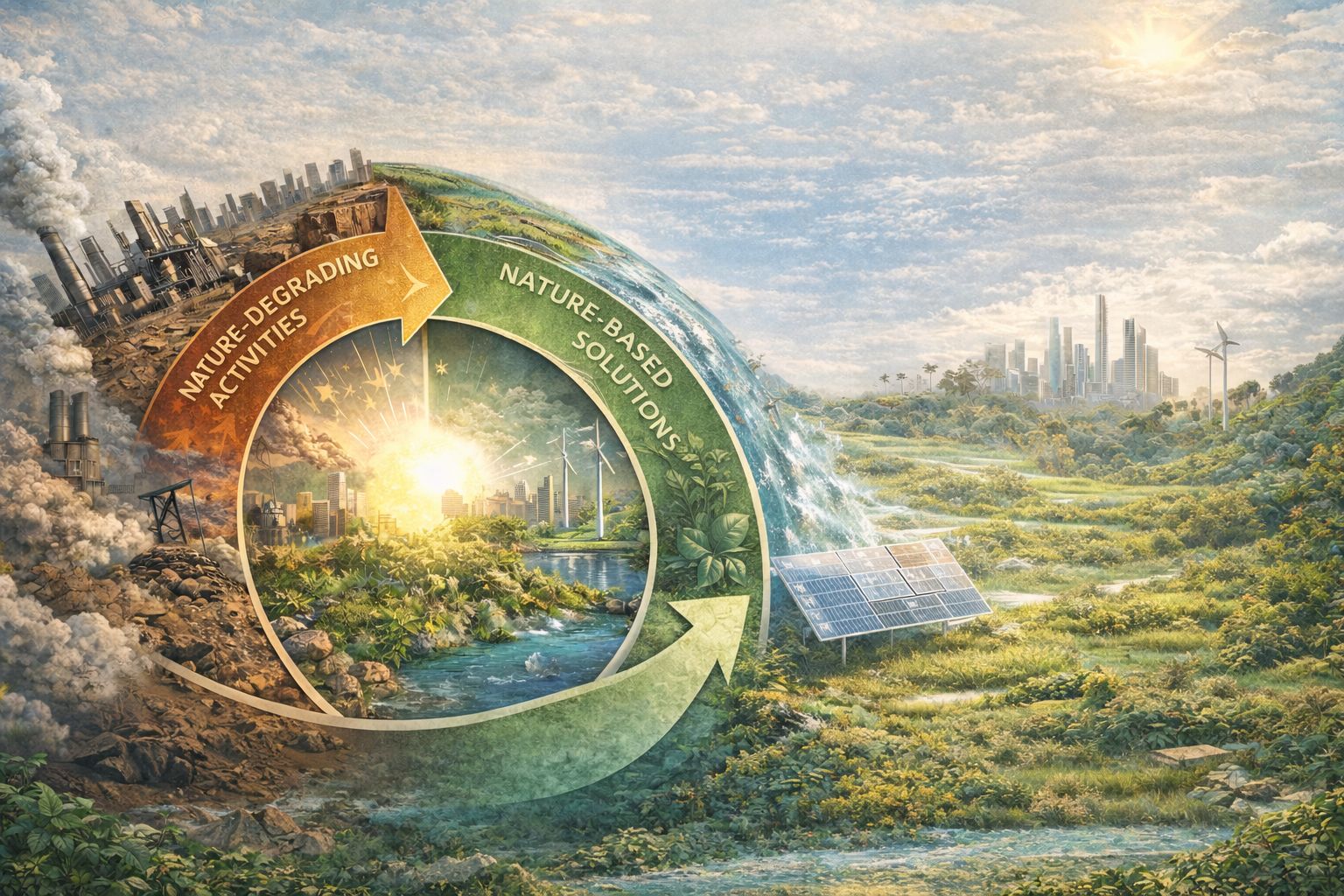
The 2026 edition of the United Nations Environment Programme’s (UNEP) State of Finance for Nature report delivers a stark warning: global finance flows directly harmful to nature reached USD 7.3 trillion in 2023, while investments in nature-based solutions (NbS) stood at just USD 220 billion—a ratio exceeding 30:1. While NbS have traditionally been associated with forestry and agriculture, there is a growing recognition that investable opportunities are expanding across all economic sectors—including construction, utilities, and extractives—as financial institutions and governments begin to move beyond that narrow focus towards a comprehensive valuation of natural infrastructure. To meet the Rio Conventions’ 2030 targets, the report calls for a ‘Big Nature Turnaround’, where investment in NbS must more than double to USD 571 billion annually, while destructive finance flows must be urgently repurposed. This urgency was reinforced by the Intergovernmental Science-Policy Platform on Biodiversity and Ecosystem Services (IPBES) Methodological assessment of the impact and dependency of business on biodiversity and nature’s contributions to people, commonly known as the ‘business and biodiversity assessment’ which found that biodiversity loss now constitutes a critical systemic risk threatening the stability of the global economy and financial system, with businesses both driving and being exposed to this risk.
Official Development Finance (ODF) remains a critical—but increasingly fragile—lifeline for scaling NbS across the Arab region. In 2023, ODF targeting NbS globally reached USD 6.8 billion, a 22 per cent increase from 2022, but the State of Finance for Nature report warns that ODF budgets are under heavy pressure due to the geopolitical situation, which will likely constrain future flows to developing countries, including many Arab states. Given that ODF often supports foundational investments in water security, land restoration, and coastal protection—areas where Arab countries face acute risks—any contraction in this funding would severely undermine the region’s ability to meet Rio Convention targets, particularly on land degradation neutrality and biodiversity conservation. The IPBES assessment underscored that current external conditions, including inadequate incentives, perpetuate business-as-usual and prevent the transformative change needed to halt biodiversity loss, making the effective use of scarce ODF resources even more critical.
Strategically, the UNEP report’s “Nature Transition X-Curve” offers a practical framework for Arab decision-makers. It calls for phasing out finance for nature-degrading activities while phasing in NbS through green budgeting, debt-for-nature swaps, and blended finance instruments. Notably, over 43 per cent of ODF targeting NbS globally in 2023 delivered against all three Rio Conventions simultaneously, highlighting opportunities for integrated climate-biodiversity-land degradation action. For Arab countries, prioritizing protection (the most cost-effective NbS) alongside restoration of wetlands, rangelands, and coastal ecosystems can yield high returns. However, without diversifying funding sources beyond strained ODF and making deliberate, proactive investments in natural infrastructure, the Arab region’s path to water, food, and economic security will remain dangerously fragile. To bridge this gap, governments must lead by scaling public investment in NbS, prioritizing those that provide essential public goods like watershed protection and climate resilience. Furthermore, the implementation of effective regulation and fiscal incentives is necessary to align national economic activity with the true value of ecosystem services. As the IPBES assessment emphasized, creating an enabling environment requires coordinated, whole-of-government action to reform policies that encourage harmful activities and to develop standardized disclosure frameworks that allow financial institutions to redirect capital away from businesses with negative impacts and toward those contributing to conservation and sustainable use. By expanding blended finance and de-risking instruments, alongside the development of high-integrity nature markets, Arab nations can successfully mobilize private capital at scale, ensuring a transition that is both economically robust and ecologically sustainable.