
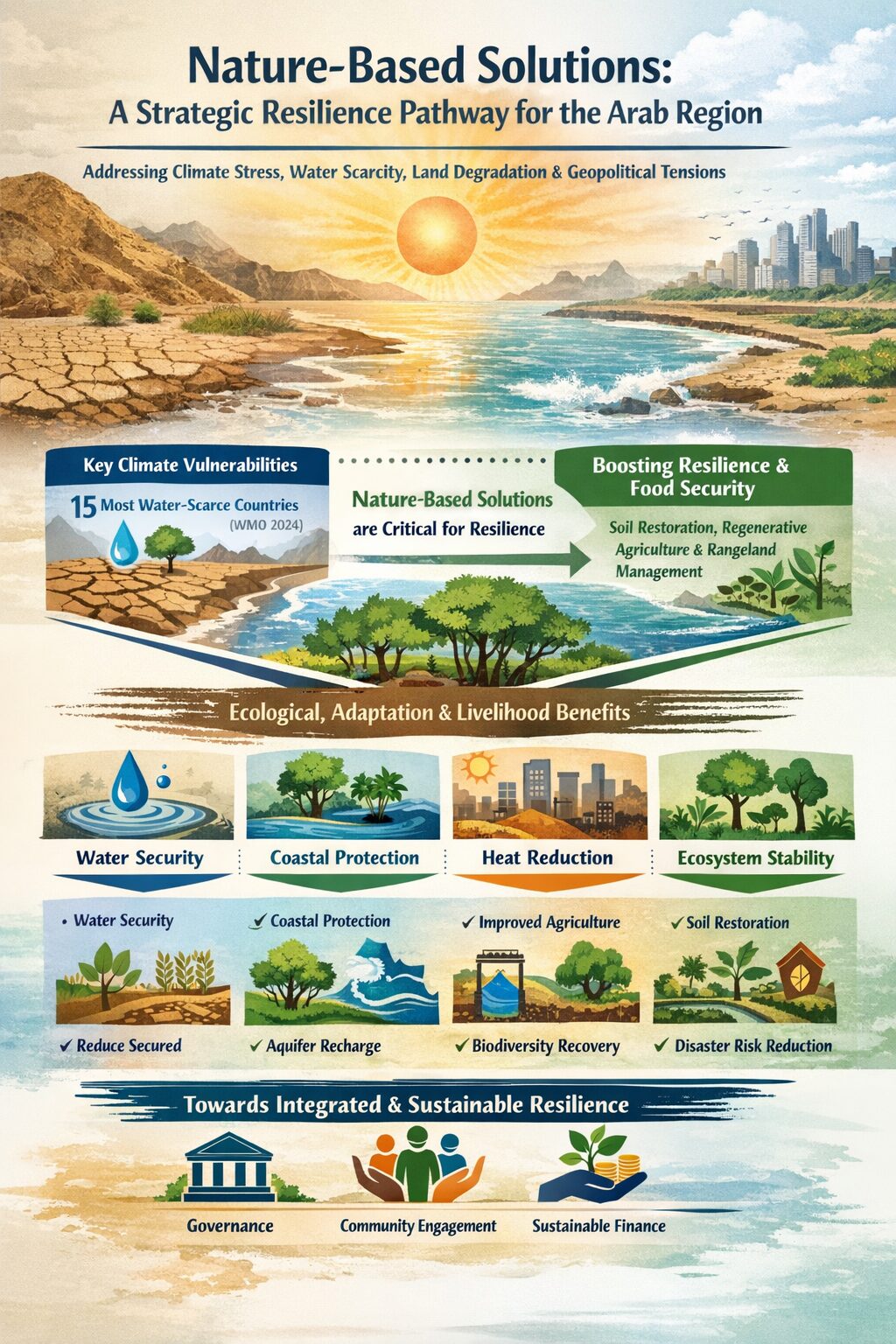
The Arab region, the arena of the Iran war, is entering a period of intensifying climate stress marked by worsening water scarcity, land degradation, extreme heat, coastal risks, and growing pressure on food and urban systems. This is further exacerbated by growing geopolitical and socio-economic stresses. In this context, Nature-Based Solutions are critically important for climate resilience in the Arab region because they are not merely environmental interventions, but a practical and strategic approach that addresses the ecological root causes of vulnerability and food security while strengthening adaptation, livelihoods, and long-term socio-economic stability. This is evidenced by:
- NbS directly respond to the region’s most pressing climate vulnerabilities. The WMO’s State of the Climate in the Arab Region 2024 describes it as a climate-vulnerable region that includes 15 of the world’s most water-scarce countries (WMO, 2025). NbS such as watershed restoration, wetland conservation, mangrove rehabilitation, dune stabilization, and urban green infrastructure help regulate water flows, reduce drought and flood risks, protect coasts, lower urban heat, and improve ecosystem stability under climate extremes.
- NbS generate multiple resilience co-benefits across sectors. Beyond climate adaptation, NbS improves food security through soil restoration, regenerative agriculture, agroforestry, and rangeland management; strengthen water security through aquifer recharge and natural filtration; support biodiversity recovery; and reduce economic losses by lowering disaster risk and infrastructure costs (UNECE, 2025).
- The Arab region has strong foundations for scaling NbS. There is growing policy momentum through national visions such as Saudi Vision 2030, UAE Net Zero 2050, Egypt Vision 2030, and Morocco’s Green Generation strategy, alongside rich traditional ecological knowledge such as aflaj irrigation, hima governance, terrace farming, and oasis systems. These assets give the region both political entry points and culturally grounded models for implementation (ESCWA, 2025).
In conclusion, the importance of NbS in the Arab region lies in their ability to transform climate resilience from a narrow adaptation agenda into a broader model of ecological and food security, social stability, sustainable development and bankable projects. Arab countries should move beyond pilot projects and systematically embed NbS into climate, water, agriculture, biodiversity, and urban planning frameworks, supported by stronger governance, community stewardship, and sustainable financing.