
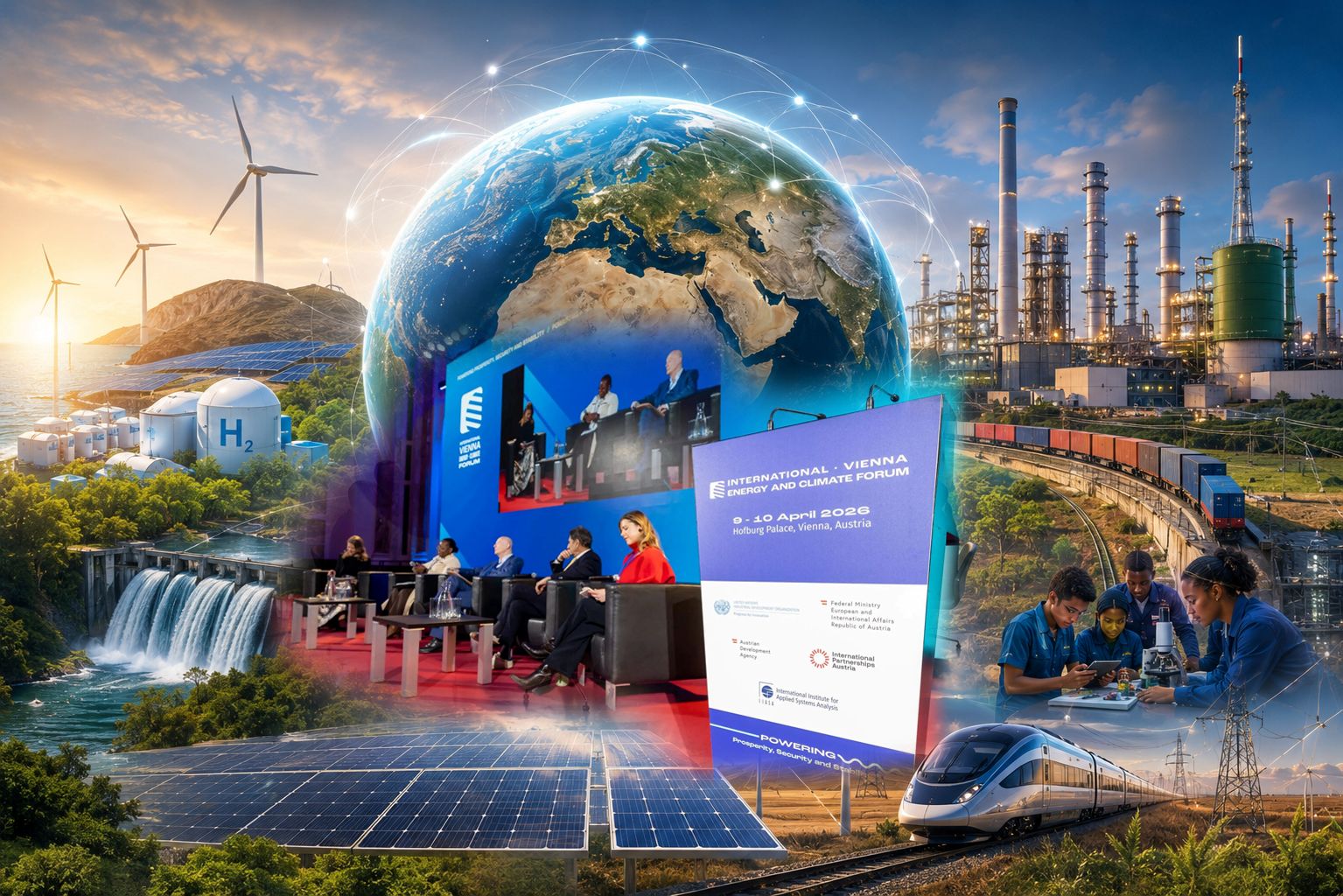
The International Vienna Energy and Climate Forum (IVECF 2026), held on 9–10 April in Vienna, Austria, convened under the theme “Powering Prosperity, Security and Stability.” The Forum marked a decisive shift in how the energy transition is framed: not simply a climate agenda, but a broader development and security imperative. Against a backdrop of rising great-power competition, participants stressed that energy security can no longer be taken for granted and that dependence on volatile fossil fuel markets has become a strategic vulnerability. Co-organized by the United Nations Industrial Development Organization (UNIDO), the Austrian Government, Austrian Development Agency (ADA), and the International Institute for Applied Systems Analysis (IIASA), the gathering brought together policymakers, financial institutions, private sector actors, and youth representatives. A central message emerged that green industrialization must create local value, rather than reinforce existing patterns of dependency, particularly for least developed countries (LDCs), landlocked developing countries (LLDCs), and small island developing States (SIDS).
For developing countries, the Forum identified persistent financial barriers as the most critical challenge. Concessional finance, while essential, remains insufficient on its own. High capital costs, risk perceptions, and fragmented access to funding continue to prevent many bankable projects from reaching implementation. Several speakers noted that external debt levels in LDCs and LLDCs are rising, while official development assistance and foreign direct investment decline. With geopolitical fragmentation weakening traditional multilateral coordination and prompting a turn towards transactional power politics, developing countries face heightened risks of being squeezed between competing blocs or left without adequate support. However, significant opportunities also emerged. Countries rich in critical minerals were urged to move beyond raw material supply and toward local value creation, job generation, and industrial development. Regional economic corridors (e.g., Lobito Corridor, West Africa Clean Energy Corridor) and initiatives like the Global Programme on Climate Resilient Renewable Energy Systems in SIDS (G-RES) were highlighted as practical mechanisms to achieve scale, attract investment, and strengthen economic sovereignty.
For Arab countries, we can glean three strategic insights beyond the climate lens. First, energy connectivity and regional integration emerged as critical levers for stability. The Caspian Green Energy Corridor and Central Asia–South Asia electricity trade projects demonstrate that cross-border energy infrastructure can underpin industrial ecosystems; a model applicable to Arab energy hubs seeking to diversify economies beyond hydrocarbons. Second, the emphasis on green hydrogen and industrial decarbonization presents an opportunity for resource-rich Arab states to position themselves as both suppliers and processors in emerging value chains, avoiding the extractive dependency trap. Third, the repeated call for depoliticizing energy and strengthening multilateral platforms, including South–South and regional partnerships, suggests that Arab countries can benefit from anchoring energy strategies in neutral, rule-based cooperation frameworks. As geopolitical tensions reshape global energy markets, those Arab economies that invest in regional value chains, transparent standards, and inclusive youth and workforce development will be best positioned to turn the energy transition into durable economic transformation.