Executive Summary
This report highlights recent developments in biodiversity conservation across the Arab region during April 2026. Key updates include ecosystem revival in Saudi Arabia’s Northern Borders, and the regional collaboration through Sharjah’s biodiversity forum. A special highlight on Egypt case in the Arab Region SDG Index and Dashboards 2026 is also provided.
1. Ecosystem Revival in Saudi Arabia’s Northern Borders
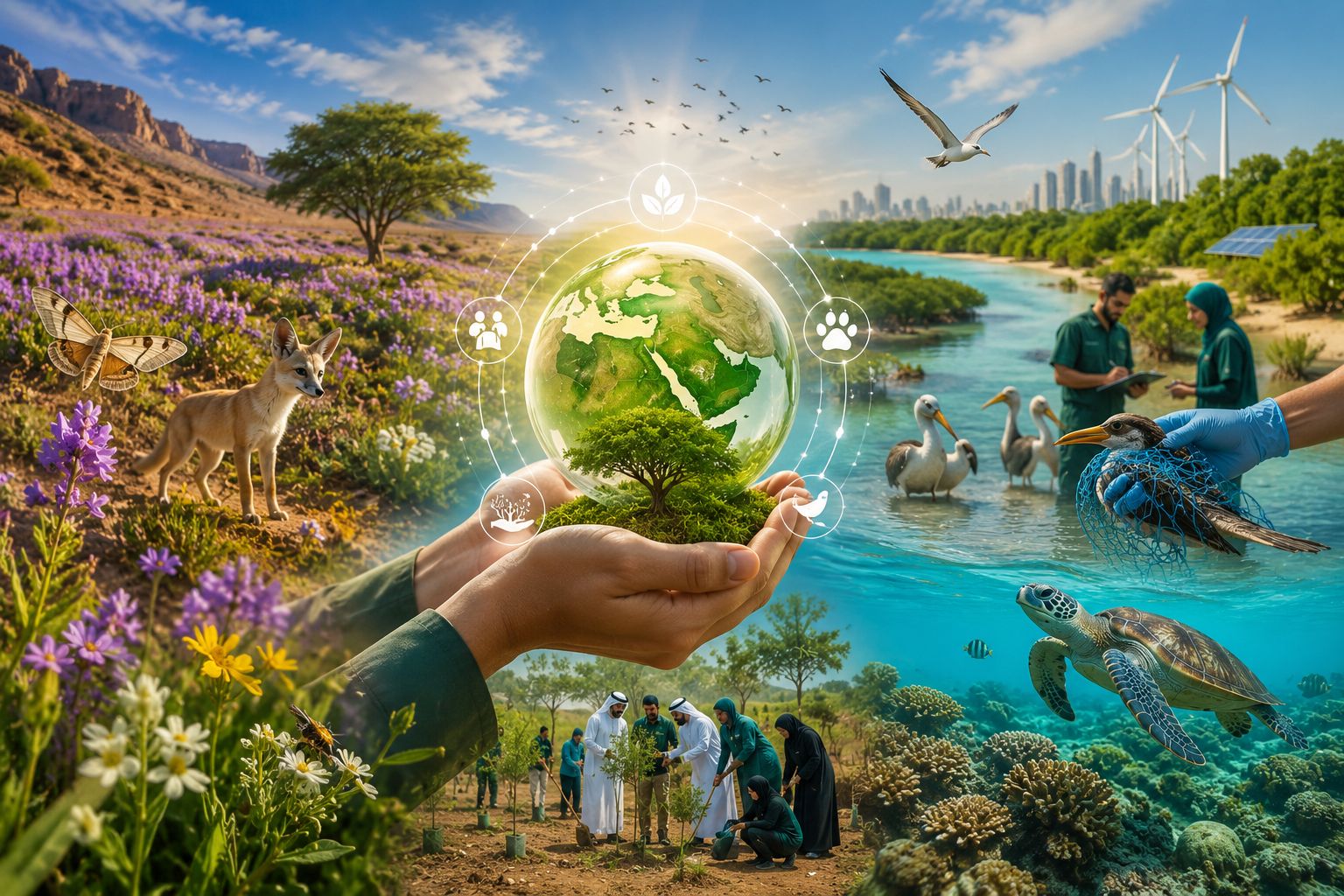
Saudi Arabia’s Northern Borders region (Arar/Rafha) is experiencing a striking ecological revival, with desert landscapes blooming after seasonal rains. The presence of wildflowers, moths, hoverflies, and the native plant Teucrium oliverianum signals improved soil health and resilience of desert ecosystems.
1.1. Ecological Transformation in Arar and Rafha
- Seasonal rains in early 2026 triggered a dramatic shift in the desert environment, turning previously arid plains into vibrant fields of wildflowers.
- The revival is particularly visible in Arar and Rafha, where dormant seeds and plant species have flourished, creating colorful landscapes that attract pollinators and wildlife.
- This transformation highlights the adaptive capacity of desert ecosystems, which can rebound quickly when water availability improves.
1.2. Biodiversity Indicators
- Wildflowers: Their sudden bloom provides food sources for insects and small animals, strengthening ecological networks.
- Pollinators: Moths and hoverflies have reappeared in large numbers, playing a crucial role in sustaining plant reproduction.
- Teucrium oliverianum: Identified as a biodiversity marker, this native plant is particularly significant. Its presence indicates healthy soil conditions and resilience against desertification.
1.3. Environmental Significance
- Soil Health: The growth of resilient species like Teucrium oliverianum suggests that soil fertility is improving, likely due to enhanced organic matter and moisture retention.
- Resilience: The revival demonstrates the desert’s ability to recover from prolonged aridity, underscoring the importance of rainfall in maintaining ecological balance.
- Pasture Renewal: Local communities benefit as natural pastures regenerate, supporting livestock and reducing reliance on imported feed.
1.4. Broader Implications
- Ecotourism Potential: Valleys such as Wadi Arar and Wadi Badna are becoming ecological attractions, drawing visitors to witness seasonal blooms and wildlife.
- Climate Adaptation: These events highlight how desert ecosystems can serve as natural laboratories for studying climate resilience and biodiversity conservation.
- Policy Impact: Saudi Arabia’s environmental initiatives, including afforestation and water conservation, align with these natural revivals, reinforcing national goals for sustainability.
This revival is not just a seasonal spectacle, it is a critical indicator of long-term ecological recovery in Saudi Arabia’s desert regions, offering lessons in sustainability and resilience for arid landscapes worldwide.
2. Sharjah International Forum for Arabian Biodiversity (SICFAB 2026)
The Sharjah International Forum for Arabian Biodiversity (SICFAB 2026), held at Sharjah Safari in the UAE, brought together 180 experts, researchers, and veterinarians to address pressing issues in regional biodiversity and wildlife health. This gathering underscores the UAE’s growing role as a hub for conservation dialogue and practical action in the Arabian Peninsula.
2.1. Focus on Seabird Rescue and Rehabilitation
One of the central themes of the forum was seabird rescue and rehabilitation. Seabirds in the Arabian Gulf face numerous threats, including oil spills, plastic pollution, and habitat loss. By sharing best practices in rescue operations, veterinary care, and rehabilitation techniques, participants emphasized the importance of building specialized facilities and training programs. These efforts not only safeguard vulnerable seabird populations but also strengthen ecological monitoring along coastal ecosystems.
2.2. Addressing Invasive Species Threats
Another major focus was the management of invasive species, which pose significant risks to native flora and fauna. Invasive plants and animals often disrupt fragile desert and coastal ecosystems, outcompeting native species and altering food chains. Experts at SICFAB 2026 discussed strategies such as early detection systems, public awareness campaigns, and coordinated eradication programs. By tackling invasive species collaboratively, the region aims to preserve its unique biodiversity and prevent ecological imbalance.
2.3. Regional Collaboration and Impact
The forum’s impact lies in its ability to strengthen regional collaboration. With participants from across the Arabian Peninsula, SICFAB 2026 fostered networks for joint research, policy development, and wildlife health initiatives. This collective approach ensures that conservation efforts are not isolated but instead integrated across borders, enhancing resilience against shared environmental challenges.
Moreover, the forum highlighted the role of Sharjah Safari as a living laboratory for conservation, where practical experiences in wildlife management can be shared and scaled across the region.
This event demonstrates how knowledge exchange and regional cooperation are vital for protecting biodiversity in the Arabian Peninsula. By addressing seabird conservation and invasive species threats, SICFAB 2026 contributes to a more sustainable and resilient ecological future for the region.
3. Integration with Sustainable Development Goals (SDGs)-Egypt Case[1].
The Arab Region SDG Index 2026 highlights progress in aligning biodiversity conservation with broader sustainability goals. Countries are increasingly linking conservation efforts to climate adaptation, food security, and community development, ensuring that biodiversity protection supports human well-being. Egypt case is summarized in the few subsections below:
Egypt’s performance in the Arab SDG Index 2026 is comparatively strong, placing it among the seven Arab countries that exceeded the two‑thirds threshold for overall SDG achievement. While Egypt shows progress in areas such as education, health outcomes, and infrastructure, it continues to face significant challenges in gender equality, climate resilience, and biodiversity conservation.
3.1. Egypt’s Overall Standing
- Score: Egypt is one of the seven Arab countries (alongside Algeria, Jordan, Morocco, Oman, Tunisia, and UAE) that surpassed the two‑thirds SDG score threshold, reflecting relatively stronger performance compared to the regional average of 60.6.
- Regional Context: Egypt belongs to the North Africa subregion, which recorded the highest average SDG score (~68). Within this group, Morocco leads, while Libya lags behind. Egypt’s score places it in the upper tier of Arab performers.
3.2. Areas of Progress
- Education (SDG 4 & SDG 5): Egypt has made measurable advances in female education, with improved ratios of female-to-male mean years of schooling. This contributes to narrowing gender gaps in educational attainment.
- Health Outcomes (SDG 3): Egypt scores relatively well on under‑5 mortality, neonatal mortality, and maternal mortality, showing green or positive trends. These improvements highlight progress in basic health services.
- Infrastructure (SDG 6 & SDG 9): Access to basic drinking water and sanitation services is strong, with positive trends. Egypt also shows progress in digital connectivity, with rising internet usage and mobile broadband subscriptions.
3.3. Persistent Challenges
- Gender Equality (SDG 5): Egypt, like all Arab countries, scores red on gender equality. Women’s economic participation and political representation remain limited, with stagnating trends.
- Climate and Environment (SDG 13, SDG 14, SDG 15): Egypt faces major challenges in climate action, biodiversity conservation, and ecosystem protection. Scores remain red for protecting marine, freshwater, and terrestrial biodiversity sites.
- Economic Diversification (SDG 8): Egypt continues to struggle with youth unemployment and limited economic diversification. Reliance on a narrow set of sectors constrains resilience and inclusive growth.
- Water Stress (SDG 6): As one of the most water‑stressed countries in the region, Egypt faces severe challenges in freshwater withdrawal and sustainable water management.
In conclusion:
- Strengths: Education, health outcomes, infrastructure, and overall SDG score above regional average.
- Weaknesses: Gender equality, biodiversity conservation, climate resilience, water stress, and economic diversification.
- Outlook: Egypt’s relatively strong position in the Arab SDG Index reflects progress in social and infrastructure indicators, but addressing environmental sustainability and gender equality will be critical for achieving the 2030 Agenda.
4. Challenges and Opportunities for Biodiversity in the Arabian Peninsula
The Arabian Peninsula faces a complex interplay of environmental challenges and emerging opportunities in biodiversity conservation. While climate pressures and resource limitations pose significant risks, innovative approaches and regional collaboration offer pathways toward resilience and ecological revival.
4.1. Challenges
Climate Change and Desertification Climate change is intensifying desertification across Saudi Arabia and neighboring states. Rising temperatures, reduced rainfall, and more frequent droughts accelerate soil degradation, making it harder for native plants to survive. This not only reduces vegetation cover but also undermines the ecological balance that supports pollinators, birds, and grazing animals. Desertification threatens both biodiversity and the livelihoods of rural communities dependent on natural pastures.
Invasive Species Threats Invasive species represent another pressing challenge. Non-native plants and animals often outcompete indigenous species, disrupt food chains, and alter fragile desert and coastal ecosystems. For example, invasive grasses can spread rapidly, consuming scarce water resources and crowding out native flora. Without coordinated monitoring and eradication programs, these species could undermine decades of conservation progress.
Limited Funding for Long-Term Monitoring Sustained biodiversity monitoring requires significant investment in technology, personnel, and infrastructure. However, funding constraints often limit the scope of long-term ecological studies in Saudi Arabia and the wider region. This gap hinders the ability to track species populations, detect early signs of ecosystem stress, and evaluate the effectiveness of conservation initiatives.
4.2. Opportunities
Community-Based Conservation in Rural Saudi Arabia Local communities in rural areas are increasingly recognized as vital partners in conservation. By involving pastoralists, farmers, and youth groups in biodiversity initiatives, Saudi Arabia can foster stewardship of natural resources. Community-based programs not only enhance ecological resilience but also provide economic incentives through eco-tourism and sustainable grazing practices.
Expanding Regional Forums Events such as the Sharjah International Forum for Arabian Biodiversity (SICFAB 2026) demonstrate the value of regional collaboration. Expanding these forums to include more Arab states would strengthen knowledge exchange, harmonize policies, and create unified strategies against shared threats like invasive species and climate change. A broader coalition could amplify conservation outcomes across the Arabian Peninsula.
Integrating AI and Remote Sensing Emerging technologies offer powerful tools for biodiversity monitoring. Artificial intelligence (AI) and remote sensing can analyze satellite imagery, detect vegetation changes, and track wildlife movements with unprecedented accuracy. These innovations reduce costs, improve data reliability, and enable early interventions against ecological threats. By adopting AI-driven monitoring systems, Saudi Arabia can overcome funding limitations and enhance its conservation capacity.
5. Conclusion
The Arab region is witnessing both natural ecosystem recovery and proactive conservation initiatives. Continued collaboration, technological integration, and youth engagement will be essential to safeguard biodiversity and ensure ecological resilience in the face of global environmental challenges.
[1] Zakzak, L., Qiblawi, Z., Luomi, M., Subramani, K., Fuller, G., Salem, F. and Lafortune G. (2026). Arab Region SDG Index and Dashboards 2026: Financing Sustainable Development in the Arab Region. Dubai and Paris: Mohammed bin Rashid School of Government (MBRSG) and Sustainable Development Solutions Network (SDSN)