
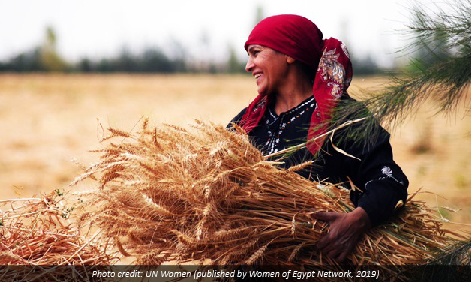
Women play a foundational role in agricultural systems across many regions; however, their contributions remain persistently undervalued and insufficiently supported within institutional frameworks, policies, and resource allocation mechanisms. In parts of North Africa and the Middle East, women now account for a significant and growing portion of the agricultural labor force, often exceeding 40–50%, yet they continue to face persistent structural barriers in land ownership, access to credit, extension services, and market participation (FAO, 2023; World Bank, 2024). These disparities translate into measurable economic and climate vulnerabilities. Recent analysis shows that female-headed rural households experience income losses of 8% higher due to heat stress and 3% higher due to flooding each year than male-headed households (FAO, 2024). While these differences may appear marginal in aggregate statistics, within smallholder and fragmented farming systems, they are economically decisive, often determining whether households maintain resilience or fall into deeper poverty.
This gap makes clear that what is often dismissed as “invisible labour” constitutes a tangible economic vulnerability and structural inefficiency. According to the World Bank, gender gaps in access to productive assets, inputs, and services significantly constrain agricultural productivity, with closing these gaps potentially increasing farm yields by 20–30%, while simultaneously improving food security and rural incomes (World Bank, 2011; World Bank, 2024). Despite their critical role in production systems, women remain disproportionately excluded from formal financial systems, agricultural advisory services, and decision-making structures, limiting both productivity gains and adaptive capacity under climate stress.
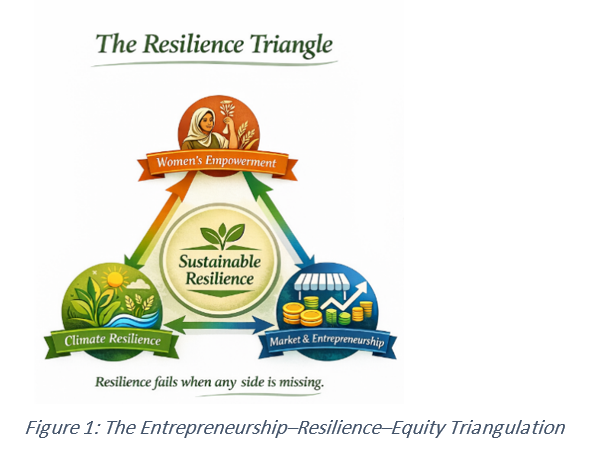
Shifting from invisible labour to investable impact, therefore, requires more than compensatory support; it demands integrated approaches that link women’s empowerment, climate resilience, and entrepreneurship. This triangulation framework positions women not merely as beneficiaries of development but as co-designers of climate-smart agriculture, inclusive value chains, and resilient livelihoods.
To this end, the international policy agenda has increasingly recognized this shift. In 2026, the International Year of the Woman Farmer was launched at a high-level conference in Rome convened by the Food and Agriculture Organization (FAO), the International Fund for Agricultural Development (IFAD), and partners, emphasizing that women’s empowerment, climate resilience, and market engagement are interdependent pillars of sustainable food systems.
The evidence is clear. Women’s limited access to productive assets, decision-making power, and income control constrains the adoption of climate-smart practices and limits participation in value chains (FAO, 2023). Transforming invisible labour into investable impact requires structural change. It demands integrated systems that connect gender equity, climate resilience, and entrepreneurship within functioning rural markets. Without addressing these dimensions simultaneously, productivity gains remain fragile, adaptation remains partial, and women remain excluded from higher-value economic opportunities. “Scaling deep” this three-pillared framework in climate adaptation strategies, plans, and implementation projects (e.g., the Murunah+ project) is therefore essential to an effective and sustainable adaptation to climate change on the ground.
From Theory to Practice: What Al-Murunah+ Demonstrates
Al-Murunah is a UK-funded project implemented by CEDARE in partnership with the International Water Management Institute (IWMI) and the International Union for Conservation of Nature (IUCN). Operating across Egypt, Jordan, Lebanon, and Palestine, the project demonstrates how an integrated, triangulated approach can be applied on the ground. While initially focused on promoting Nature-Based Solutions (NbS) to strengthen water and agricultural resilience, the project expanded through Al-Murunah+ to explicitly integrate gender-transformative approaches alongside climate resilience and market-oriented interventions.
A central principle of Al-Murunah+ is “scaling deep.” Rather than focusing exclusively on geographic expansion, “scaling out” or policy mainstreaming “scaling up”, scaling deep seeks to transform social norms, intra-household bargaining dynamics, and community-level power structures that ultimately determine whether climate and market interventions endure.
Al-Murunah+ is structured around three interdependent pillars that translate gender equality into measurable economic and climate outcomes (Figure 1). First, it strengthens shared financial decision-making within households, ensuring women participate meaningfully in budgeting, investment, and risk management. Second, it expands women’s access to credit, productive assets, and Nature-Based Solutions (NbS)-aligned enterprises, enabling climate-resilient entrepreneurship and structured market participation. Third, it promotes community-level transformation of socio-cultural norms by engaging local leaders on gender roles and inclusive decision-making, creating an enabling environment where women’s economic leadership is socially recognized and sustained. Together, these pillars integrate empowerment, resilience, and market access into a cohesive model for durable rural transformation. The interaction effect of these three dimensions produces outcomes greater than the sum of individual interventions. Women are not merely recipients of support; they become entrepreneurs operating within climate-resilient value chains and supported by enabling household and community systems.
Furthermore, a key innovation of Murunah+ is the deliberate targeting of couples rather than individuals. By engaging both men and women in structured dialogue sessions and joint economic planning exercises, the project addresses gender dynamics directly within households. This methodology reduces the risk of backlash, strengthens shared financial governance, and fosters co-ownership of climate-smart investments. Women’s economic engagement is thus legitimized within the household, while men are positioned as partners in sustaining adaptive and market-oriented strategies. These impacts are evident in Murunah+ key milestones that include:
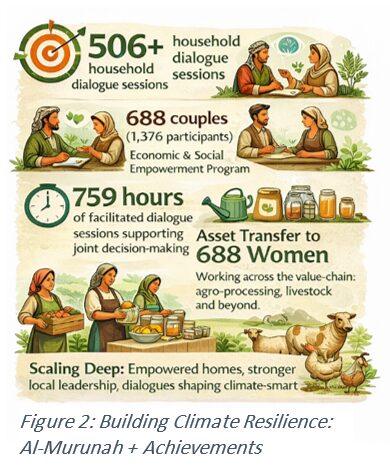
- 506+ household dialogue sessions, enabling couples to make joint decisions on financial management, planning, and economic pressures
- 688 couples enrolled in the Economic and Social Empowerment Program
- 600+ Women received asset transfers across localized value chains, encompassing climate-smart agro-processing, resilient livestock rearing, and agricultural machinery.
- 759 hours of facilitated dialogue supporting shared decision-making
- Women are increasingly speaking publicly in village meetings and committees, stepping into visible leadership roles.
These outputs demonstrate early shifts in agency, voice, participation, and transformation of household power dynamics. Women are increasingly co-leading household economic decisions, participating in village-level committees, and shaping climate-resilient production strategies and entrepreneurship.
Entrepreneurship in this context functions as a resilience multiplier. Climate-smart enterprises diversify household income, reduce vulnerability to environmental shocks, and strengthen adaptive capacity. Simultaneously, income autonomy enhances women’s decision-making power, reinforcing empowerment in a virtuous cycle.
In conclusion, transforming women from invisible laborers into recognized economic actors is not a symbolic goal, it is a structural necessity for resilient agrifood systems. Evidence shows that climate adaptation, productivity gains, and market growth are deeply shaped by who controls resources and decision-making power. Gender-transformative projects and initiatives such as the Al-Murunah+ project demonstrate that when gender-equitable households, NbS-aligned entrepreneurship, and community norm transformation converge, women’s empowerment translates into measurable resilience and sustainable market participation. Investing in rural women is therefore not only a matter of equity, but a strategic imperative for climate adaptation, food security, and inclusive economic development.