
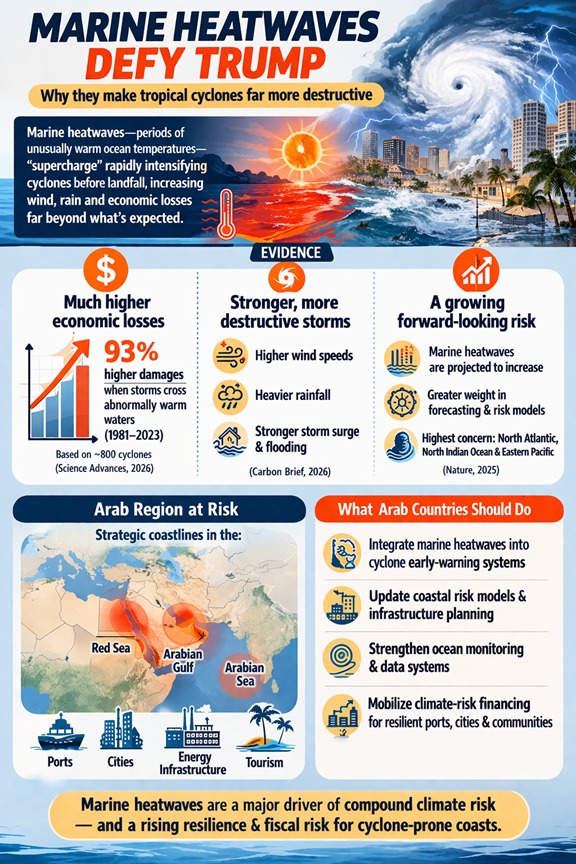
Defying Trump’s “Don’t mention the climate” stance (Guardian, 2026), an important shift emerges in how climate marine risk is being understood. Marine heatwaves are increasingly researched as a critical amplifier of tropical cyclone, because they “supercharge” rapidly intensifying storms, increasing wind speed, rainfall, and ultimately economic losses far beyond what would be expected (Carbon Brief, 2026). This is evidenced by:
- Storms interacting with marine heatwaves cause substantially higher losses. Drawing on a new Science Advances study of nearly 800 tropical cyclones worldwide from 1981 to 2023, rapidly intensifying cyclones passing over abnormally warm ocean waters produce 93% higher economic damages than comparable storms, even after accounting for levels of coastal development (Science Advances, 2026).
- Marine heatwaves strengthen the physical characteristics that make storms more destructive. They do not just correlate with losses; they actively worsen the storm conditions that drive storm surge, flooding, and infrastructure damage (Carbon Brief, 2026).
- Pointing to a growing forward-looking risk, projected increases in marine heatwaves mean that these compound events should be given greater weight in future forecasting, climate risk assessment, and adaptation planning, particularly in the North Atlantic, North Indian Ocean, and eastern Pacific (Nature, 2025).
In conclusion, marine heatwaves are no longer a background ocean anomaly, but an increasingly important driver of compound climate risk with direct economic consequences for cyclone-prone coasts. For Arab countries, especially those with densely populated and economically strategic coastlines along the Red Sea, Arabian Gulf and parts of the Arabian Sea, this finding underscores the need to treat unusually warm seas as a growing resilience and fiscal risk, not just an environmental signal. Practically, this translates to integrating marine heatwave conditions into cyclone early-warning systems, coastal risk models, infrastructure planning and disaster preparedness strategies, while strengthening ocean monitoring and climate-risk financing to better protect ports, cities, tourism assets and coastal communities.