
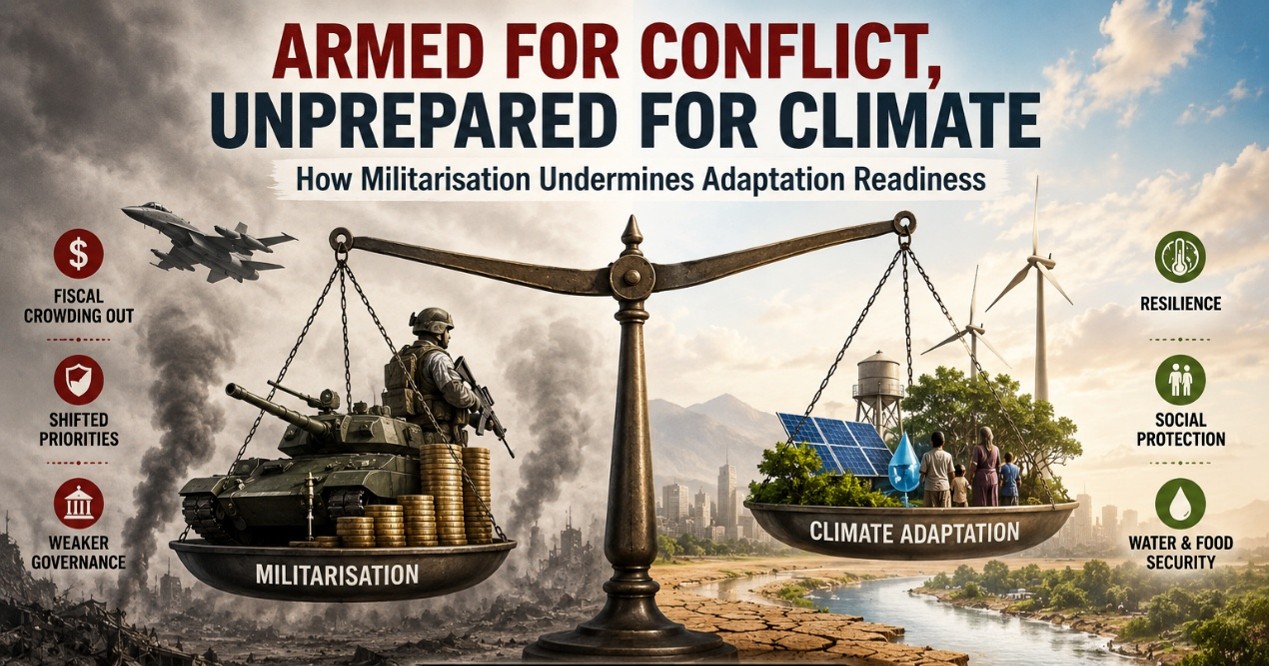
Rising militarisation is increasingly competing with climate adaptation for fiscal resources, institutional attention, and political priority. A new study (Ko & Michaelou, 2026), covering 150 countries, finds that militarisation “significantly” undermines countries’ readiness to adapt to climate change, especially in developing countries where governance systems are weaker and public budgets are already constrained. This finding is particularly important because adaptation readiness is not only about exposure to climate risks, but also about whether governments have the institutions, finance, and social capacity to act before climate shocks become disasters. The negative effect of militarisation is strongest in the economic and social dimensions of adaptation readiness, with impacts that persist in the short and medium term before weakening over time. The implications are threefold:
- Militarisation creates a fiscal crowding-out effect, as defence budgets, security infrastructure, personnel costs, and weapons procurement absorb public resources that could otherwise support climate-resilient infrastructure, early warning systems, water security, health preparedness, and social protection (CEDARE, 2025).
- Militarisation shifts institutional priorities, pushing governments to treat security threats as immediate and climate adaptation as secondary, even though climate impacts increasingly act as threat multipliers for food insecurity, displacement, economic instability, and social unrest (CEO, 2025).
- The impact is most severe in developing countries, where limited fiscal space, governance vulnerabilities, and weaker accountability mechanisms make adaptation funding more exposed to political diversion and institutional neglect (The University of Utah, 2025).
Militarisation can push climate adaptation down the state agenda, weakening climate institutions’ ability to protect budgets and deliver long-term resilience. This makes adaptation a governance challenge, not just a technical or financial one. Therefore, adaptation finance needs protection through stronger budget safeguards, climate budget tagging, independent oversight, and closer integration of climate resilience into national security planning.
For Arab countries, the risk is acute: rising climate pressures coincide with conflict, geopolitical rivalry, and high defence spending. As a result, adaptation may remain underfunded just when resilience is most needed.