
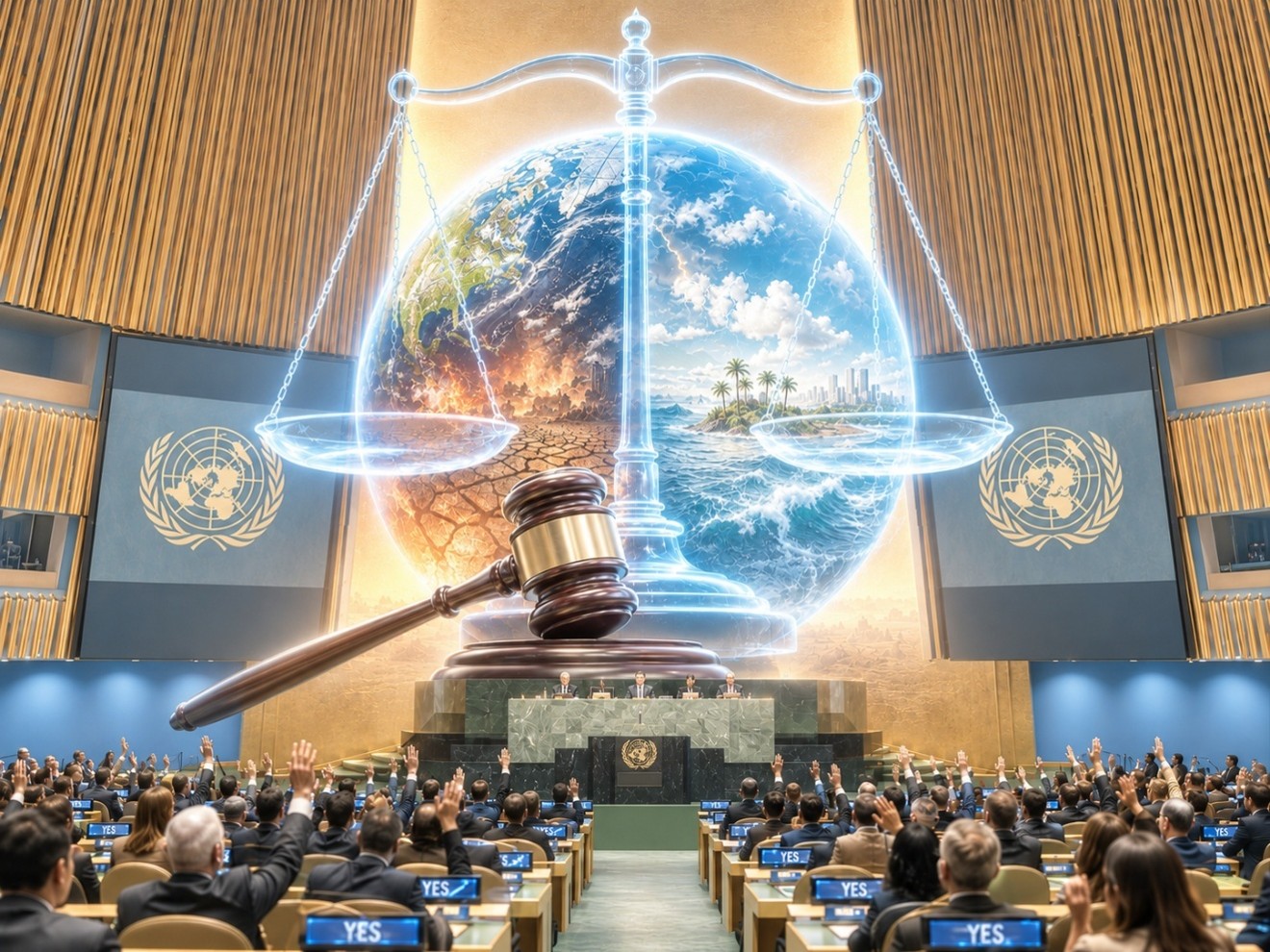
On 20 May 2026, the UN General Assembly’s 141–8 vote backing the ICJ climate opinion marked a major shift toward treating climate action as a legal responsibility, despite opposition from the United States, Russia and Iran, among others. The vote shows growing international support for turning climate justice from a political demand into a legal standard (UN, 2026).
The real significance of the vote lies not only in its legal content, but in its political message: even as the US attempted to block or weaken the resolution, the majority of states moved to strengthen the link between climate policy, action, and justice (The Guardian, 2026). This represents a shift from treating climate commitments mainly as diplomatic pledges toward framing climate inaction as a matter of legal responsibility and state accountability. This is evidenced by:
- The resolution accelerates climate litigation and policy pressure. Although advisory opinions are not binding judgments, the Court’s finding that states have legal obligations to protect the climate system (International Court of Justice, 2026) gives national courts, vulnerable states, and civil society a stronger foundation to challenge inadequate climate action and demand greater accountability (Climate Home News, 2026).
- The vote exposed an ever-widening divide between climate-vulnerable states and fossil-fuel powers. Vulnerable states used international law to demand protection and accountability, while major fossil-fuel states resisted language that could increase their legal or financial responsibility (The Guardian, 2026).
- US opposition reinforces the politicization of climate responsibility.
The Trump administration opposed the resolution and objected to language related to fossil fuels and state responsibility, warning that it could affect US industry and economic interests. This position fits a broader pattern of US politicizing climate by retreating from multilateral climate governance, including earlier moves away from climate institutions and international commitments (AP News, 2026).
In conclusion, the UN vote should be read as a strong signal that climate change is no longer only a matter of voluntary commitments, negotiations, or technical emissions targets. It is increasingly becoming a question of legal duty, justice and responsibility. The advisory opinion may not immediately force governments to change policy, but it gives courts, vulnerable states, civil society and climate-affected communities a stronger legal foundation to challenge inadequate climate action.
For Arab countries, the implications are mixed but important. Fossil-fuel-exporting states may view stronger legal scrutiny of fossil fuels as a strategic risk, especially as climate litigation and transition pressure expand. At the same time, climate-vulnerable Arab countries facing heat stress, water scarcity, drought, sea-level rise and food-security risks have an interest in strengthening international climate accountability. The regional priority should therefore be to engage constructively with climate law, prepare for a more litigation-driven climate landscape, and align energy-transition strategies with long-term climate resilience and economic diversification.