
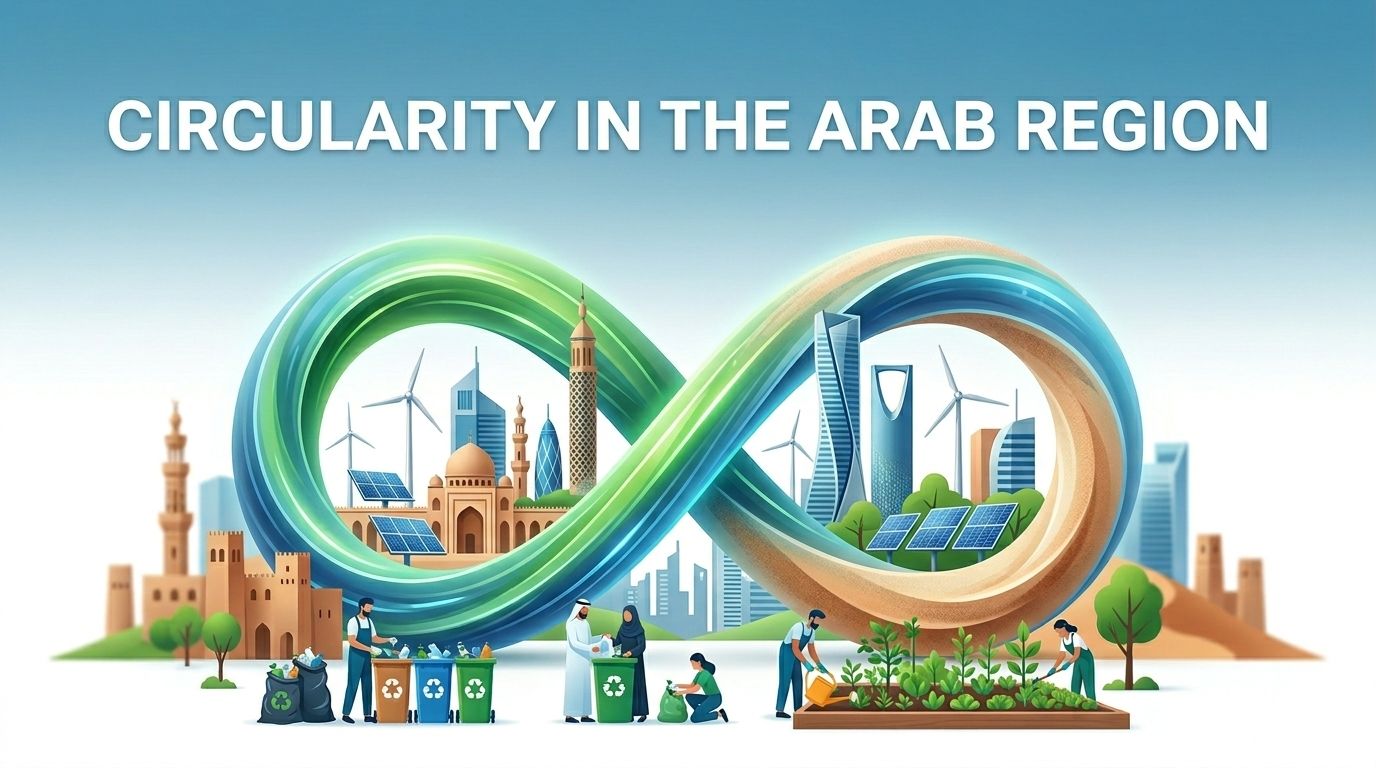
Sustainable entrepreneurship is increasingly recognized as a cornerstone of economic diversification, job creation, and environmental resilience in the Arab region. However, Across the Arab region, enabling sustainable and circular entrepreneurship is constrained by a common set of structural barriers, mainly: fragmented policy and enforcement, weak waste/resource value chains, limited data/standards for secondary materials, and skills gaps in circular design, repair, and business modelling, which raise risk and transaction costs for startups and SMEs (UN ESCWA, 2023). A further, increasingly important constraint is secure access to critical minerals (and the ability to recover them domestically through recycling) that exposes Arab countries to import concentration, price volatility, and geopolitical supply risks, which can undermine circular business models (IEA, 2024).
Yet these challenges play out differently by sub-region: in the Gulf (GCC), governments often have stronger fiscal space and ambitious “green growth” agendas, but circular ventures still face market-creation problems (cheap virgin materials and subsidised utilities), heavy reliance on large infrastructure-led solutions, and procurement/regulatory frameworks that can be innovative but unevenly translated into SME opportunities (Gulf Research Centre, 2023). In North Africa and parts of the Levant, the binding constraints are more frequently access to finance and liquidity, informality in waste collection and recycling, limited municipal capacity and infrastructure, and higher macro/political risk. This causes circular entrepreneurs to struggle to scale beyond pilots even when there is clear demand and strong job potential (GIZ, 2023). Across both contexts, inclusion barriers, especially for women-led and youth enterprises, compound financing and market-entry constraints, reducing the pipeline of investable circular ventures (UNDP, 2024).
As countries confront these growing pressures related to resource scarcity, waste generation, climate change, and unemployment, the transition from linear economic models toward sustainable and circular systems has become both a development priority and a strategic economic opportunity. Enabling this transition requires more than innovative business ideas alone; it depends on coherent public policies and effective support mechanisms that create gender-responsive, inclusive, and enabling environments for green and social enterprises. In this context, the Centre for Environment and Development for the Arab Region and Europe (CEDARE) plays a key role by supporting policy dialogue, regional coordination, and technical assistance that help translate sustainability objectives into viable and scalable circular business models.
Public Policies as Enablers of Circular Entrepreneurship
Across the Arab region, public policy has emerged as a decisive factor in shaping the success of sustainable and circular enterprises. Regulatory frameworks, incentive structures, and institutional coordination determine whether entrepreneurs are able to operate within formal markets, access resources, and scale innovative solutions. Across the Arab region, circularity strategy development is advancing but uneven, most countries now acknowledge circular economy principles in national visions (e.g. UAE, Egypt, KSA), NDCs and sector plans (e.g. Morocco, Tunisia), yet many are still moving from broad policy intent to fully operational roadmaps with clear targets, incentives, and implementation/monitoring arrangements, resulting in fragmented progress across sectors and countries (UN ESCWA, 2023).
CEDARE has consistently supported governments in strengthening these enabling environments by providing technical expertise, facilitating stakeholder dialogue, and promoting policy coherence across sectors. A clear illustration of the role of policy in enabling circular entrepreneurship can be seen in Egypt’s e-waste sector. Through the Sustainable Recycling Industries (SRI) Programme, implemented in collaboration with national authorities and international partners, policy reforms were supported that formally recognized e-waste as a regulated waste stream under Waste Management Law No. 202 of 2020 and its Executive Regulations. These reforms laid the groundwork for a structured e-waste management system based on Extended Producer Responsibility (EPR), shifting responsibility upstream while creating new opportunities for licensed recycling enterprises. CEDARE’s engagement in such policy processes reflects its broader mandate to strengthen governance frameworks that support sustainable business development across the region.
Strengthening Support Mechanisms for Sustainable Enterprises
Policy frameworks alone are insufficient without complementary support mechanisms that help enterprises navigate technical, regulatory, and market challenges. Capacity building, standard-setting, and business development services are essential to move circular entrepreneurship from concept to implementation (GIZ, 2023). CEDARE has contributed to the design and delivery of such mechanisms by working closely with public institutions, research centers, and private sector actors.
Within the SRI Programme, targeted support helped establish technical standards for environmentally sound recycling, develop auditing and certification frameworks, and build institutional capacities within relevant ministries. These interventions contributed to the rapid growth of Egypt’s formal e-waste recycling sector, expanding from a single licensed recycler in 2016 to more than 27 formal entities by 2024. Business incubators such as the E-Khorda programme further supported entrepreneurs through training, technical assistance, and administrative guidance, demonstrating how coordinated public support can catalyze circular business ecosystems.
Beyond national initiatives, CEDARE’s regional work emphasizes knowledge exchange and replication of good practices. Projects such as Waste2Fashion, which promotes circular textile systems in the Mediterranean, highlight the importance of cross-border collaboration, value-chain integration, and policy alignment in enabling sustainable entrepreneurship beyond individual sectors or countries.
Access to Investment and Financial Sustainability
Access to appropriate financing remains one of the most persistent barriers facing green and social ventures in the Arab region (UN ESCWA, 2023). Circular business models often require higher upfront investments, longer payback periods, and specialized infrastructure, making them less attractive to conventional financing mechanisms. Public policies and support mechanisms therefore play a crucial role in de-risking investment and creating sustainable financing pathways.
CEDARE has supported efforts to link policy instruments with financial sustainability, particularly through Extended Producer Responsibility (EPR)-based financing models. In the e-waste sector, the development of EPR fee structures and implementation roadmaps under the SRI Programme has demonstrated how policy-driven financing mechanisms can generate predictable revenue streams to support recycling operations, compliance systems, and environmental safeguards. Such models not only improve environmental outcomes but also enhance the financial viability of circular enterprises, making them more attractive to investors.
At the regional level, CEDARE continues to advocate for blended finance approaches, public–private partnerships, revolving funds, and policy incentives that encourage investment in green and social ventures, particularly those aligned with national climate and circular economy strategies.
Gender and Inclusion in Sustainable Business Development
Inclusive entrepreneurship is essential for ensuring that the benefits of sustainable development are broadly shared. Women and youth remain underrepresented in many green and circular sectors, often due to structural barriers related to access to finance, skills, and markets. Integrating gender-sensitive, responsive and transformative considerations into public policies and support mechanisms is therefore critical to unlocking the full potential of sustainable entrepreneurship (UNDP, 2024).
Through its projects and policy engagement, CEDARE promotes inclusive approaches that embed gender considerations into capacity-building programmes, entrepreneurship support, and stakeholder engagement. In sectors such as waste management and sustainable textiles, targeted training, education pathways, and community-based models have shown potential to increase women’s participation across value chains, particularly in areas related to reuse, repair, and recycling. Strengthening these inclusive dimensions enhances not only social outcomes but also the resilience and innovation capacity of circular business ecosystems.
Conclusion and Outlook
Looking ahead, the enabling environment for sustainable and circular entrepreneurship in the Arab region is expected to continue evolving, supported by growing policy alignment with circular economy principles, climate action commitments, and green growth strategies. As regulatory frameworks mature, new opportunities are likely to emerge for scaling circular business models, particularly in areas such as waste management, recycling, sustainable manufacturing, and resource-efficient digital solutions. At the same time, several challenges will need to be addressed, including uneven policy implementation across countries, limited access to tailored support mechanisms for early-stage ventures, and the need to better integrate informal actors into formal circular value chains. Overcoming these barriers will be essential to unlocking long-term environmental and socio-economic benefits and ensuring that sustainable entrepreneurship becomes a central pillar of inclusive and resilient development in the region.
By supporting policy dialogue, regional coordination, and technical assistance, CEDARE continues to play a strategic role in enabling these transitions. As countries in the Arab region seek to scale sustainable entrepreneurship, strengthening policy coherence, expanding access to investment, and embedding inclusivity within support mechanisms will remain critical priorities for building resilient, competitive, and future-oriented economies.