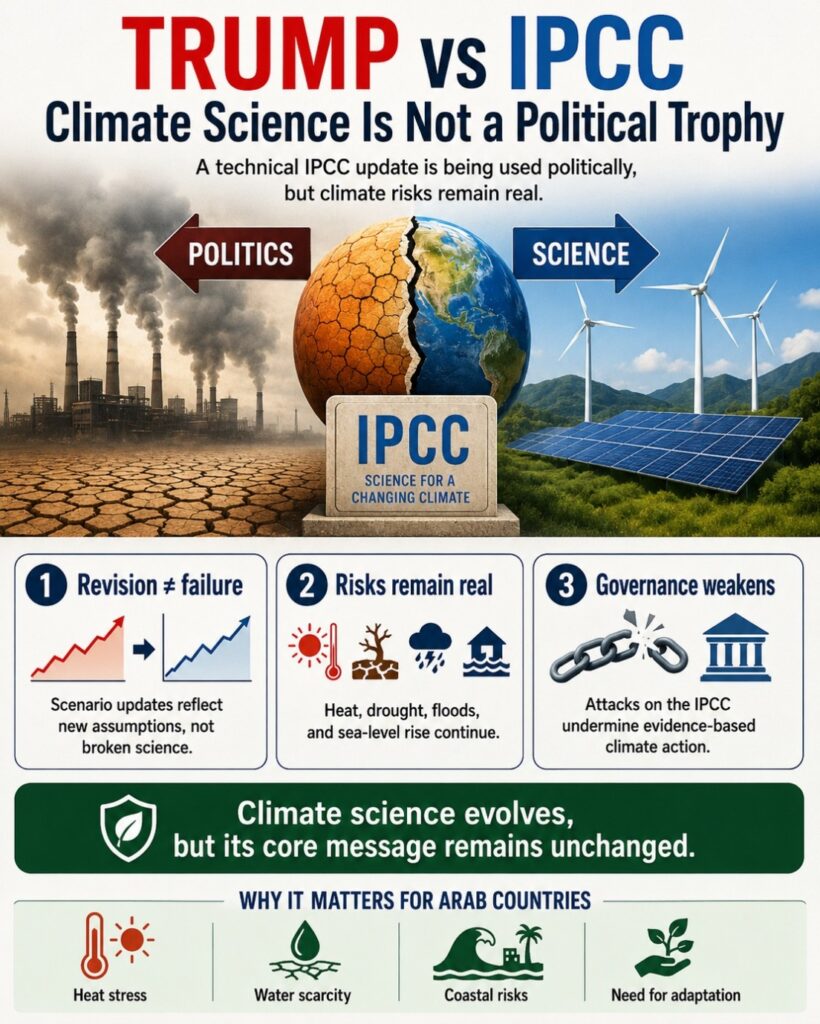
Trump’s celebration of the IPCC’s reported move away from the most extreme warming scenario on 17 May 2026 risks turning a technical update in climate modelling into a political weapon against climate science. Trump framed the IPCC’s reassessment of very high-end warming pathways as proof that past climate warnings were “WRONG,” even though the scientific meaning is more nuanced: the most extreme scenarios may be less likely because of changes in energy trends, policy assumptions, and renewable deployment, not because climate change is no longer dangerous (New York Post, 2026). The real issue is therefore not whether one scenario has been adjusted, but whether political actors use scientific refinement to weaken public trust in climate action. This makes Trump’s attack on the IPCC less a victory over “failed predictions” than a broader challenge to the institutions that translate climate science into policy: a concern reinforced by the earlier U.S. withdrawal from the UNFCCC and the IPCC. This is evidenced by:
- Scientific revision is being misrepresented as scientific failure. Climate scenarios are not fixed prophecies; they are tools for assessing possible futures under different assumptions about emissions, technology, policy, and development. If the IPCC gives less weight to the most extreme pathway, this may reflect shifts in the global energy system and policy landscape, not the collapse of climate science (New York Post, 2026).
- Climate risks remain real despite scenario revisions. Reducing reliance on the most extreme warming pathway does not mean climate change is no longer dangerous (IPCC, 2026).
- The attack on the IPCC weakens evidence-based climate governance. Trump’s broader withdrawal from the IPCC and UNFCCC undermines the institutions that provide shared scientific baselines for climate negotiations, emissions reporting, adaptation planning, and finance (Carbon Brief, 2026).
In conclusion, the IPCC’s adjustment of climate scenarios should be read as evidence of scientific discipline, not scientific retreat. Climate science evolves as evidence improves, but its central message remains unchanged: warming is real, human-driven, and already damaging societies and economies. The danger is that selective political messaging turns scientific updating into public confusion. Politicizing that process may serve short-term ideological narratives, but it weakens long-term preparedness. For Arab countries, the priority should be to strengthen regional climate science capacity, invest in adaptation, and maintain engagement with multilateral climate institutions regardless of U.S. political shifts.