

Executive Summary
Arab countries face a climate paradox. The region contributes unevenly to global emissions, with some economies highly dependent on fossil fuels and others highly climate-vulnerable with limited financial resources, yet nearly all Arab countries face intensifying climate risks: higher temperatures, water scarcity, droughts, floods, food insecurity, polluted air, coastal pressures, and health risks. The World Bank describes MENA as one of the world’s most climate-vulnerable regions, exposed to higher temperatures, rising sea levels, droughts, floods, intense water scarcity, and polluted air (World Bank, 2023). UNDP similarly stresses that Arab climate vulnerability is deeply linked to food insecurity, water scarcity, displacement, conflict, and ecosystem degradation (UNDP, 2018).
The central argument of this report is that climate capacity building in Arab countries should no longer be treated as “training.” It should be redesigned as a strategic institutional transformation agenda. The region does not only need more climate awareness; it needs a new generation of climate-able institutions able to use data, assess risk, mobilize finance, design bankable projects, protect public health, manage food and water risks, and negotiate effectively in global climate diplomacy.
This requires a shift from conventional workshops to an integrated Arab Climate Capacity Accelerator built around five innovations: systems thinking, digital climate intelligence, policy labs, living laboratories, and institutional certification. The expected result is not simply more trained individuals, but stronger climate governance, better investment decisions, improved public health, more resilient food-water-energy systems, cleaner cities, and a stronger Arab voice in climate negotiations and climate finance.
1. Why Climate Capacity Building Has Become a Strategic Necessity
Climate change is increasingly a governance stress test for Arab countries. It tests whether institutions can coordinate across sectors, use evidence, manage uncertainty, protect vulnerable groups, and convert climate commitments into implementation. The challenge is not only environmental; it is economic, social, fiscal, health-related, and geopolitical.
The Arab region is particularly exposed because climate risks are concentrated in systems that are already under pressure. Water scarcity is chronic, food import dependence is high, urbanization is rapid, energy systems are in transition, and air pollution remains a major public health issue in many cities. Public budgets are constrained in several Arab countries. Conflict and displacement further weaken adaptive capacity in this fragile context. UNDP notes that the Arab region is the world’s most water-scarce and food-import-dependent region, with climate risks intertwined with food insecurity, malnutrition, resource insecurity, displacement, and ecosystem degradation (UNDP, 2018).
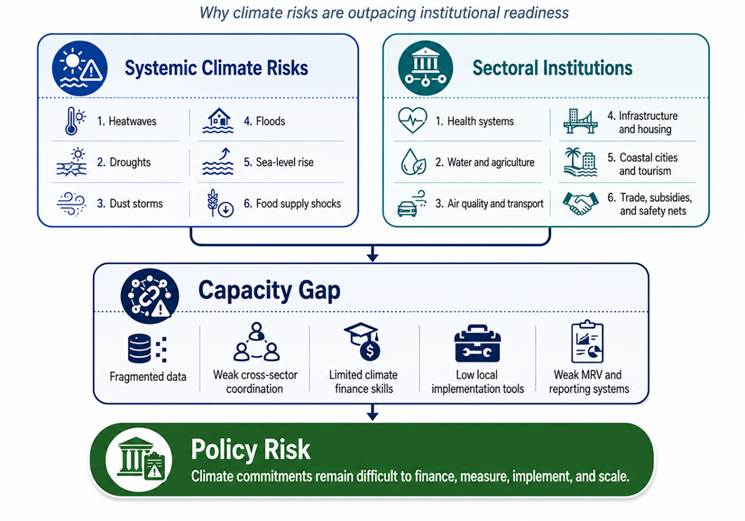
The problem is therefore not only that climate hazards are increasing, but that institutional capacity has not kept pace with the complexity of those hazards. Many climate-related decisions still occur in fragmented silos: water ministries plan water infrastructure, agriculture ministries manage food production, energy ministries handle electricity supply, health ministries respond to disease burdens, and environment ministries prepare climate reports. But climate risk cuts across all of these sectors at different municipal levels. Capacity building must therefore become the connective tissue that links these systems.
Figure 1. The Arab Climate Capacity Gap
2. Why Conventional Capacity Building Is No Longer Enough
Traditional climate capacity building in the Arab region has often relied on short workshops, general awareness sessions, and project-based training. These activities are useful but insufficient. They rarely change institutional behavior, budget decisions, project design, or cross-ministerial coordination. The climate challenge now requires a deeper model.
2.1 Climate risk is no longer linear and climate action is becoming more technical
Climate shocks now cascade across sectors: heatwaves can strain energy systems, worsen air pollution, increase health risks, and raise water demand, while droughts can reduce food production, increase prices, intensify groundwater use, and damage ecosystems. At the same time, Arab countries must manage increasingly technical climate tasks, including NDCs, adaptation plans, MRV systems, transparency reports, climate finance, carbon markets, and technology assessment. Officials need to understand how risks cascade across the water-energy-food-ecosystems nexus, public health, air quality, urban planning, finance, and social protection. Capacity building must therefore focus on practical systems skills, such as risk mapping, finance proposals, adaptation indicators, mitigation options, and policy briefings.
2.2 Climate finance is becoming a capacity test
Climate finance is not only about availability of money. It is also about the capacity to prepare bankable projects, quantify benefits, meet safeguards, design MRV systems, align proposals with national priorities, and demonstrate transformational impact. Countries with weak institutional and technical capacity are less able to access finance, even when their needs are high. This makes capacity building a gateway to investment. Without it, Arab countries risk remaining underfunded in adaptation, underprepared for carbon markets, and dependent on externally designed project pipelines.
Therefore, Arab climate capacity building must shift to practical systems that deliver better integrated decisions, finance access, and resilience outcomes.
Table 1. From Conventional Training to Transformational Capacity Building
| Dimension | Conventional Approach | Needed Arab Region Approach |
| Purpose | Awareness raising | Institutional performance and policy delivery |
| Format | One-off workshops | Continuous learning, labs, certification |
| Content | General climate concepts | Risk, finance, data, MRV, WEFE, health, air quality, and other key sectors |
| Participants | Environment officials | Line ministries and local authorities |
| Tools | Presentations | Dashboards, models, templates, datasets, simulations |
| Outputs | Attendance certificates | Project concepts, policy briefs, MRV plans, risk maps |
| Impact | Improved knowledge | Better decisions, finance access, resilience outcomes |
3. Sectoral Linkages: Where Capacity Building Can Create the Greatest Value
3.1 WEFE nexus: from sector competition to integrated resilience
The water-energy-food-ecosystems nexus should be at the center of Arab climate capacity building. Water scarcity affects agricultural production, energy demand, food imports, ecosystems, and social stability. Energy choices affect desalination, irrigation, cooling, emissions, and air pollution. Food systems depend on water, energy, trade routes, storage, subsidies, and rural livelihoods.
A climate capacity program should train officials to identify trade-offs and co-benefits. For example, solar-powered irrigation may reduce emissions but can worsen groundwater overuse if not governed properly. Desalination can improve water security but increase energy demand unless powered by renewables. Expanding food production may support food security but increase water stress unless climate-smart agriculture is adopted.
3.2 Food security: from emergency response to anticipatory planning
Arab food security is highly climate-sensitive. Capacity building should help countries move from reactive food crisis management to anticipatory planning. This requires skills in vulnerability mapping, climate-smart agriculture, early warning, crop risk assessment, food import risk analysis, storage policy, and social protection targeting. Thus a useful innovation would be the development of tools such as integrated sustainable development models or Climate-Food Security Stress Tests for Arab countries. These would simulate how drought, fertilizer price shocks, port disruptions, or heatwaves could affect food prices, import bills, local production, and vulnerable households.
3.3 The climate-air quality-health nexus: from monitoring to preparedness
Air quality and health should be integrated into climate capacity building because heatwaves, dust storms, pollution, water quality decline, disease risks, and food insecurity directly affect public health. Capacity building should move beyond pollution monitoring to support early warning, risk communication, cleaner transport, better urban planning, and health preparedness. This requires skills in emissions inventories, data analysis, forecasting, QA/QC, heat-health action plans, hospital readiness, disease surveillance, and communication with vulnerable groups. Together, these capacities can turn climate and air quality data into practical policies that reduce exposure, protect health, and support mitigation and adaptation.
3.4 Infrastructure and cities: from climate-proofing to climate-smart investment
Arab cities are at the frontline of climate impacts. Capacity building should enable municipalities and infrastructure agencies to screen investments for climate risk, design nature-based solutions, upgrade drainage, reduce urban heat, improve waste systems, and integrate air quality and climate goals into urban and mobility planning.
4. Proposed Innovative Methodology
4.1 Arab Climate Capacity Accelerator
Arab countries should establish a regional Arab Climate Capacity Accelerator that capacity building from a training activity into a practical mechanism for policy innovation, institutional reform, and climate investment readiness. The accelerator should begin with national climate capacity diagnostics to identify gaps in data, MRV, finance, coordination, local implementation, communication, negotiations, and inclusion, producing a clear Climate Capacity Gap Map for each country.
Figure 2. The Arab Climate Capacity Innovation Model/Capacity Accelerator
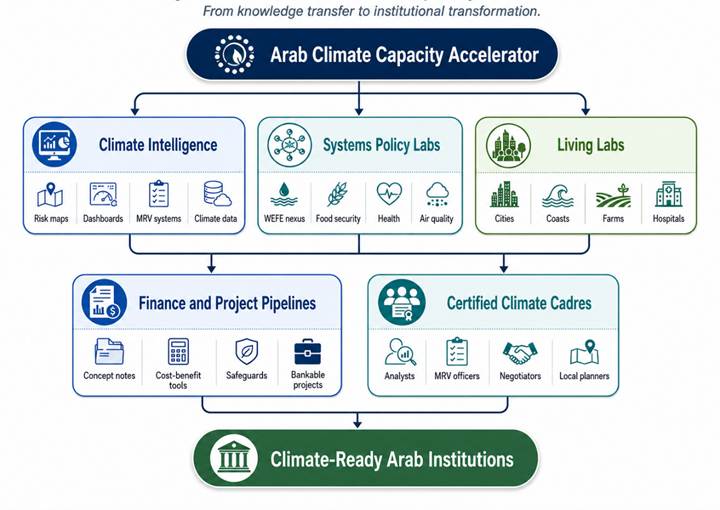
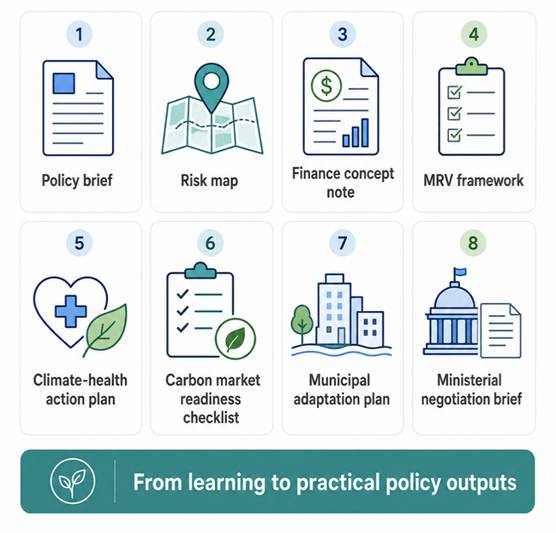
Capacity enhancement should be organized around mission-based modules, policy labs, simulations, digital climate intelligence tools, and living labs that allow officials to solve real problems in cities, coasts, farms, hospitals, waste facilities, and industrial zones. Each module should generate usable outputs, such as risk maps, MRV frameworks, policy briefs, adaptation plans, and finance concept notes. Climate finance bootcamps should also be embedded to help countries convert national priorities into bankable projects, especially as carbon markets and Article 6 mechanisms become increasingly important for mobilizing private and international climate finance.
4.2 Mission-based modules
Training should be organized around visions and missions rather than academic themes. Instead of “Module 1: climate science,” the program could use problem-solving missions such as:
- Protecting Arab cities from extreme heat and polluted air
- Securing water and food systems under climate stress
- Building bankable adaptation and mitigation pipelines
- Preparing for carbon markets and climate finance
- Turning climate data into policy decisions
- Strengthening Arab climate diplomacy and negotiation readiness
This approach enhances the relevance and practical value of learning by making it problem-oriented, engaging, and directly linked to the production of actionable outputs.
5. Expected Impacts
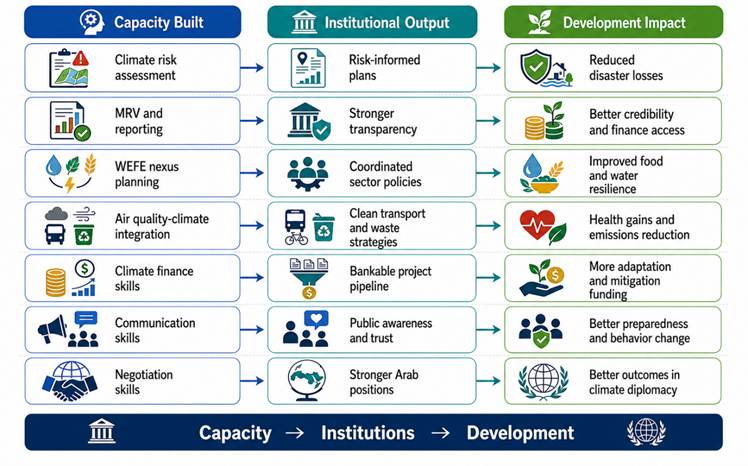
- Institutional impact: The main institutional impact would be stronger climate governance. Ministries would be better able to coordinate, share data, design joint policies, and align climate action with national development plans. This is particularly important because climate risk requires coordination across environment, agriculture, water, energy, health, finance, planning, transport, housing, and local government.
- Policy impact: Capacity development would improve the quality of climate policies by making them more evidence-based, costed, measurable, and linked to implementation. It would help countries move from broad commitments to operational plans with indicators, budgets, responsibilities, and timelines.
- Financial impact: By strengthening project preparation and MRV capacity, Arab countries would be better positioned to access climate finance. The most important result would be a pipeline of bankable adaptation, mitigation, air quality, food security, and resilience projects.
- Health and air quality impact: Integrated climate-air quality capacity would support cleaner transport, better waste management, early warning systems, and heat-health preparedness. This would produce immediate public health co-benefits while advancing climate goals.
- Food and water security impact: Better WEFE planning would help countries reduce maladaptation and improve resilience. It would support more efficient irrigation, climate-smart agriculture, renewable-powered water systems, food risk monitoring, and ecosystem-based adaptation.
- Regional diplomacy impact: A stronger Arab climate capacity platform would improve the region’s negotiating power. It would allow Arab countries to develop common positions on adaptation finance, loss and damage, water scarcity, food security, carbon markets, technology transfer, and just transition.
Impact Pathways: From capacity building to institutional outputs and development impacts
6. Policy Recommendations for Arab Countries
- Treat climate capacity as national infrastructure. Climate capacity should be treated like infrastructure: planned, financed, maintained, and upgraded. Arab countries should establish national climate capacity strategies linked to NDCs, adaptation plans, green economy strategies, and sectoral development plans.
- Create an Arab Climate Capacity Accelerator. Arab countries should establish a regional accelerator that supports training, technical assistance, peer learning, digital tools, data platforms, certification, and project preparation. It should be bilingual, regionally owned, and linked to universities, research centers, municipalities, and ministries.
- Build climate capacity beyond environment ministries. Environment ministries remain central, but climate implementation depends on other sectors. Training should target finance, planning, agriculture, water, energy, transport, health, housing, local development, and municipalities.
- Institutionalize WEFE nexus planning. Arab governments should require major climate-related policies and investments to assess impacts across water, energy, food, and ecosystems. This would reduce policy contradictions and improve resilience.
- Link every capacity program to project finance. Every major training program should produce practical outputs that can feed into finance pipelines: concept notes, feasibility outlines, investment plans, MRV frameworks, and adaptation indicators.
- Develop Arabic climate knowledge systems. Arab countries should invest in Arabic climate glossaries, technical manuals, open learning platforms, sector toolkits, policy templates, and communication materials. This is essential for institutional ownership and long-term use.
- Certify national and municipal climate cadres. A certification system should be created for climate risk analysts, MRV officers, climate finance specialists, municipal resilience planners, climate-health officers, and climate negotiators.
- Use living labs to test adaptation and mitigation. Arab countries should move from classroom-only training to applied learning in real locations. Living labs can demonstrate solutions for urban heat, water scarcity, food resilience, flood management, air quality, and coastal adaptation.
- Strengthen Arab climate diplomacy capacity. Arab countries should create a regional climate diplomacy academy to prepare negotiators and technical experts on adaptation finance, carbon markets, loss and damage, transparency, technology transfer, and just transition.
Conclusion
Without capacity, climate commitments remain promises; with capacity, they become plans, projects, finance, resilience, and measurable development gains. Climate capacity building in Arab countries must be reimagined. The region does not need more isolated workshops; it needs climate-capable institutions. It needs ministries that can coordinate, cities that can plan, health systems that can anticipate, farmers that can adapt, data systems that can guide policy, and finance teams that can convert priorities into investable projects.
There is a dire need to shift capacity building from knowledge transfer to institutional transformation, linking climate science with policy, data with finance, adaptation with health, air quality with mitigation, and national planning with regional cooperation. In doing so, it turns capacity building into one of the most important climate investments Arab countries can make.
References
Food and Agriculture Organization of the United Nations (2024). Near East and North Africa: Regional overview of food security and nutrition. FAO.
Intergovernmental Panel on Climate Change (2022). Climate change 2022: Impacts, adaptation and vulnerability. Contribution of Working Group II to the Sixth Assessment Report of the Intergovernmental Panel on Climate Change. Cambridge University Press.
United Nations Development Programme (2018). Climate change adaptation in the Arab States: Best practices and lessons learned. UNDP.
United Nations Framework Convention on Climate Change (2026). Reporting and review under the UNFCCC and the Paris Agreement. UNFCCC.
World Bank (2025). State and trends of carbon pricing 2025. World Bank. https://doi.org/10.1596/978-1-4648-2255-1
World Bank (2023). Climate and development in the Middle East and North Africa. World Bank. https://www.worldbank.org/en/region/mena/brief/climate-and-development-in-the-middle-east-and-north-africa
World Health Organization (2021). WHO global air quality guidelines: Particulate matter, ozone, nitrogen dioxide, sulfur dioxide and carbon monoxide. WHO.
World Health Organization (2024). Ambient outdoor air pollution. WHO.
World Resources Institute (2025). Enhanced transparency framework. WRI.