Executive Summary
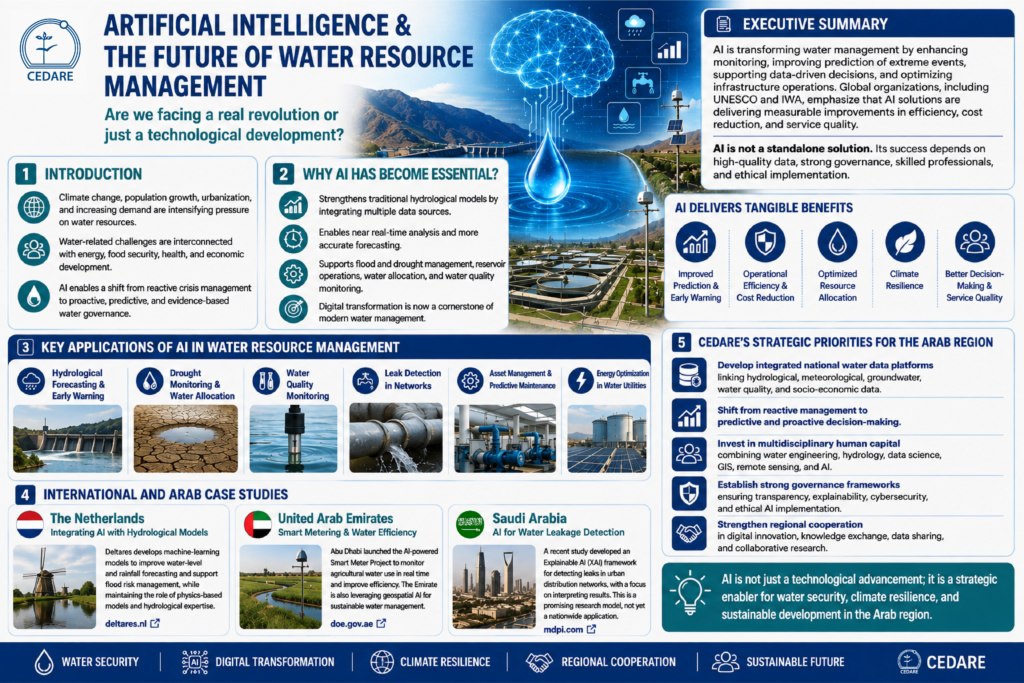
The water sector is undergoing a profound transformation driven by the rapid advancement of Artificial Intelligence (AI), Big Data, the Internet of Things (IoT), remote sensing technologies, early warning systems, telemetry, and field sensing technologies. AI is no longer merely an emerging technology; it has become one of the key enablers of more efficient, resilient, and sustainable water resources management amid growing challenges arising from climate change, population growth, urbanization, and increasing water demand.
According to the United Nations Educational, Scientific and Cultural Organization (UNESCO), AI has the potential to transform water management by enhancing monitoring systems, improving the prediction of extreme hydrological events, supporting evidence-based decision-making, and optimizing the operation of water infrastructure. However, these benefits can only be realized within robust governance frameworks that ensure high-quality data, transparency, and the responsible use of technology (Moreno-Rodenas et al., 2025).
Similarly, the International Water Association (IWA) emphasizes that many water utilities around the world have already moved beyond pilot projects and are integrating AI solutions into their daily operations. Applications such as early leak detection, asset management, predictive maintenance, and energy optimization are delivering measurable improvements in operational efficiency while reducing costs and enhancing service quality (IWA, 2025).
This article explores how AI is reshaping the future of water resources management by reviewing leading global applications, examining key challenges and opportunities for the Arab region, and presenting CEDARE’s perspective on the strategic priorities required to strengthen regional water security.
1. Introduction
The world is entering an unprecedented era of pressure on water resources. Climate change has intensified the frequency and severity of droughts and floods, while population growth, urban expansion, and industrial development continue to accelerate water demand. At the same time, water management systems have become increasingly complex, requiring institutions to process enormous volumes of data and make timely decisions under highly dynamic and uncertain conditions.
According to the United Nations World Water Development Report 2024, water-related challenges are now inseparably linked to climate action, energy security, food security, public health, and sustainable economic development. Addressing these interconnected challenges requires innovative tools capable of supporting decision-making in environments characterized by uncertainty (UNESCO, 2024).
Within this context, Artificial Intelligence has emerged as one of the principal drivers of digital transformation in the water sector. Through its capacity to process vast datasets, identify complex patterns, and generate predictive insights, AI enables water authorities to shift from reactive crisis management toward proactive, predictive, and evidence-based water governance.
Nevertheless, AI should not be viewed as a stand-alone solution. Its effectiveness depends fundamentally on the availability of reliable data, advanced digital infrastructure, and skilled professionals capable of interpreting AI-generated insights and translating them into sound policies and operational decisions.
2. Why AI Has Become Essential for Water Resources Management?
Traditionally, water resources management has relied on conventional hydrological models, historical monitoring records, and engineering expertise. While these tools remain indispensable, they are increasingly challenged by the accelerating impacts of climate change, which have made historical patterns less reliable predictors of future conditions.
According to UNESCO and Deltares, AI does not replace conventional hydrological models; rather, it strengthens them by integrating multiple data sources, including:
- Satellite observations
- Hydrological monitoring station data
- Meteorological information
- Smart meter data
- Field sensor measurements
- Unmanned aerial vehicle (UAV) imagery
- Historical databases
By processing these diverse datasets in near real time, AI supports more accurate decision-making in flood forecasting, drought management, reservoir operations, water allocation, and water quality monitoring (Moreno-Rodenas et al., 2025).
The Organisation for Economic Co-operation and Development (OECD) further highlights that digital transformation has become a cornerstone of modern water governance, improving institutional performance, enhancing operational efficiency, and strengthening resilience to future risks (OECD, 2024).
3. From Data to Decision: How AI Is Transforming Water Management
The true value of Artificial Intelligence lies in its ability to convert vast amounts of raw data into actionable intelligence. Historically, water institutions collected extensive datasets but often lacked the analytical capacity to extract meaningful insights or identify critical operational patterns.
Today, advances in Machine Learning and Deep Learning enable AI systems to analyze millions of records within minutes, uncover hidden relationships, and detect patterns that would be difficult—or impossible—for human analysts to identify using conventional statistical methods.
The International Water Association (IWA) reports that water utilities integrating AI into their operational systems have achieved significant improvements in asset management, reduced unplanned service interruptions, accelerated response to infrastructure failures, and enhanced overall service quality for consumers (IWA, 2025).
Some of the most transformative applications of AI in water management include:
| Application Area | Role of AI | Expected Benefits |
| Water Distribution Networks | Leak detection and pressure analysis | Reduced water losses and improved network efficiency |
| Dams and Reservoirs | Flow forecasting and reservoir operation optimization | Improved storage management and reduced flood risk |
| Agriculture | Intelligent irrigation scheduling | Enhanced water-use efficiency and increased agricultural productivity |
| Water Quality Management | Analysis of chemical and biological indicators | Early detection of contamination events |
| Asset Management | Predictive maintenance | Lower operating costs and extended infrastructure lifespan |
4. Key Applications of Artificial Intelligence in the Water Sector
- Flood Forecasting and Disaster Risk Management
Floods remain among the world’s most destructive and costly natural disasters, while climate change continues to increase both their frequency and unpredictability. AI has significantly enhanced flood forecasting by integrating satellite observations, radar imagery, rainfall measurements, meteorological data, and hydrological models into predictive systems capable of generating faster and more accurate forecasts.
UNESCO highlights that Deep Learning techniques have demonstrated remarkable capabilities in modelling complex hydrological processes, particularly when combined with physics-based hydrological models rather than replacing them entirely (Moreno-Rodenas et al., 2025).
- Early Leak Detection in Water Distribution Networks
According to the International Water Association (IWA), Non-Revenue Water (NRW) remains one of the greatest operational and financial challenges facing water utilities worldwide. AI-powered systems can continuously analyse pressure, flow, and smart meter data to identify abnormal patterns associated with hidden leaks before they become visible.
This capability reduces response times, lowers repair costs, minimizes water losses, and improves network efficiency. The World Bank identifies AI-enabled leak detection as one of the most mature and impactful applications of digital transformation within the water sector.
- Optimizing Water Treatment and Desalination Plants
Water and wastewater treatment facilities, together with desalination plants, are among the most energy-intensive components of water infrastructure. AI enables operators to analyse thousands of operational variables in real time—including flow rates, energy consumption, raw water quality, and equipment performance—to:
- Improve operational efficiency;
- Reduce energy consumption;
- Enable predictive maintenance;
- Extend equipment lifespan; and
- Lower operating costs.
UNESCO identifies the integration of AI with industrial control systems as one of the most promising directions for improving the efficiency and resilience of critical water infrastructure, while emphasizing the continued importance of human oversight in operational decision-making.
- Water Quality Monitoring
Recent years have witnessed significant advances in applying AI to water quality monitoring through the integration of sensor networks, satellite observations, and unmanned aerial vehicles (UAVs).
Rather than relying solely on periodic sampling, AI-powered monitoring systems can predict contamination events and harmful algal blooms, allowing authorities to intervene before environmental and public health risks escalate.
In Europe, the OASIS Project combines AI with Copernicus Earth Observation data to develop operational tools for monitoring water quality and aquatic ecosystems while supporting the implementation of European environmental policies.
5. Global Applications of AI in Water Resources Management: From Research to Real-World Implementation
Over the past decade, Artificial Intelligence has evolved from a promising research topic into a practical operational tool adopted by water utilities, government agencies, and research institutions worldwide. According to UNESCO and Deltares, AI applications have expanded well beyond data analytics to become integral components of decision-support systems for surface water and groundwater management, irrigation, hydropower, flood and drought risk management, water quality monitoring, and the Water-Energy-Food Nexus (Moreno-Rodenas et al., 2025) UNESCO.
Despite this rapid progress, the study concludes that successful operational applications consistently rely on three fundamental pillars:
- The availability of high-quality and continuously updated data.
- Effective integration between hydrological expertise and data science.
- Clear governance frameworks that ensure transparency, accountability, and Explainable Artificial Intelligence (XAI) UNESCO.
Key Global Applications of Artificial Intelligence in Water Resources Management:
- Artificial Intelligence, Geospatial Analysis, and Satellite-Based Water Resources Monitoring
Platforms such as Google Earth Engine are used to analyze satellite imagery and geospatial data through artificial intelligence and machine learning techniques. These applications support the monitoring of surface water bodies and reservoirs, drought and flood detection, evapotranspiration analysis, land-use changes, and water-quality indicators.
Google Earth Engine: https://earthengine.google.com/
- Flood Forecasting and Early Warning Systems
Google Flood Hub represents an advanced practical application of artificial intelligence for river flood forecasting, generating inundation maps, and providing early warnings, with forecasts available several days in advance in supported areas.
Google Flood Hub: https://sites.research.google/floodforecasting/
- 3. Geographic Information Systems and Artificial Intelligence for Water Utilities and Network Management
Esri’s ArcGIS provides an integrated environment that combines Geographic Information Systems (GIS), artificial intelligence and machine learning, real-time data, asset management, digital twins, and dashboards to support the planning and operation of water networks and utilities.
Esri – Water Utilities: https://www.esri.com/en-us/industries/water-utilities/segments/drinking-water
- Artificial Intelligence for Agricultural Irrigation Water Management
Tools developed by the Food and Agriculture Organization of the United Nations (FAO), such as AquaCrop, CROPWAT, and the ETo Calculator, can be integrated with artificial intelligence technologies to improve the estimation of crop water requirements, irrigation scheduling, and water-use efficiency in agriculture.
FAO – Land, Soil and Water Software: https://www.fao.org/land-water/resources/tools/software/en
- Development of Customized Artificial Intelligence Models for Water Resources Management
Leading institutions are increasingly developing customized artificial intelligence models that integrate satellite data, IoT and sensor data, weather information, groundwater data, agricultural data, water consumption data, and GIS. These models can be used to forecast water demand, detect water losses and leakages, predict drought conditions, optimize water-resource allocation, and support evidence-based decision-making. Such models can be developed using frameworks such as TensorFlow and PyTorch.
TensorFlow: https://www.tensorflow.org/
PyTorch: https://pytorch.org/
6. International and Arab Case Studies
6.1. The Netherlands: Integrating Artificial Intelligence with Hydrological Models
The Netherlands is a global leader in water management and is increasingly integrating Artificial Intelligence with conventional hydrological models to improve water-level and rainfall forecasting and strengthen flood-risk management. Deltares is developing machine-learning models that can accelerate forecasting and scenario analysis while maintaining the role of physics-based models and hydrological expertise. Deltares – AI is reshaping the world of water
6.2. United Arab Emirates: Smart Metering and Water-Use Efficiency
The United Arab Emirates represents an emerging Arab model for leveraging Artificial Intelligence and digital transformation in water management. In Abu Dhabi, the AI-powered Smart Meter Project was launched to integrate smart meters with digital platforms, improving the monitoring of agricultural water consumption and providing farmers with real-time data and analytics to enhance water-use efficiency. The Emirate is also exploring the use of geospatial data and AI to support sustainable water management.
Abu Dhabi Department of Energy – AI-Powered Smart Meter Project
6.3. Saudi Arabia: Artificial Intelligence for Water Leakage Detection
Saudi Arabia is witnessing growing interest in applying Artificial Intelligence to water distribution networks. A recent study developed an Explainable Artificial Intelligence (XAI) framework for detecting water leakage in urban distribution networks using real and simulated data, with an emphasis not only on identifying leaks but also on interpreting the model’s results. The study represents a promising applied research model rather than evidence of nationwide operational deployment.
MDPI – Explainable AI for Water Leakage Detection in Urban Water Distribution Networks
7. The Arab Region: Opportunities and Challenges
The Arab region is among the most water-scarce regions in the world. Many countries possess renewable freshwater resources well below the internationally recognized water poverty threshold of 1,000 cubic metres per capita per year, while several fall below 500 cubic metres per capita, a level classified as absolute water scarcity (FAO, 2024; UNESCO, 2024). Simultaneously, the region faces mounting pressures from rapid population growth, urbanization, rising temperatures, prolonged droughts, and increasingly frequent climate extremes. Consequently, improving water-use efficiency has become a strategic imperative rather than simply a developmental objective.
Within this context, AI offers significant opportunities to transform water management, provided that countries can simultaneously address institutional and technological challenges while investing in digital infrastructure and human capacity.
- Key Opportunities
Improving Agricultural Water Productivity
Agriculture accounts for approximately 80–85% of total freshwater withdrawals across most Arab countries (FAO AQUASTAT, 2024). AI can integrate satellite imagery, soil moisture sensors, weather forecasts, and crop water requirements to generate dynamic irrigation schedules that reduce water consumption while maintaining agricultural productivity.
Sustainable Groundwater Management
Groundwater constitutes a critical water source throughout much of the Arab region, yet many aquifers are experiencing unsustainable abstraction rates. AI integrated with remote sensing and groundwater models can estimate abstraction rates, monitor aquifer depletion, identify areas under greatest stress, and support more informed groundwater allocation decisions.
Enhancing Desalination Performance
Arab countries—particularly those in the Gulf—produce a substantial share of the world’s desalinated water. AI presents opportunities to improve desalination efficiency through optimized plant operations, reduced energy consumption, predictive maintenance, and enhanced water quality management.
Strengthening Early Warning Systems
The increasing occurrence of flash floods and droughts across the region highlights the need for more effective early warning systems. AI integrated with meteorological and remote sensing data can significantly improve forecasting accuracy and emergency preparedness (WMO, 2023).
- Major Challenges
Despite these opportunities, AI adoption faces several structural constraints:
- Limited availability and quality of water data.
- Insufficient digital infrastructure, including smart meters and real-time monitoring systems.
- Shortages of multidisciplinary professionals with expertise in water science, AI, and data analytics.
- Weak data governance frameworks addressing transparency, explainability, cybersecurity, and privacy.
- Financial constraints associated with digital transformation and long-term capacity development.
Conclusions
Artificial Intelligence is no longer a future option for water resources management; it has become a fundamental enabler of more efficient, resilient, and sustainable water governance. Nevertheless, success should not be measured by the number of AI algorithms or applications deployed, but rather by their capacity to improve decision-making, optimize resource utilization, and strengthen institutional resilience to climate-related risks.
For the Arab region, AI’s greatest value lies in addressing pressing regional priorities—including improving irrigation efficiency, reducing non-revenue water, managing groundwater resources, and strengthening early warning systems—rather than replicating international experiences that may not reflect regional environmental, social, and economic realities.
The future of AI in water management depends on appropriate technology that is affordable, locally manageable, and sustainable in operation and maintenance.
CEDARE believes that the future of digital water management should be founded upon trusted data, responsible technology, and capable institutions. By investing in data systems, institutional capacity, sound governance, and regional cooperation, Arab countries can leverage AI not only to improve water management but also to reinforce water security and accelerate progress toward the Sustainable Development Goals.
References
- Food and Agriculture Organization of the United Nations. (2024). AQUASTAT Database. FAO. https://www.fao.org/aquastat
- International Water Association. (2024). Artificial Intelligence in Urban Water Systems. IWA Publishing. https://iwa-network.org/
- International Water Association. (2025). GenAI and Agentic AI for Water Utilities: An IWA White Paper. IWA Publishing. https://iwa-network.org/
- Moreno-Rodenas, A., Solomatine, D., van der Ploeg, M., et al. (2025). Applications of Artificial Intelligence for Water Management. UNESCO–Deltares. https://doi.org/10.54677/VGVL7976
- Organisation for Economic Co-operation and Development. (2024). Digital Water: Digital Transformation to Improve Water Services. OECD Publishing. https://www.oecd.org/water/
- UNESCO. (2024). United Nations World Water Development Report 2024: Water for Prosperity and Peace. UNESCO. https://www.unesco.org/reports/wwdr/2024
- World Meteorological Organization. (2023). State of Climate Services 2023: Water. WMO. https://library.wmo.int/
- International Water Management Institute. (2024). Strategic Plan 2024–2030. IWMI. https://www.iwmi.org/
- Deltares. (2025). Artificial Intelligence for Sustainable Water Management. Deltares. https://www.deltares.nl/
- FAO. (2024). AQUASTAT Database. Food and Agriculture Organization of the United Nations. https://www.fao.org/aquastat
- Moreno-Rodenas, A., et al. (2025). Applications of Artificial Intelligence for Water Management. UNESCO & Deltares. https://doi.org/10.54677/VGVL7976
- UNESCO. (2024). United Nations World Water Development Report 2024: Water for Prosperity and Peace.
- WMO. (2023). State of Climate Services: Water. https://library.wmo.int/