
1. Executive Summary
The construction sector is one of the largest consumers of raw materials and a major generator of solid waste worldwide. Construction and Demolition Waste (CDW) accounts for a significant proportion of total waste generation, placing increasing pressure on natural resources, landfill capacity, and the environment. As urbanization and infrastructure development continue to accelerate, particularly in developing regions, improving the management of CDW has become an essential component of sustainable development.
The circular economy provides a practical framework for transforming the construction sector from the traditional linear model of “take, make, and dispose”, to one that prioritizes resource efficiency, waste prevention, material reuse, and high-value recycling. Circular approaches such as designing buildings for durability and adaptability, extending the lifespan of construction materials, recovering valuable resources from demolition waste, and adopting digital technologies can significantly reduce environmental impacts while creating economic value and supporting green job creation.
Realizing this transition requires an enabling environment that includes supportive policies and regulations, investment in recycling infrastructure, quality standards for secondary construction materials, economic incentives, and stronger collaboration among governments, the private sector, academia and civil society.
In the Arab region, rapid urban growth, ambitious infrastructure projects, and increasing resource constraints present both challenges and opportunities for advancing circular construction practices. While progress varies across countries, growing interest in sustainable building, green procurement, and integrated waste management provides a strong foundation for accelerating the transition toward a circular economy. Regional cooperation, knowledge exchange, and capacity building can further support the adoption of innovative solutions tailored to local contexts.
This report presents a concise overview of circular economy strategies for construction and demolition waste management, outlines the key enabling conditions for their implementation, and highlights emerging opportunities from an Arab regional perspective, and provides concrete examples of some of the leading countries in this field.
2. Introduction
2.1 Construction and Demolition Waste: A Growing Sustainability Challenge
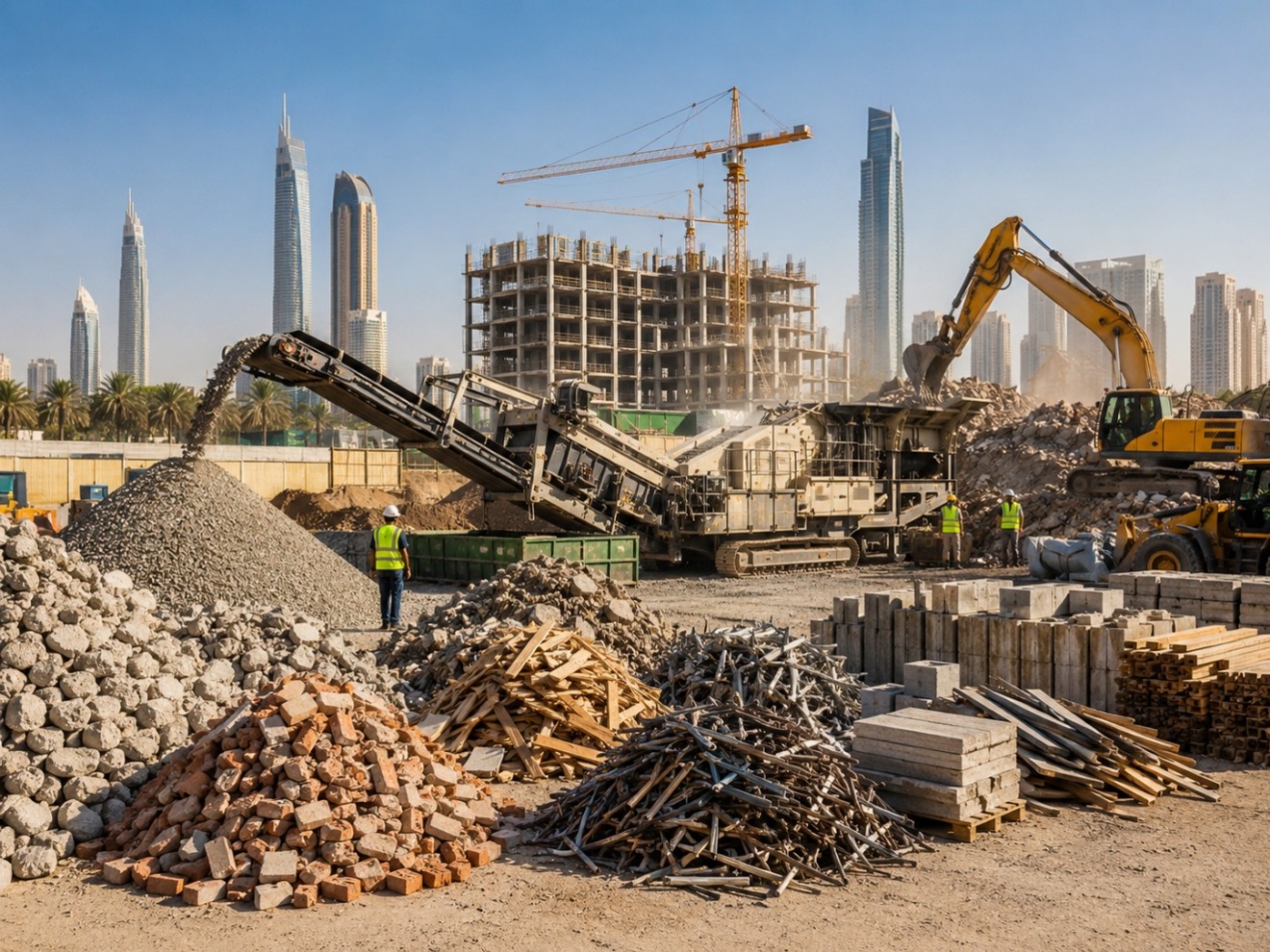
The construction sector is a key driver of economic development but is also one of the world’s largest consumers of raw materials and generators of solid waste. Construction and demolition waste (CDW), including concrete, bricks, metals, wood, glass, asphalt, and excavated materials is generated throughout the lifecycle of buildings and infrastructure.
Rapid urbanization and investment in buildings and infrastructure are increasing demand for construction materials and the volume of CDW generated. Meanwhile, the buildings and construction sector remains a major contributor to global resource consumption, energy use, and greenhouse gas emissions, highlighting the need for more sustainable material management and resource use. CDW accounts for approximately 30–40% of total solid waste generated globally, while the construction sector is responsible for extracting and consuming around half of the world’s raw materials.
Continued reliance on landfilling for large volumes of CDW, places increasing pressure on landfill capacity, contributes to environmental degradation, and results in the loss of valuable secondary resources. In the Arab region, rapid urbanization, population growth, and large-scale infrastructure and reconstruction projects are driving a steady increase in CDW generation, underscoring the need to strengthen recycling infrastructure, improve waste management systems, and promote circular economy practices. (UNEP & Global ABC, 2025; UNEP, 2024; European Commission, 2024).
Several Arab countries—particularly in the Gulf Cooperation Council (GCC) and North Africa—are integrating circular economy principles into their national strategies. Driven by rapid urbanization, infrastructure expansion, and mega-development projects, these nations are moving away from linear “take-make-dispose” models toward resource recovery and recycling for Construction and Demolition Waste (CDW). Despite the significant progress, further efforts are needed to strengthen recycling infrastructure, develop secondary material markets, and establish enabling policy frameworks (UNESCWA, 2025).
2.2 Circular Economy as a Pathway to Resource Efficiency
Circular economy offers an alternative to the traditional linear model by keeping products and materials in use for as long as possible. In the construction sector, this includes designing for durability, minimizing waste, extending the life of buildings and components, and recovering materials for reuse and recycling.
These approaches can reduce dependence on raw materials, improve resource efficiency, lower environmental impacts, and create economic opportunities through secondary (recycled and reused) material markets. Their successful implementation depends on supportive policies, investment in recycling infrastructure, quality standards for recycled materials, and collaboration among governments, industry, and academia (European Environment Agency, 2020; European Commission Joint Research Centre, 2024).
3. Circular Economy Approaches to Construction and Demolition Waste
3.1 Designing Out Waste and Extending Building Life
The transition to a circular economy begins at the design stage by preventing waste before it is generated. Strategies such as modular construction, and design for adaptability and disassembly enable buildings to be renovated, or dismantled efficiently, allowing materials and components to remain in use for longer. The use of durable materials and flexible building layouts also extends building service life, reducing the need for demolition and lowering demand for raw materials (European Commission, 2020).
3.2 Reuse of Construction Materials and Building Components
Reusing construction materials is one of the most effective circular economy strategies because it retains the value of products with minimal additional processing. Structural steel, timber, bricks, concrete elements, doors, and windows can often be recovered from demolition projects and incorporated into new developments. Compared with manufacturing new materials, reuse reduces energy consumption, conserves natural resources, and diverts waste from landfills (Ghaffar et al., 2020).
3.3 Recycling and Recovery of Construction and Demolition Waste
When direct reuse is not feasible, recycling provides an important pathway for recovering value from construction and demolition waste. Materials such as concrete, asphalt, metals, glass, and gypsum can be processed into secondary raw materials for new construction projects. Effective source separation improves recycling efficiency and material quality, reducing landfill disposal and supporting more sustainable resource management.
Many countries have also introduced recycling targets and waste management policies to increase recovery rates and encourage circular construction practices (European Commission, 2020).
3.4 Digital Technologies and Innovative Business Models
Digital technologies are increasingly supporting circular construction practices by improving the management of building materials throughout their life cycle. Building Information Modelling (BIM), digital material passports, and Internet of Things (IoT) technologies enable better material tracking, maintenance planning, and end-of-life recovery. At the same time, innovative business models such as material leasing, product-service systems, and online marketplaces for reclaimed construction products help retain material value and encourage more efficient resource use (Akinade et al., 2015).
4. Enabling Conditions for Circular CDW Management
4.1 Policy and Regulatory Frameworks
Strong policy and regulatory frameworks provide the foundation for effective circular CDW management. Governments can accelerate circular practices through measures such as landfill restrictions, mandatory waste management plans, recycled content requirements, and green public procurement. Clear regulations also help create long-term certainty for businesses by establishing consistent expectations for waste prevention, reuse, and recycling across the construction sector (European Commission, 2020).
4.2 Economic Incentives and Market Development
Economic factors strongly influence whether circular CDW practices become competitive with conventional waste disposal. Measures such as differentiated landfill fees that discourage disposal of recyclable materials, tax incentives for recycling facilities, concessional finance for circular economy investments, and targeted financial support for the use of recovered materials can encourage investment in circular solutions. Public procurement policies, including minimum quotas or preferences for recycled construction materials in public projects, can further stimulate market demand and increase confidence in secondary materials. In addition, supporting small and medium-sized enterprises (SMEs) involved in recycling and material recovery through access to finance, technical assistance, and capacity building can strengthen local recycling markets and drive innovation. Developing reliable markets for reused and recycled construction products also requires greater demand from clients, contractors, and public authorities, alongside improved confidence in the quality and performance of secondary materials (OECD, 2020).
4.3 Standards, Capacity Building, and Stakeholder Collaboration
The adoption of circular CDW management requires shared standards, technical knowledge, and cooperation among stakeholders throughout the construction value chain. Standards for design approaches, such as design for disassembly and adaptability, help ensure that buildings can be more easily repaired, modified, and dismantled at the end of their useful life. Building professional capacity through training and collaboration between designers, contractors, material suppliers, and waste operators is also essential for overcoming implementation barriers and scaling circular practices (ISO, 2020).
5. Arab Perspective
5.1 Current Status and Key Challenges in the Arab Region
Construction activity continues to expand across many Arab countries, leading to growing volumes of CDW. While several countries have introduced regulations and invested in recycling facilities, landfilling remains the predominant management practice in much of the region due to limited recycling infrastructure, inconsistent data collection, weak enforcement, and varying institutional capacities. Rapid urbanization, population growth, and ongoing reconstruction efforts in some countries are further increasing pressure on waste management systems and the demand for sustainable resource management (ESCWA & UNEP, 2024).
5.2 Emerging Policies and Initiatives
Circular economy principles are increasingly being incorporated into national development and sustainability strategies across the Arab region.
Key Arab Countries & Concrete Examples:
(i) UAE
- The UAE is one of the regional pioneers in integrating circular economy practices within construction, anchored by the UAE Circular Economy Policy 2021–2031.
- Policy Mandates: The Ministry of Climate Change and Environment (MOCCAE) issued ministerial resolutions requiring construction and infrastructure projects to use a minimum percentage of recycled aggregates in non-structural applications (such as road sub-bases and pavement).
- Al Dhafra Recycling Facility (Abu Dhabi): Managed in collaboration with Tadweer (Abu Dhabi Waste Management Company), this facility is one of the largest CDW recycling plants globally, capable of processing tens of thousands of tonnes of concrete waste per day into certified recycled aggregates.
- Dubai Municipality Standards: Dubai strictly regulates CDW management by requiring construction projects to submit waste management plans before obtaining building permits and encouraging off-site prefabrication to minimize waste at the source.
(ii) Kingdom of Saudi Arabia
- Under Vision 2030 and the National Waste Management Strategy, Saudi Arabia aims to divert over 60% of CDW away from landfills and transition toward a Circular Carbon Economy (CCE) and broader resource circularity.
- SIRC (Saudi Investment Recycling Company): SIRC (a wholly-owned subsidiary of the Public Investment Fund) leads CDW recycling efforts, establishing processing facilities across major cities. In Riyadh alone, SIRC operates large-scale C&D recycling plants targeting the processing of millions of tonnes of debris annually.
- Giga-Project Integration (NEOM, Qiddiya, Red Sea Global): Saudi giga-projects mandate circular construction principles. NEOM, for instance, enforces a zero-waste-to-landfill strategy during construction, utilizing crushed excavation rock and concrete on-site for land reclamation, road bases, and concrete mixing rather than relying on virgin aggregate extraction.
(iii) Qatar
- Qatar’s National Environment and Climate Change Strategy (QNECS) and Qatar National Vision 2030 place heavy emphasis on waste reduction and material recycling in infrastructure projects.
- Ashghal (Public Works Authority) Initiatives: Ashghal set benchmark recycling mandates across national road and building projects. Ashghal introduced recycling guidelines that require construction projects to use between 15% and 30% recycled materials (such as Reclaimed Asphalt Pavement and crushed concrete) in road construction.
- Rawda Rashid Recycling Hub: Located near Doha, this dedicated site processes millions of tonnes of accumulated construction waste, turning raw debris into usable aggregate materials for ongoing infrastructure projects.
(iv) Egypt
- Egypt has embedded circular waste practices into its Sustainable Development Strategy: Egypt Vision 2030 and Integrated Waste Management Law (Law No. 202 of 2020).
- New Administrative Capital & Mega-Cities: Due to massive real estate expansion, Egypt’s Ministry of Housing and Ministry of Environment installed mobile and stationary crushing and screening units directly at new city construction sites. This enables developers to process rubble on-site for backfilling, road bases, and non-bearing masonry blocks.
- Green Building Codes: The Egyptian Green Building Council (Egypt GBC) and local authorities promote materials reuse and waste reduction guidelines as part of national sustainable construction criteria.
(v) Oman
- Under Oman Vision 2040 and managed by be’ah (Oman Environmental Services Holding Company), dedicated construction waste diversion centers process concrete and masonry waste into secondary aggregates for road construction.
(vi) Lebanon
- In response to post-disaster reconstruction and severe resource constraints, national policy frameworks led by academic and governmental bodies (such as the Ministry of Environment) target an 80% recycling rate for CDW into certified recycled aggregates to reduce unregulated dumping.
5.3 Opportunities for Regional Cooperation, Knowledge Sharing, and Investment
Regional cooperation presents significant opportunities to accelerate the transition towards circular construction and demolition waste management. Establishing an Arab construction and demolition waste knowledge platform could facilitate the exchange of best practices, research findings, and case studies among countries. Developing regional technical guidelines and harmonized standards for recycled construction materials would improve quality assurance and facilitate the wider use and trade of secondary materials across the region.
In addition, implementing regional pilot projects, promoting joint research and innovation, and organizing regional training and capacity-building programmes would strengthen institutional and technical capacities while supporting the adoption of circular economy practices. Increased investment in recycling infrastructure and digital technologies would further enhance resource efficiency and create new economic opportunities across the Arab region. Strengthening collaboration through knowledge exchange, harmonized technical standards, joint research, and capacity building can help countries share successful practices and overcome common challenges. Increased investment in recycling infrastructure, digital technologies, and workforce development would also strengthen markets for secondary construction materials while creating new economic opportunities and supporting more resource-efficient construction sectors.
6. Conclusion
The transition towards circular construction and demolition waste management presents a significant opportunity to reduce environmental impacts, improve resource efficiency, and create economic value from materials that would otherwise be discarded. By prioritizing waste prevention, material reuse, and high-quality recycling, circular approaches can reduce the consumption of virgin resources, minimize landfill disposal, and support more sustainable construction practices. While many countries have made progress through policy development, recycling initiatives, and technological innovation, further efforts are needed to accelerate the transition, particularly in the Arab region.
Moving forward, governments should strengthen regulatory frameworks, establish clear recycling targets, and introduce economic incentives that encourage material recovery and reuse. Municipalities should invest in waste segregation, collection systems, recycling infrastructure, and data monitoring to improve the efficiency of CDW management. The construction industry should adopt circular design principles, increase the use of recycled materials, and implement effective on-site waste management practices. At the regional level, organizations should promote knowledge sharing, develop harmonized technical standards, and support joint pilot projects and capacity-building initiatives to accelerate the adoption of circular economy practices across the Arab region.