
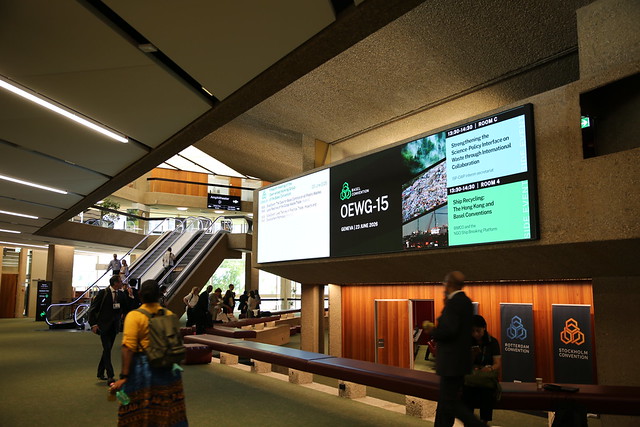
The 15th meeting of the Basel Convention’s Open-Ended Working Group (OEWG 15), held in Geneva from 23-26 June 2026, addressed the growing complexity of global waste management challenges, including plastics, electronic waste, batteries, and used textiles. The meeting highlighted how this nearly 40-year-old multilateral environmental agreement must evolve to address emerging waste streams while maintaining its core mechanisms, particularly the prior informed consent (PIC) procedure. The agenda was notably packed due to recent amendments on e-waste and plastic waste, as well as ongoing work to update technical guidelines and review proposed changes to Convention annexes that form the legal backbone of national waste management regulations for most Parties.
Developing countries face significant challenges in implementing the Convention’s growing mandates, particularly regarding capacity-building, technical assistance, and enforcement. The discussions on waste batteries, used textiles, and plastic waste revealed substantial infrastructure gaps, with African Group representatives emphasizing the need for financial mechanisms and technology transfer to support environmentally sound management (ESM). The informal sector’s role in battery recovery and textile waste management in developing countries was highlighted as both a challenge and an opportunity that guidelines should address. Some countries cautioned against new mandatory reporting burdens without accompanying capacity-building support, while others stressed that successful implementation of battery guidelines would require effective collection schemes. The debate on used textiles revealed tensions between environmental protection and economic livelihoods, with some nations noting that secondhand clothing trade employs significant portions of their service sectors. The significant resistance from some developing countries to expanding Convention scope, citing implementation fatigue from recent e-waste and plastic amendments, underscores the need for realistic, phased approaches that balance environmental objectives with developmental realities.
For Arab countries, several strategic considerations emerge from OEWG 15 proceedings, with several consistently positioned themselves as cautious voices regarding new regulatory burdens, opposing expanded PIC requirements for plastic waste and expressing concerns about potential disruptions to recycling markets and trade flows. The growing attention to textile waste and e-waste, both significant import streams for many Arab nations, suggests that proactive engagement in developing technical guidance and classification systems would be strategically beneficial. The discussions on aligning Basel codes with World Customs Organisation (WCO) Harmonized System customs codes present an opportunity for Arab countries to enhance enforcement capacity. Additionally, the debate on ship recycling and the Hong Kong Convention’s relationship with the Basel Convention is particularly relevant given the region’s significant shipping and port activities. Arab countries could consider: 1) investing in technical capacity to participate effectively in developing guidelines that reflect regional realities; 2) actively engaging in discussions on Convention Annex I and III revisions to ensure changes align with national regulatory frameworks; and 3) exploring regional coordination mechanisms for waste management that balance environmental protection with economic development priorities.