
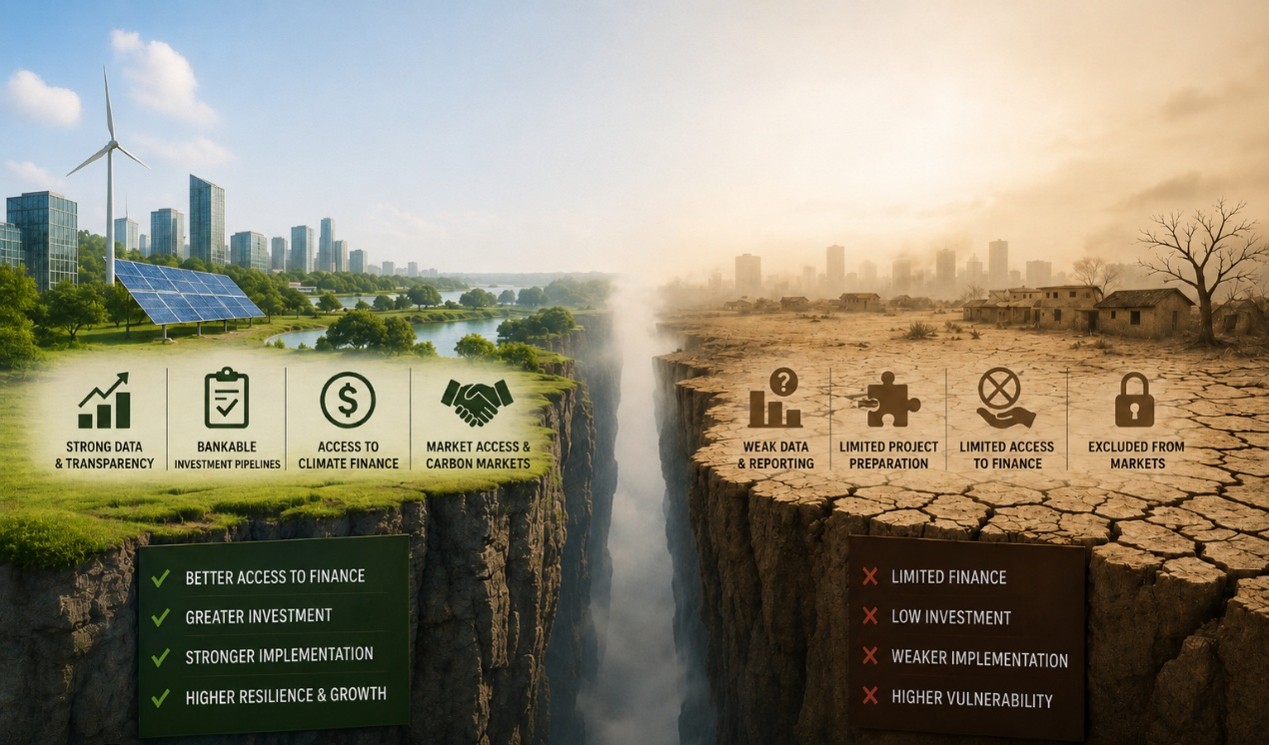
Global climate action is entering a new phase where ambition alone is no longer enough. Countries are increasingly being judged by their technical readiness: their ability to produce credible data, submit transparent reports, prepare bankable investment pipelines, access climate finance, and participate in emerging carbon markets. This is creating a new climate divide between countries that have the institutions, data systems, financial tools, and market infrastructure needed to act, and those that remain constrained by weak reporting capacity, fragmented governance, limited project preparation, and restricted access to finance. In this context, climate action is becoming less about whether countries support the Paris Agreement in principle, and more about whether they have the systems required to convert commitments into finance, investments, and measurable results. This is evidenced by:
1. Climate transparency is becoming a gateway to credibility and finance.
Under the Paris Agreement’s Enhanced Transparency Framework, countries are required to submit Biennial Transparency Reports, NDC progress, climate impacts and adaptation, capacity-building needs, and areas for improvement. In July 2026, 37 countries presented their first BTRs during SB64 in Bonn, marking the largest participation so far in the Facilitative Multilateral Consideration of Progress (UNFCCC, 2026). This shows that transparency is no longer only a reporting exercise; it is becoming a measure of institutional readiness, policy credibility, and finance preparedness.
2. Climate finance is increasingly linked to investment pipelines, not only political claims.
COP29 finance outcome set a new goal for developed countries to mobilize at least USD 300 billion annually for developing countries by 2035, alongside efforts to scale total climate finance from public and private sources to USD 1.3 trillion per year (UNFCCC, 2024). However, accessing this finance will depend heavily on countries’ ability to present mature, costed, bankable, and measurable projects.
3. Carbon markets are creating another layer of climate inequality.
The global climate agenda is increasingly moving toward the operationalization of carbon markets, especially under Article 6 of the Paris Agreement, where implementation, transparency, and market integrity are becoming central concerns. The World Bank’s (2026) carbon pricing report notes that direct carbon pricing now covers nearly one-third of global emissions and that carbon pricing revenues reached more than USD 107 billion in 2025. New platforms such as the Article 6 Pipeline are also being developed to improve transparency and access to data on Article 6 implementation (UNEP, 2026). Countries without these foundations risk being excluded from new climate finance and market opportunities.
Overall, the new climate divide is not only between developed and developing countries, but also between countries that are technically prepared for the next phase of climate action and countries that are not. For Arab countries, this divide is particularly important. The region faces urgent adaptation and mitigation needs, especially in water security, food systems, urban resilience, energy transition, and heat stress, but many countries still face challenges in data availability, institutional coordination, project preparation, and access to concessional finance. To avoid being marginalized in the emerging climate economy, Arab countries need to invest in national transparency systems, climate finance strategies, bankable project pipelines, carbon market readiness, and regional cooperation on data and technical capacity. In the coming phase, climate leadership will not only belong to countries with ambitious targets, but to those able to prove, finance, and implement them.